The Battle of Adwa
Quality reviewed September 2026
- Grades
- Grades 9-12
- Time
- About two 50-minute class periods
- Includes
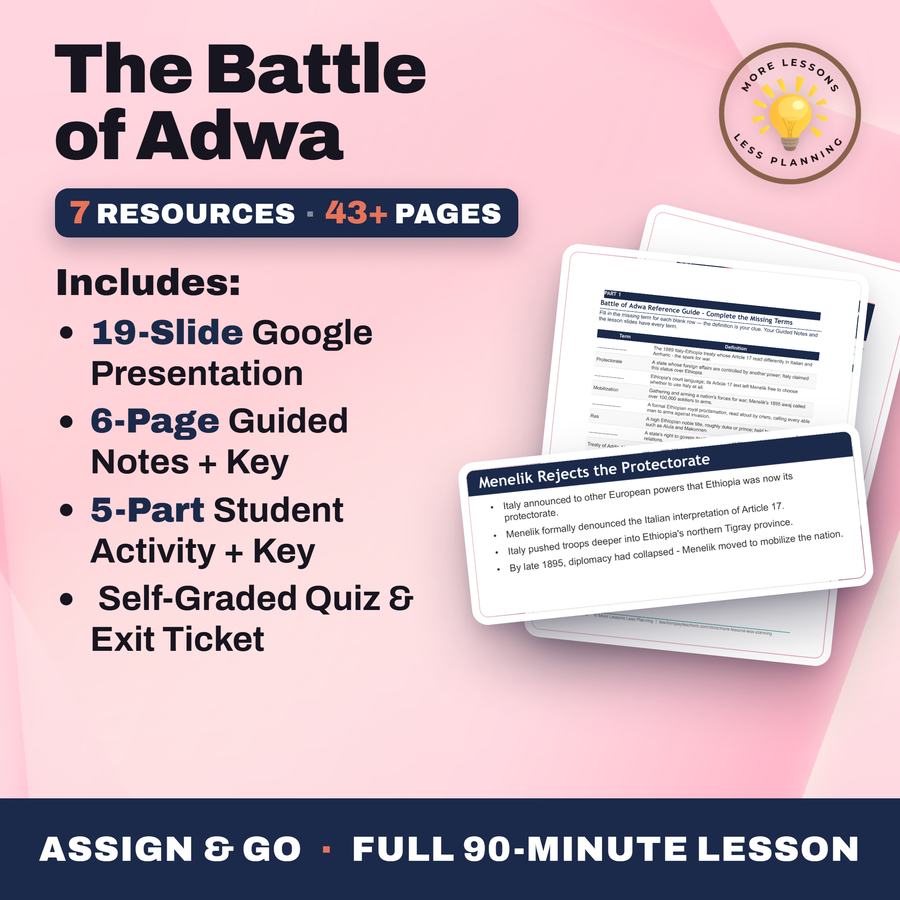
- 11 ready-to-teach files
- Format
- Word (.docx) · PowerPoint (.pptx)
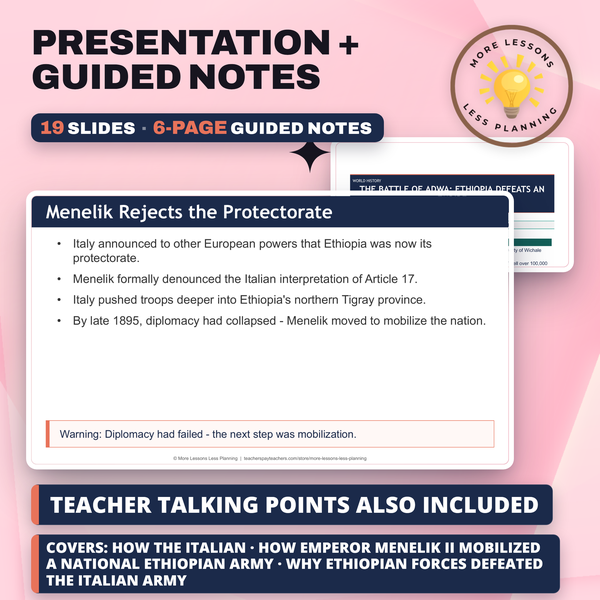
- Slide deck
- Guided notes
- Guided notes teacher key
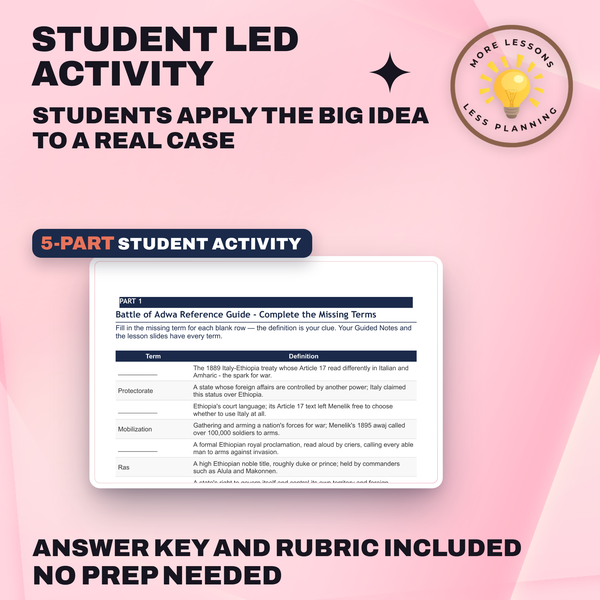
- Activity + answer key
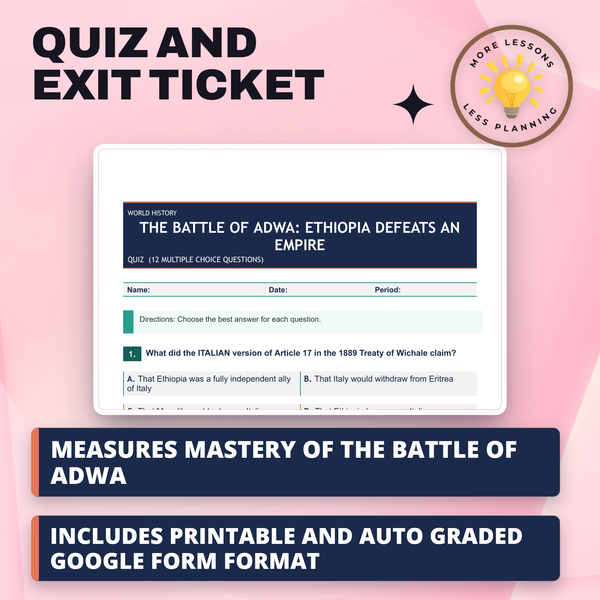
- Quiz + answer key
- Exit ticket + answer key
- Teacher guide
- Teacher presentation notes
What students do
- Explain how the Italian and Amharic versions of Article 17 of the Treaty of Wichale differed
- Map Emperor Menelik II's mobilization of a national army of well over 100,000 soldiers
- Argue that Ethiopia's 1896 victory at Adwa reflects strategy and agency rather than luck
- Analyze Menelik II's own 1895 war-proclamation as evidence of Ethiopia's reasons for fighting
What it covers
- The disputed treaty translation that became the spark for war
- The roles of Empress Taytu Betul, Ras Alula, and Ras Makonnen in Ethiopia's mobilization
- The terms of the 1896 Treaty of Addis Ababa and what it secured for Ethiopian independence
Learning targets
- Explain how the Italian and Amharic versions of Article 17 of the 1889 Treaty of Wichale (Ucciali) differed, and why that difference became the spark for war.
- Describe how Emperor Menelik II mobilized a national Ethiopian army of well over 100,000 soldiers, and identify the roles of Empress Taytu Betul, Ras Alula, and Ras Makonnen.
- Explain why Ethiopian forces defeated the Italian army at the Battle of Adwa on 1 March 1896.
- Summarize the terms of the 1896 Treaty of Addis Ababa and its significance for Ethiopian independence.
- Evaluate Ethiopia's victory at Adwa as an example of African sovereignty, strategy, and agency - not luck - defeating a European invader.
Peek inside
1
Government
Emperor Menelik II ruled Ethiopia from its highland capital, commanding armies and signing treaties.
2
Religion
Government, Church, Army, Diplomacy
By 1889, Ethiopia was a fully African state, not a land waiting to be claimed.
Emperor II ruled Ethiopia from its highland capital, commanding armies and signing treaties.
Ethiopia had its own centuries-old , not an import.
Ethiopia conducted its own with Italy, France, and Russia.
1. What is the short name for the 1889 treaty between Italy and Emperor Menelik II whose Article 17 read differently in Italian than in Amharic?
Why this matters
Article 17 of the Treaty of Wichale said one thing in Amharic and another in Italian, and that gap is what Italy used to claim Ethiopia as a protectorate it never agreed to. Menelik II answered by mobilizing a national army of well over 100,000 soldiers, backed by leaders like Empress Taytu Betul, Ras Alula, and Ras Makonnen, before the sides met at Adwa.
Crediting Ethiopia's win to Italian weather or bad maps erases everyone who planned it, so this lesson centers Menelik's own 1895 proclamation, written before the fighting started. Reading his reasoning in his own words turns Adwa from an upset into a victory built on strategy and agency.
From one teacher to another
Ethiopia won at Adwa because Italy had bad luck with weather and faulty maps, or so too many textbooks still tell it. I center the activity on Menelik II's own 1895 proclamation instead, since it shows a leader who'd already sized up the treaty dispute correctly and moved a force past 100,000 soldiers into position before the fighting started. Empress Taytu Betul and the generals beside her, Ras Alula no less than Ras Makonnen, get proper credit here, and the lesson ends with the 1896 treaty that secured Ethiopian independence.
Every file in this toolkit
Download
Where should I send the next one?
Everything here is free and it stays that way. Leave your email and I'll send you the new lessons as they go up. You can unsubscribe from any one of them.
Related resources
Cities and Slums
Life in the Factory
Railroads and the Transportation Revolution
Sparks of the Industrial Revolution
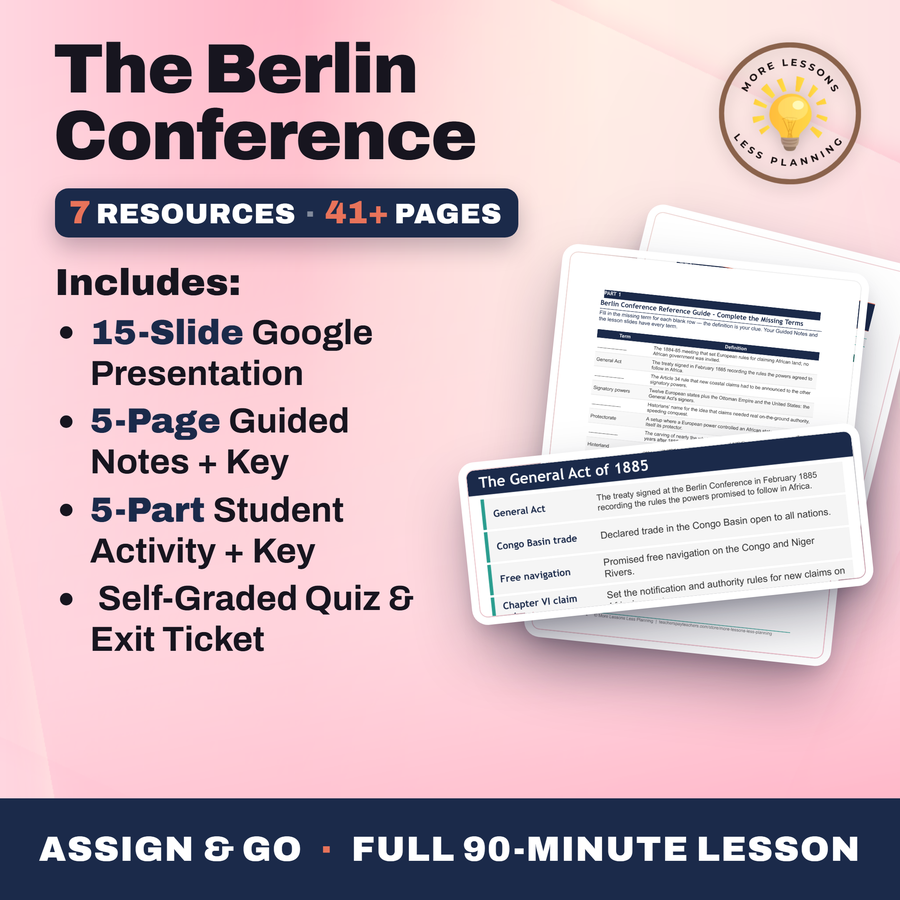
The Berlin Conference
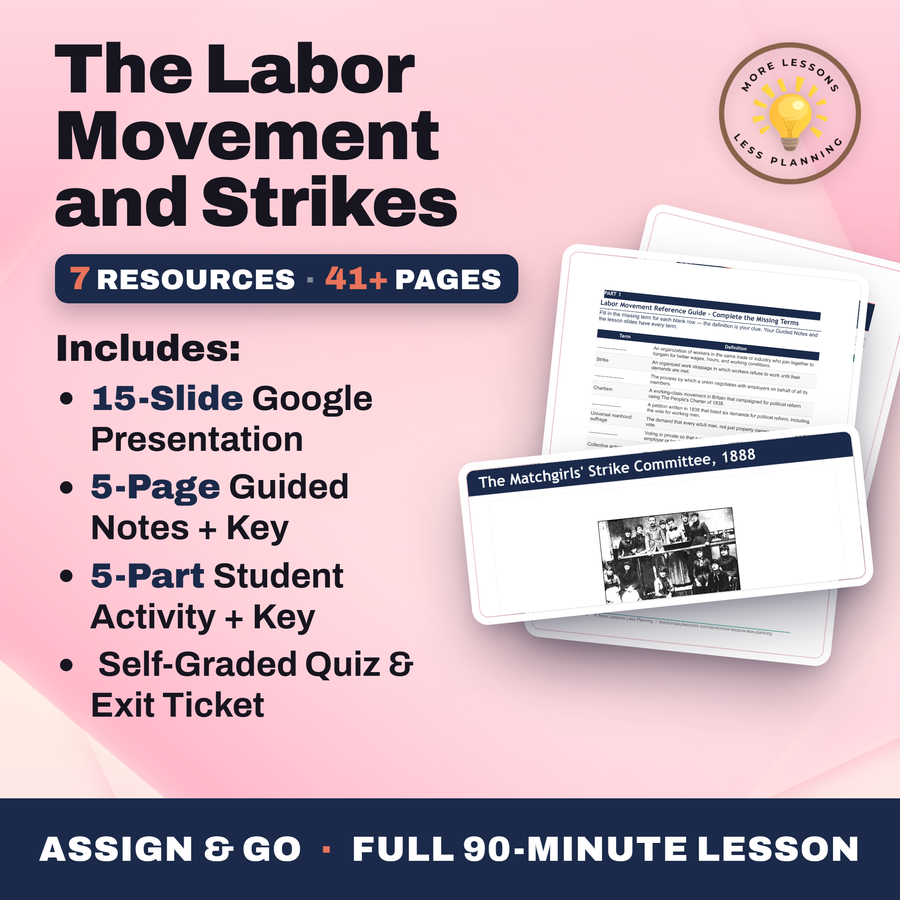
The Labor Movement and Strikes
Every lesson on this site is free to download and use. If one of them saved you a prep period, you can chip in a few bucks toward my three kids' daycare fund. That's genuinely where tips go.