The Berlin Conference
Quality reviewed September 2026
- Grades
- Grades 9-12
- Time
- About two 50-minute class periods
- Includes
- 11 ready-to-teach files
- Format
- Word (.docx) · PowerPoint (.pptx)
- Slide deck
- Guided notes
- Guided notes teacher key
- Activity + answer key
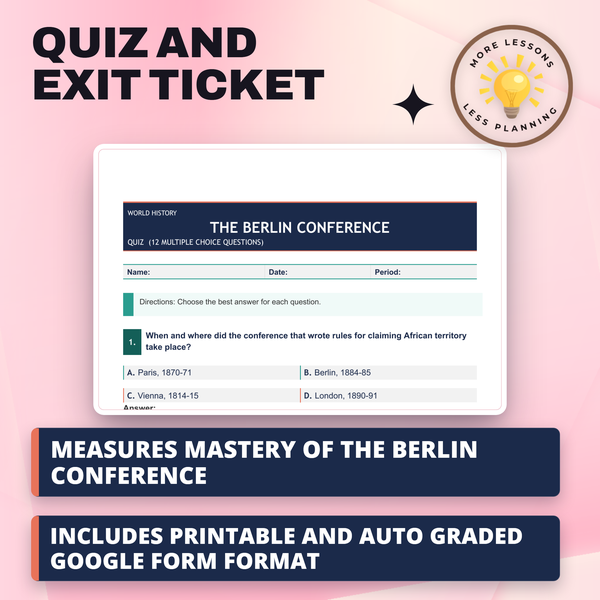
- Quiz + answer key
- Exit ticket + answer key
- Teacher guide
- Teacher presentation notes
What students do
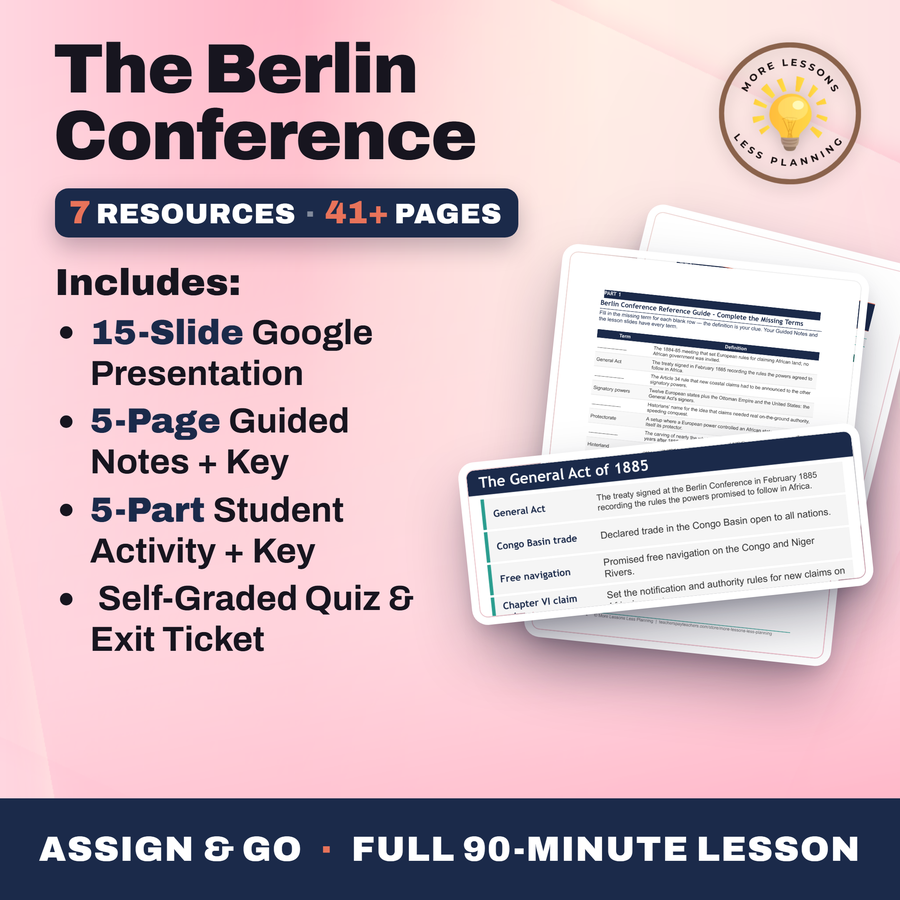
- Identify who wrote the rules for claiming African land at the 1884-85 Berlin Conference, and who was excluded from the room
- Read Articles 34 and 35 of the General Act and explain the notification requirement and the authority requirement in their own words
- Explain how those two rules sped up the partition of Africa to roughly 90 percent of the continent by about 1914
- Weigh the treaty's rules against African sovereignty and resistance, including Ethiopia's 1896 victory at Adwa, and write an evidence-based verdict
What it covers
- The Berlin Conference of 1884-85, its twelve European signatories plus the Ottoman Empire and the United States, and the total absence of any African government
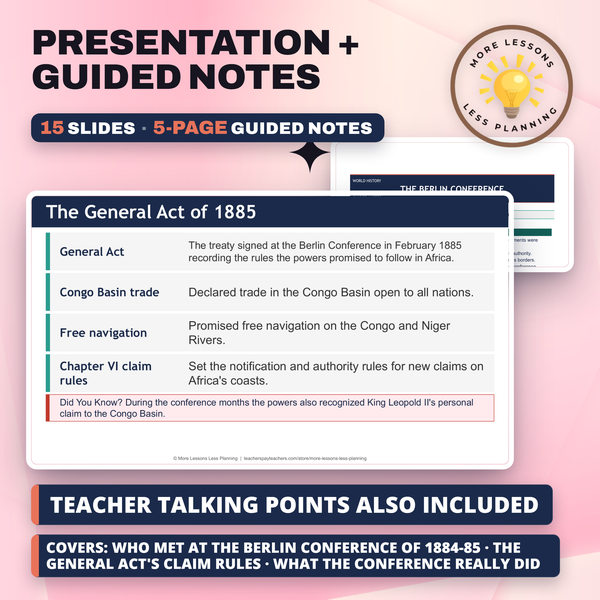
- The actual text of the General Act's Articles 34 and 35 - notification and "effective occupation" - with sourcing, comprehension, and analysis questions
- The accelerated partition of Africa in the thirty years after 1885
- African sovereignty and resistance, including Ethiopia's victory at the Battle of Adwa
Learning targets
- Describe who met at the Berlin Conference of 1884-85 - and which governments were excluded.
- Explain the General Act's claim rules: Article 34 notification and Article 35 authority.
- Distinguish what the conference really did from the myth that it drew Africa's borders.
- Describe African sovereignty, agency, and resistance before and after the conference.
- Judge, using treaty evidence and lesson facts, why African exclusion mattered.
Peek inside
Sovereign States, Not Empty Land
In 1884, African states already held , the right of a state to govern itself.
The Caliphate governed millions across the West African Sahel.
The Asante Empire ruled from its capital at on the Gold Coast.
The Sultanate of linked Africa, Arabia, and India through Indian Ocean trade.
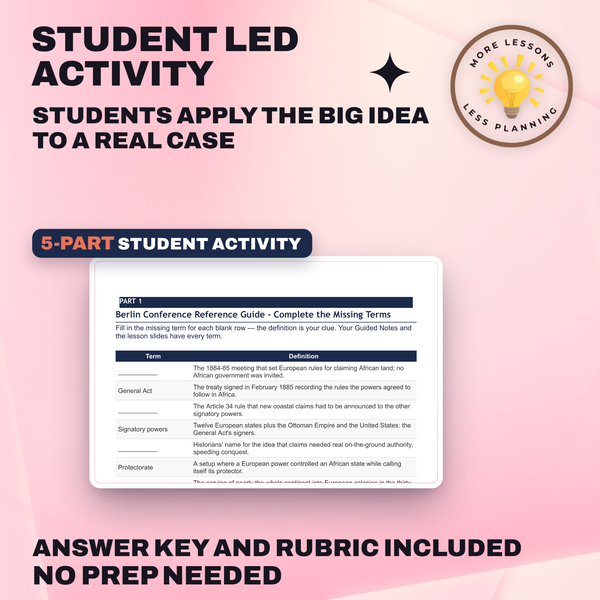
1. What do we call the 1884-85 meeting where European powers set shared rules for claiming African land, with no African government invited?
Why this matters
Articles 34 and 35 of an 1885 treaty did most of the real work of dividing a continent: one required European powers to notify each other before claiming land, the other required an occupation to count as effective. Twelve European governments signed alongside the Ottoman Empire and the United States, and no African government was in the room.
A rule can sound bureaucratic and still reshape a continent, which is the gap I want students to sit inside, reading the treaty's actual wording rather than a summary that tells them how to feel. Tracking who owed notice to whom under Articles 34 and 35 makes the partition feel mechanical rather than inevitable.
From one teacher to another
I wrote this one to put the treaty itself in front of students instead of a summary of it. The guided notes cover who was in the room at Berlin in 1884-85 and who wasn't - no African government signed or helped write the rules - before the primary source drops them into the actual text of Articles 34 and 35: the notification rule and the authority rule historians call "effective occupation," even though the treaty's own wording only says occupations must "be considered as effective." Students have to trace who owes each duty and who receives each notice, and notice that every rule runs between European powers only. The activity closes by asking them to weigh the treaty's mechanics against real African resistance, including Ethiopia's 1896 victory at Adwa, and write a verdict grounded in evidence rather than a summary of what they already believed. Guided notes, activity, quiz, and exit ticket ship with answer keys, plus a teacher guide.
Every file in this toolkit
Download
Where should I send the next one?
Everything here is free and it stays that way. Leave your email and I'll send you the new lessons as they go up. You can unsubscribe from any one of them.
Related resources
Cities and Slums
Life in the Factory
Railroads and the Transportation Revolution
Sparks of the Industrial Revolution
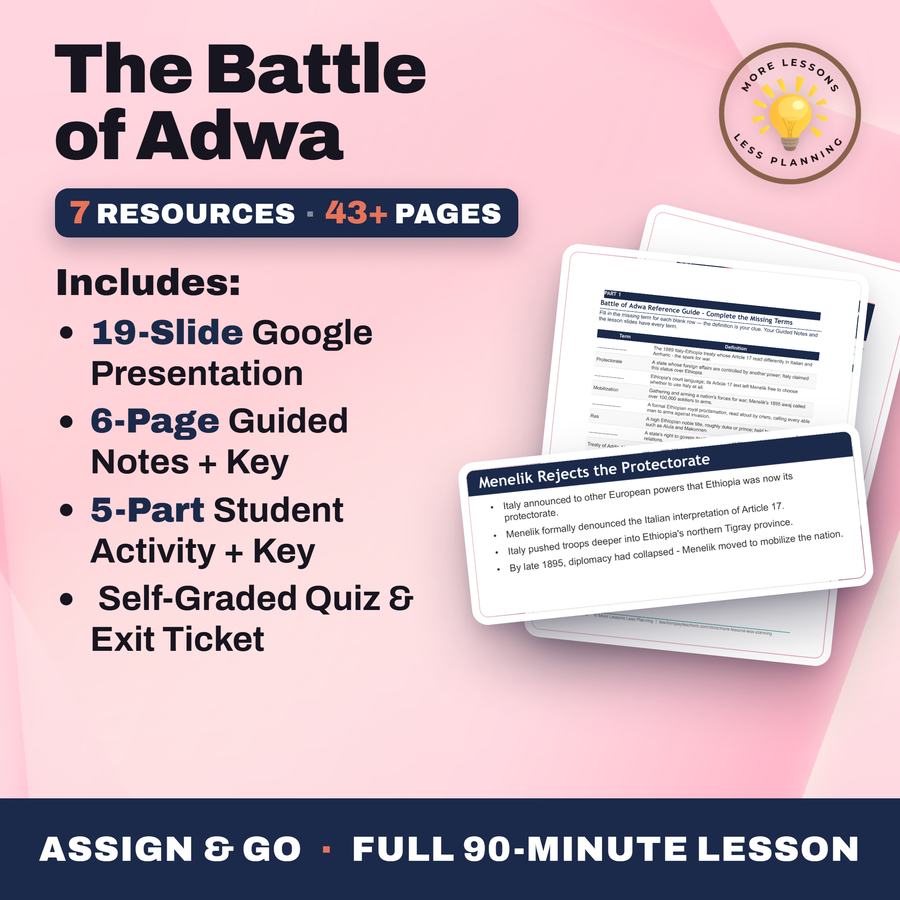
The Battle of Adwa
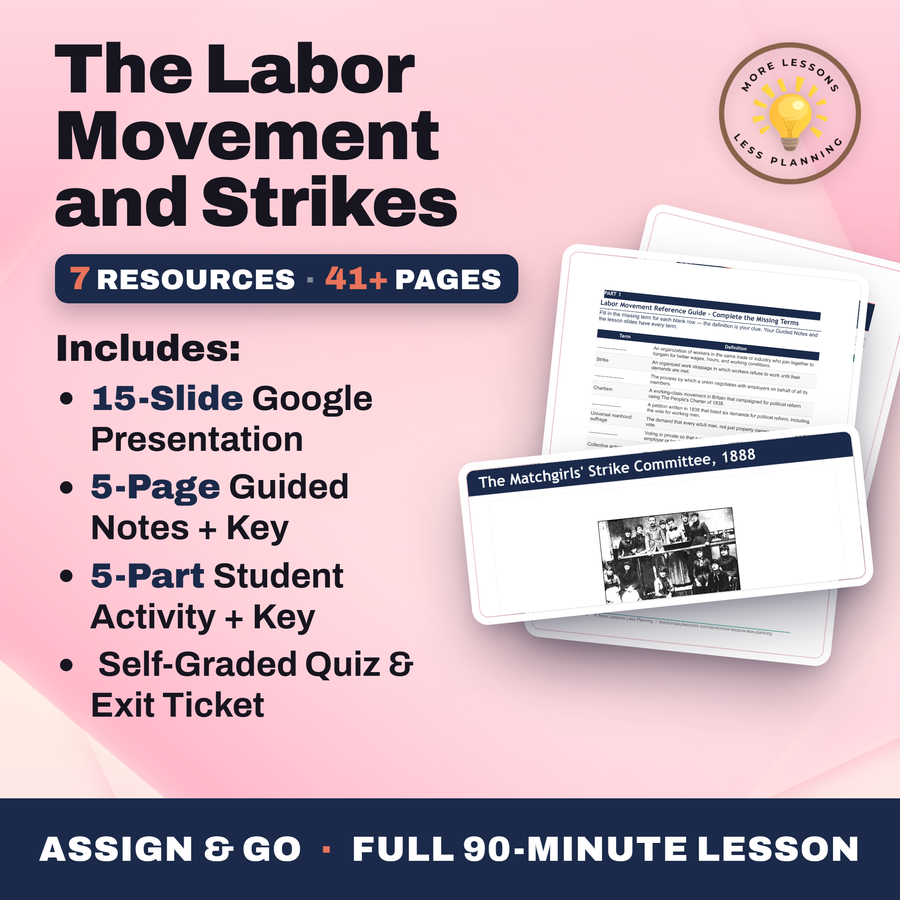
The Labor Movement and Strikes
Every lesson on this site is free to download and use. If one of them saved you a prep period, you can chip in a few bucks toward my three kids' daycare fund. That's genuinely where tips go.