The Scientific Revolution - Copernicus and Galileo
- Slide deck
- Guided notes
- Guided notes teacher key
- Activity + answer key
- Quiz + answer key
- Exit ticket + answer key
- Teacher guide
- Teacher presentation notes
Where should I send the next one?
Everything here is free and it stays that way. Leave your email and I'll send you the new lessons as they go up. You can unsubscribe from any one of them.
Every file in this toolkit
Related resources
Causes of the French Revolution
Aggression and Appeasement
Alliances and the Causes of WWI
Blitzkrieg and the Fall of France
Confucianism and Social Order
D-Day and the Liberation of Europe
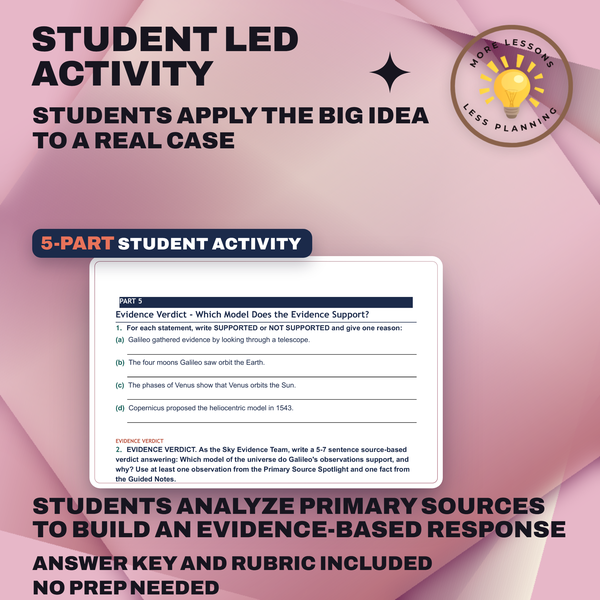
What students do
- Analyze an adapted excerpt of Galileo's 1610 Sidereus Nuncius
- Compare the geocentric and heliocentric models of the universe
- Explain what Jupiter's four moons and the phases of Venus prove about which model fits the evidence
- Argue whether Galileo's observations support the heliocentric model over the geocentric one
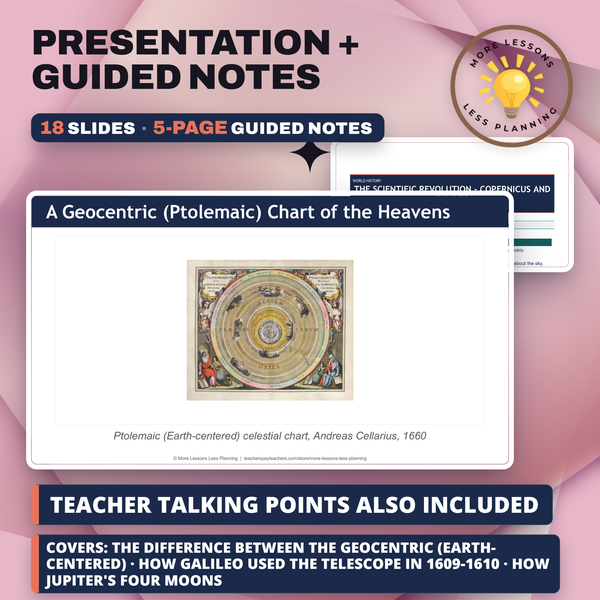
What it covers
- How Galileo's telescope observations of Jupiter's moons and Venus's phases challenged the Earth-centered universe
- The historical conflict between Galileo and the Catholic Church, described in neutral terms
- Key vocabulary including geocentric, heliocentric, the Ptolemaic and Copernican models, and observation
Learning targets
- Explain the difference between the geocentric (Earth-centered) and heliocentric (Sun-centered) models of the universe.
- Describe how Galileo used the telescope in 1609-1610 to gather evidence about the sky.
- Explain how Jupiter's four moons and the phases of Venus provided evidence for the heliocentric model.
- Describe, in neutral historical terms, the conflict between Galileo and the Catholic Church.
- Explain why observation-based evidence marks the birth of modern science.
From one teacher to another
When it works, students are hunched over the same four faint objects near Jupiter that Galileo logged night after night in 1610, arguing about what they prove. I pulled the excerpt straight from Sidereus Nuncius so they're reasoning from Galileo's own observations instead of a textbook's summary of what he supposedly saw. I still give the Church conflict a place in the story, though I keep the telling matter-of-fact instead of turning it into a morality tale.
Every lesson on this site is free to download and use. If one of them saved you a prep period, you can chip in a few bucks toward my three kids' daycare fund. That's genuinely where tips go.