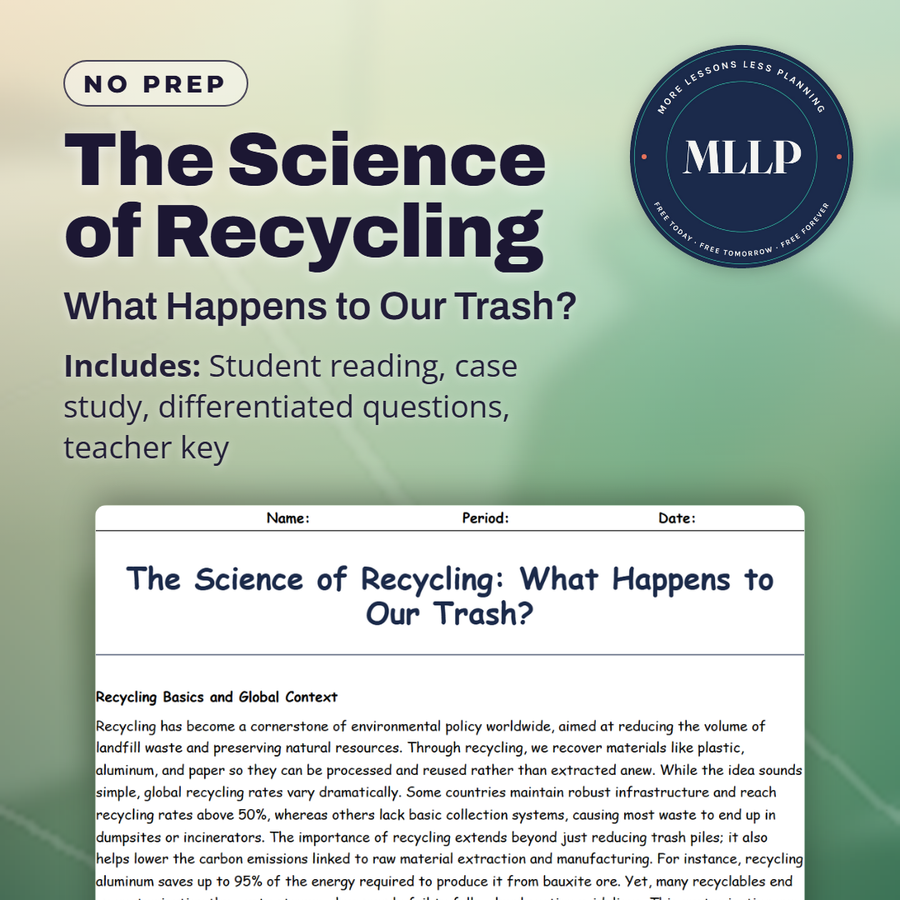
The Science of Recycling: What Happens to Our Trash?
Quality reviewed September 2026
Facts verified September 9, 2026
- Subject
- Science
- Grades
- Grades 9-12
- Length
- 8-page student worksheet
- Time
- About one 50-minute class period
- Great for
- Sub plans and independent work
- Includes
- Reading passage, comprehension questions + full answer key
- Format
- Print-and-go PDF
What students do
- Trace the journey of recyclables from collection through sorting at Materials Recovery Facilities
- Analyze how different polymers require distinct processing methods and affect recycling economics
- Evaluate the effectiveness of incentive-based recycling programs like Japan's QR code system
- Identify contamination problems that disrupt recycling streams and render batches unusable
What it covers
- Materials sorting and processing technology
- Recycling economics and polymer chemistry
- Global recycling infrastructure and innovation
Start reading this worksheet
Recycling Basics and Global Context
Recycling has become a cornerstone of environmental policy worldwide, aimed at reducing the volume of landfill waste and preserving natural resources. Through recycling, we recover materials like plastic, aluminum, and paper so they can be processed and reused rather than extracted anew. While the idea sounds simple, global recycling rates vary dramatically. Some countries maintain robust infrastructure and reach recycling rates above 50%, whereas others lack basic collection systems, causing most waste to end up in dumpsites or incinerators. The importance of recycling extends beyond just reducing trash piles; it also helps lower the carbon emissions linked to raw material extraction and manufacturing. For instance, recycling aluminum saves up to 95% of the energy required to produce it from bauxite ore. Yet, many recyclables end up contaminating the waste stream when people fail to follow local sorting guidelines. This contamination can disrupt processing machinery and render entire batches unusable. Understanding the science behind recycling—how materials are sorted, cleaned, and repurposed—is crucial for improving overall efficiency and environmental outcomes.
The Journey of Recyclables
Once recyclables are collected, they often go to a Materials Recovery Facility (MRF). Here, conveyors, magnets, optical scanners, and human sorters help separate items by type. Paper is baled separately, while metals like steel and aluminum are extracted using powerful magnets or eddy currents. Plastics are sorted by their resin identification codes, which indicate the polymer’s chemical composition. After sorting, the materials move to specialized plants for processing. Aluminum might be melted down and cast into new products, while paper could be mixed with water to form pulp, then rolled into sheets for new paper goods. Plastics pose a greater challenge because each resin type has unique melting points and chemical properties. Some facilities only accept select kinds of plastic due to economic and technological constraints. The journey doesn’t end at the recycling facility; markets must exist for the end product. If recycled materials lack buyers, they may still end up in landfills. Government regulations and consumer demand play vital roles in creating a robust marketplace for recycled goods, underscoring that recycling is not just a scientific process but also an economic and social one.
Environmental Trade-Offs and Innovations
While recycling offers numerous benefits, it isn’t always a perfect solution. Chemical recycling of plastic, for instance, requires large amounts of energy and can still produce byproducts that pose environmental risks. Paper recycling uses significant water resources and can only be done a limited number of times before fibers degrade. That said, ongoing innovations seek to make the process more sustainable. Researchers explore advanced sorting technologies that increase the purity of the recovered materials, while policymakers advocate for extended producer responsibility, compelling manufacturers to consider product end-of-life in their designs. Some countries invest in large-scale composting for organic waste, thereby decreasing the load on recycling facilities. Others implement “pay-as-you-throw” schemes, encouraging residents to produce less waste overall. Meanwhile, biodegradable plastics and biopolymers are on the rise, though their breakdown often requires industrial composting conditions not always readily available. Recycling programs function best when combined with upstream measures like waste reduction and reuse campaigns, illustrating that no single strategy can address waste management comprehensively.
Like what you read? The full reading, the case study, and every question set are in the free download below, along with the answer key.
Why this matters
A single mixed-fiber item can jam a piece of equipment built to handle plastic alone, and that fact alone tells students recycling is not as simple as tossing a bottle in the right bin. This reading takes them inside a Materials Recovery Facility instead, where aluminum magnets, optical scanners, and human sorters catch what the machines cannot.
The Japan case study is the turning point: households scan a QR code and earn points for sorting correctly, and contamination drops because the incentive is immediate instead of abstract. I always follow it with the catch, that recovered material still needs a buyer, or the careful sorting ends up in a landfill anyway.
From one teacher to another
Recycling sounds simple until students see a Materials Recovery Facility, aluminum magnets, optical scanners, human sorters catching the stuff that breaks machines. The Japan case study is brilliant: households scan QR codes and earn points, so sorting accuracy goes up and contamination drops. Then I show them the catch: plastics aren't all the same, mixed fibers jam equipment, and markets have to exist for the recovered stuff or it all ends up in landfills anyway. Real infrastructure, not magic.
What you get
Download
Where should I send the next one?
Everything here is free and it stays that way. Leave your email and I'll send you the new lessons as they go up. You can unsubscribe from any one of them.
Related resources
Earth Day: The 1970 Protest That Changed America
Environmental Crimes: The Forensic Science of Eco-Terrorism
Fast Fashion & the Environment: The Hidden Costs of Our Clothes
Land Use and Federal vs. State Power: Who Controls Natural Resources?
Oil Spills, Protests, and Policy: The Environmental Legacy of the 20th Century
The Carbon Footprint of Everyday Life: A Data Analysis Challenge
Every lesson on this site is free to download and use. If one of them saved you a prep period, you can chip in a few bucks toward my three kids' daycare fund. That's genuinely where tips go.