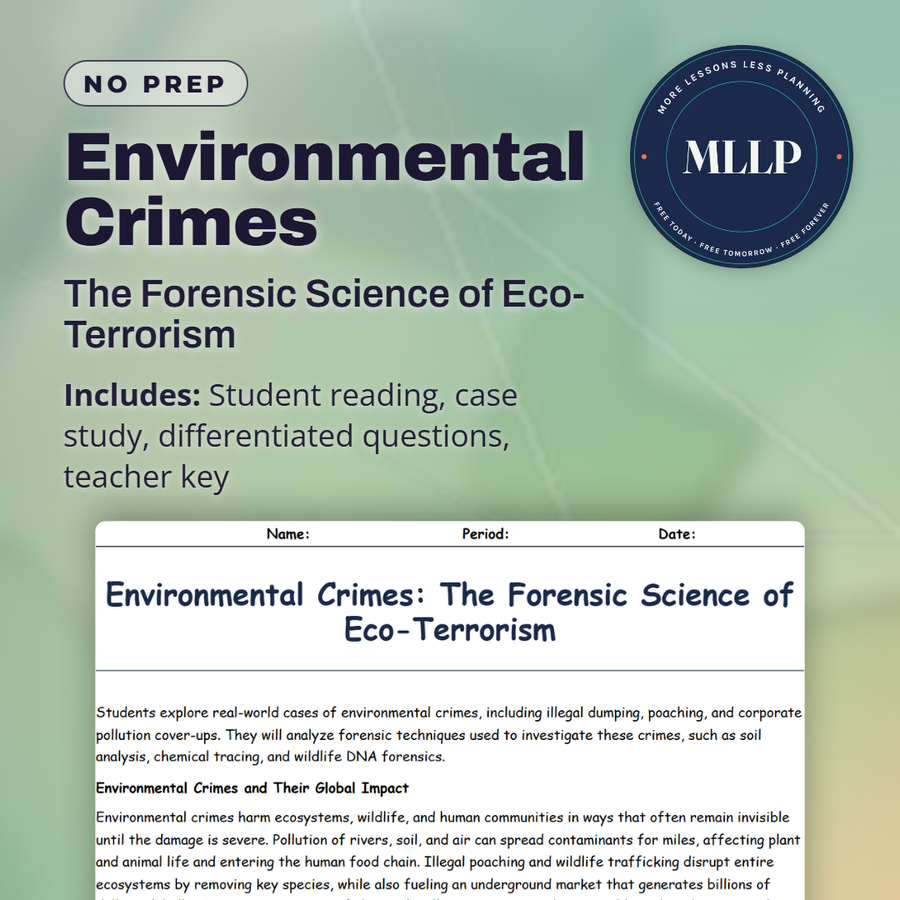
Environmental Crimes: The Forensic Science of Eco-Terrorism
Quality reviewed September 2026
Facts verified September 9, 2026
- Subject
- Science
- Grades
- Grades 9-12
- Length
- 9-page student worksheet
- Time
- About one 50-minute class period
- Great for
- Sub plans and independent work
- Includes
- Reading passage, comprehension questions + full answer key
- Format
- Print-and-go PDF
What students do
- Identify forensic methods that connect environmental crimes to specific companies or poachers
- Analyze how DNA evidence can trace poached wildlife back to their origins and habitats
- Explain why environmental crimes require collaboration across multiple jurisdictions
- Evaluate the effectiveness of international cooperation in disrupting organized poaching rings
What it covers
- Forensic science and environmental investigations
- Illegal poaching and wildlife trafficking
- International law enforcement coordination
Start reading this worksheet
Students explore real-world cases of environmental crimes, including illegal dumping, poaching, and corporate pollution cover-ups. They will analyze forensic techniques used to investigate these crimes, such as soil analysis, chemical tracing, and wildlife DNA forensics.
Environmental Crimes and Their Global Impact
Environmental crimes harm ecosystems, wildlife, and human communities in ways that often remain invisible until the damage is severe. Pollution of rivers, soil, and air can spread contaminants for miles, affecting plant and animal life and entering the human food chain. Illegal poaching and wildlife trafficking disrupt entire ecosystems by removing key species, while also fueling an underground market that generates billions of dollars globally. Corporate cover-ups of chemical spills or toxic waste dumping add another dimension, where profit is prioritized over ecological health. This type of crime rarely stays confined to one geographic area because water, air, and even migrating animals carry the consequences far beyond the initial site of violation. Investigators often face challenges tracing the origin of pollutants or proving a direct link to a specific corporation or individual. Despite these hurdles, understanding the cascading ecological effects has become increasingly vital. Scientists, law enforcement officials, and environmental organizations frequently collaborate to gather and share evidence, aiming to hold culprits accountable. By revealing the broader impact of these crimes, society gains the opportunity to push for legislation and enforcement measures that discourage future violations. Although some regions still lack adequate legal frameworks to protect natural resources, international agreements and growing public awareness are slowly turning the tide. Together with improved technology, these developments mean that perpetrators of environmental crimes can no longer hide behind corporate facades or remote locations.
The Role of Forensic Science in Uncovering Eco-Terrorism
When it comes to environmental crimes, forensic science serves as a crucial tool for uncovering the who, what, and how behind each violation. Soil analysis can pinpoint contaminants and determine whether toxic substances match chemicals used by specific industries. Investigators collect soil samples from multiple locations, comparing these samples with known profiles of corporate waste or illicit chemicals. In the case of chemical tracing, advanced laboratories detect microscopic signatures that align with certain industrial processes. For instance, the presence of polychlorinated biphenyls (PCBs) might connect an illegal dumping site to a company known for improper disposal. Meanwhile, wildlife DNA forensics helps identify poached animals. If officials recover tusks, horns, or hides, specialized testing can confirm the species, sometimes even tracing animals back to specific regions through genetic markers. This genetic evidence can be so precise that it leads investigators straight to regional poaching networks. Law enforcement organizations partner with environmental scientists to build airtight cases for prosecution, using lab findings as indisputable proof of wrongdoing. The approach blends classical detective work (such as interviewing witnesses and checking shipping records) with advanced science, creating a powerful deterrent against those who believe they can operate outside the law. The rise of specialized training programs has also led to more local agencies being equipped to conduct environmental forensics, meaning a single suspicious discharge into a river can spark a multi-level investigation. Ultimately, this combination of meticulous laboratory work and field investigation strengthens efforts to protect our planet’s most vulnerable resources.
Like what you read? The full reading, the case study, and every question set are in the free download below, along with the answer key.
Why this matters
Ivory seized at a border checkpoint used to be nearly impossible to trace back to a single animal once smugglers scattered. Genetic markers change that: a DNA sample pulled from a tusk can point to the specific elephant population it came from, turning contraband into evidence against an actual poaching network.
My students come around on this the moment they watch agencies from different countries compare notes in real time, proof that environmental crime is organized, not incidental. Contaminated soil becomes testimony about industrial dumping in the same reading, and a case built across borders only holds together when everyone shares what they know before a suspect crosses the next one.
From one teacher to another
This worksheet gets students thinking like investigators. They see DNA forensics stopping wildlife traffickers, a long way from the crime shows they know. The Interpol case study walks through seized ivory and tusks, how genetic markers pinpoint which elephants were poached. Students calculate how contaminated soil tells the story of industrial dumping. What makes this real is watching agencies from different countries compare notes in real time, stopping suspects from escaping across borders.
What you get
Download
Where should I send the next one?
Everything here is free and it stays that way. Leave your email and I'll send you the new lessons as they go up. You can unsubscribe from any one of them.
Related resources
Earth Day: The 1970 Protest That Changed America
Fast Fashion & the Environment: The Hidden Costs of Our Clothes
Land Use and Federal vs. State Power: Who Controls Natural Resources?
Oil Spills, Protests, and Policy: The Environmental Legacy of the 20th Century
The Carbon Footprint of Everyday Life: A Data Analysis Challenge
The Government’s Role in Protecting the Environment: A Policy Debate
Every lesson on this site is free to download and use. If one of them saved you a prep period, you can chip in a few bucks toward my three kids' daycare fund. That's genuinely where tips go.