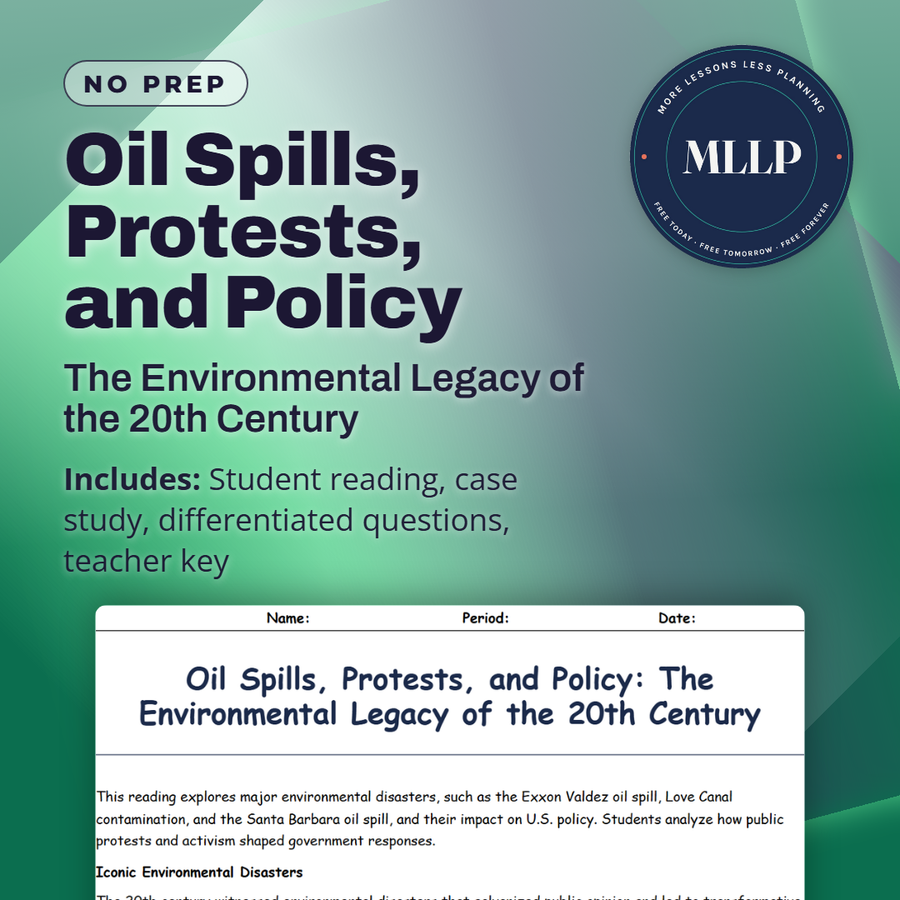
Oil Spills, Protests, and Policy: The Environmental Legacy of the 20th Century
Quality reviewed September 2026
Facts verified September 9, 2026
- Subject
- Science
- Grades
- Grades 9-12
- Length
- 8-page student worksheet
- Time
- About one 50-minute class period
- Great for
- Sub plans and independent work
- Includes
- Reading passage, comprehension questions + full answer key
- Format
- Print-and-go PDF
What students do
- Analyze how media images of environmental disasters created political pressure for regulation
- Trace the legislative responses following Santa Barbara, Love Canal, and Exxon Valdez spills
- Evaluate the effectiveness of Superfund in holding corporations accountable for contamination
- Identify how grassroots activism influenced the passage of the Oil Pollution Act of 1990
What it covers
- Environmental disasters and their ecological impacts
- Grassroots activism and public demonstrations
- Federal legislation and environmental enforcement
Start reading this worksheet
This reading explores major environmental disasters, such as the Exxon Valdez oil spill, Love Canal contamination, and the Santa Barbara oil spill, and their impact on U.S. policy. Students analyze how public protests and activism shaped government responses.
Iconic Environmental Disasters
The 20th century witnessed environmental disasters that galvanized public opinion and led to major policy reforms. The Santa Barbara oil spill in 1969, for instance, released tens of thousands of barrels of crude oil into the Pacific Ocean, coating California beaches with tar and killing marine life. Media coverage of oil-soaked birds and polluted shorelines outraged citizens, spurring some of the first major environmental protests. A decade later, the Exxon Valdez spill in Alaska’s Prince William Sound (1989) leaked over 10 million gallons of oil, devastating fishing communities and wildlife, including orcas and seabirds. In both cases, public outrage played a key role in demanding stricter regulations on oil drilling and transport. Meanwhile, the contamination at Love Canal in upstate New York illustrated how hazardous waste disposal could wreak havoc on residential communities. Families complained of foul odors, chemical burns, and a spike in illnesses, prompting the federal government to relocate households. These disasters collectively underscored the vulnerability of local ecosystems and communities, accelerating a push for regulatory reforms in the late 20th century.
Public Protests and Activism
Reacting to these catastrophes, citizens organized protests, sit-ins, and boycotts that drew national attention. Grassroots organizations circulated petitions, partnered with scientists to document health impacts, and lobbied politicians for stricter environmental laws. These actions put pressure on elected officials, who realized that failing to address environmental disasters could be politically damaging. Earth Day, first celebrated in 1970, emerged as a symbol of popular mobilization around these issues. Protesters in coastal regions demanded better safeguards for drilling operations; local communities near industrial sites fought for stricter oversight of waste disposal. Media coverage amplified their grievances, as images of oil-slicked beaches or corroded chemical drums evoked strong emotional responses. This collective action helped usher in legislation like the National Environmental Policy Act (NEPA), which required environmental impact statements for significant federal projects. Activism thus became a driving force behind new regulations, illustrating that public pressure and political will often go hand in hand.
Like what you read? The full reading, the case study, and every question set are in the free download below, along with the answer key.
Why this matters
An oil-soaked bird on a beach was just a sad photograph until Santa Barbara turned it into evidence in a political fight. That single image reframed pollution as something citizens could point to and demand a fix for, not an accident industry would quietly clean up on its own.
It is tempting to read a law like Superfund as proof that officials simply noticed a problem and acted. This reading shows the opposite order: people at Love Canal fought first, and residents near Exxon Valdez collected their own water samples when official reports claimed recovery was already happening. Once students see that sequence, environmental law stops reading like background noise and starts reading like a record of who refused to stay quiet.
From one teacher to another
Students are shocked when they see oil-soaked birds from Santa Barbara beaches. That one image changed legislation. The reading traces how citizens organized after Exxon Valdez, collected water samples themselves because official reports claimed recovery was already happening, and kept pushing for stricter tanker standards. Then they see Love Canal, where families fought chemical companies, and suddenly environmental policy stops being abstract. It's tragedy, activism, and law working together.
What you get
Download
Where should I send the next one?
Everything here is free and it stays that way. Leave your email and I'll send you the new lessons as they go up. You can unsubscribe from any one of them.
Related resources
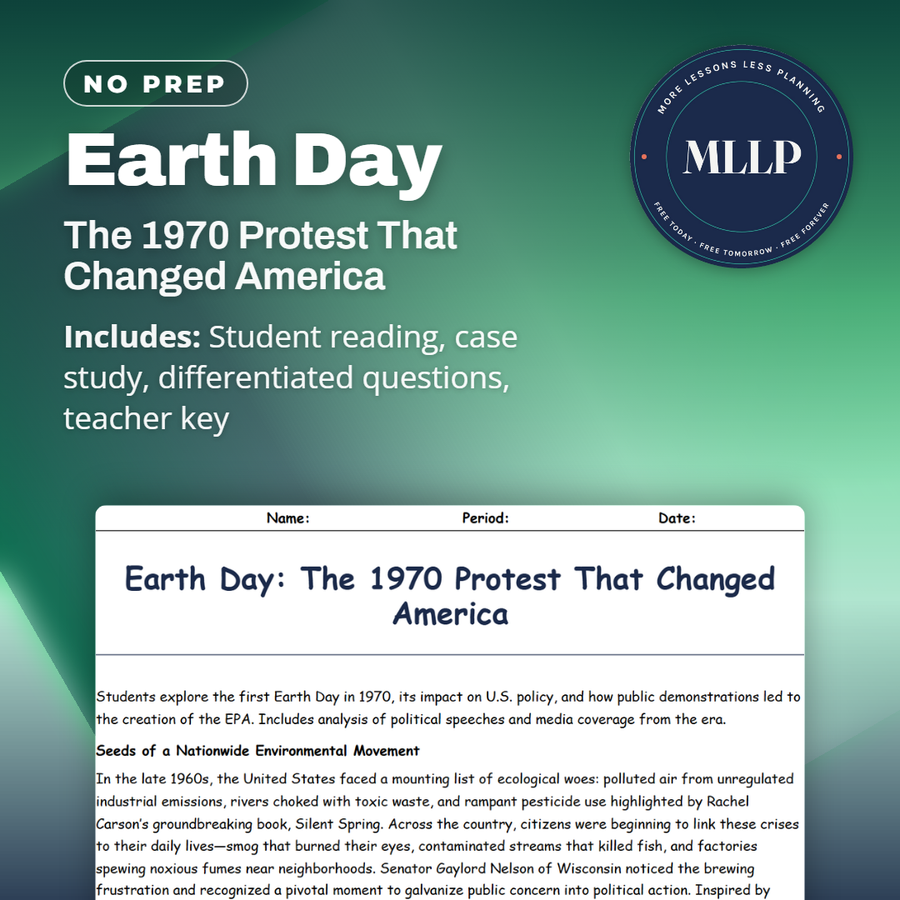
Earth Day: The 1970 Protest That Changed America
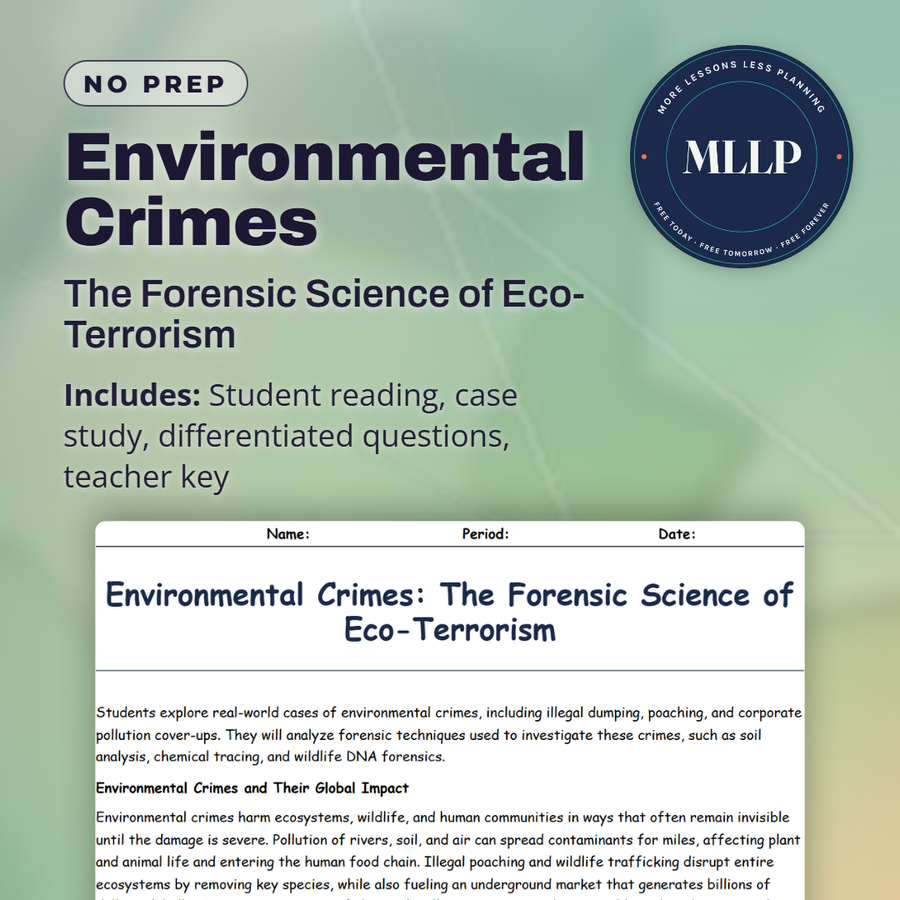
Environmental Crimes: The Forensic Science of Eco-Terrorism
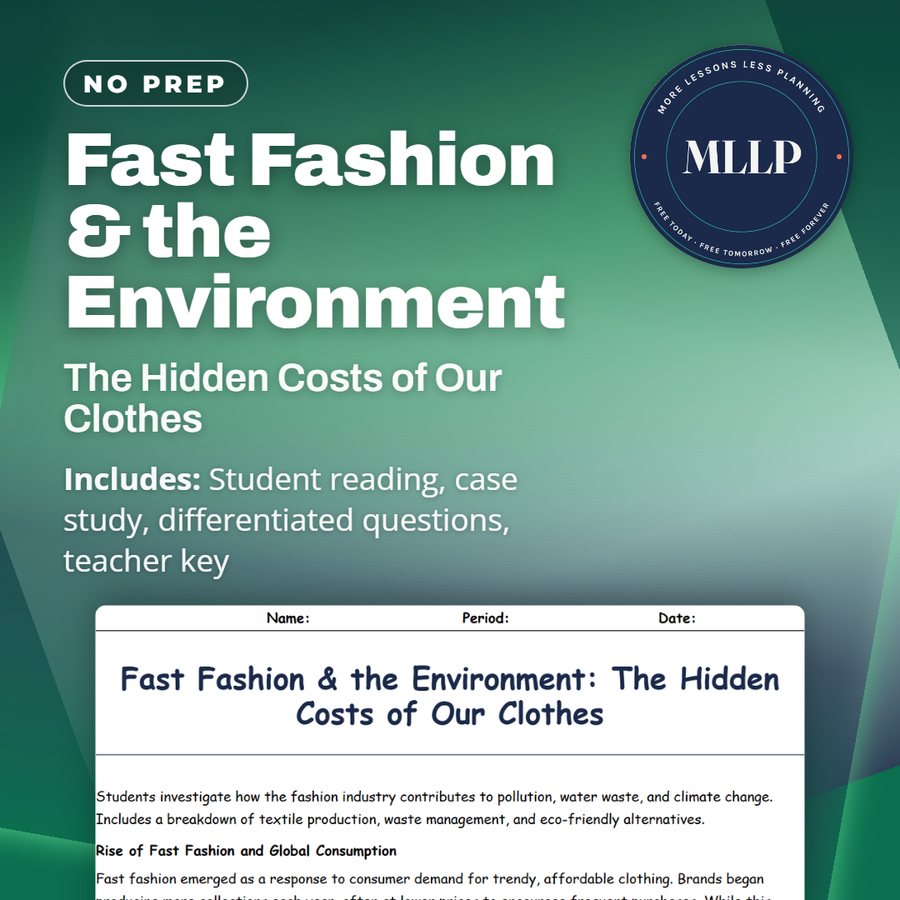
Fast Fashion & the Environment: The Hidden Costs of Our Clothes
Land Use and Federal vs. State Power: Who Controls Natural Resources?
The Carbon Footprint of Everyday Life: A Data Analysis Challenge
The Government’s Role in Protecting the Environment: A Policy Debate
Every lesson on this site is free to download and use. If one of them saved you a prep period, you can chip in a few bucks toward my three kids' daycare fund. That's genuinely where tips go.