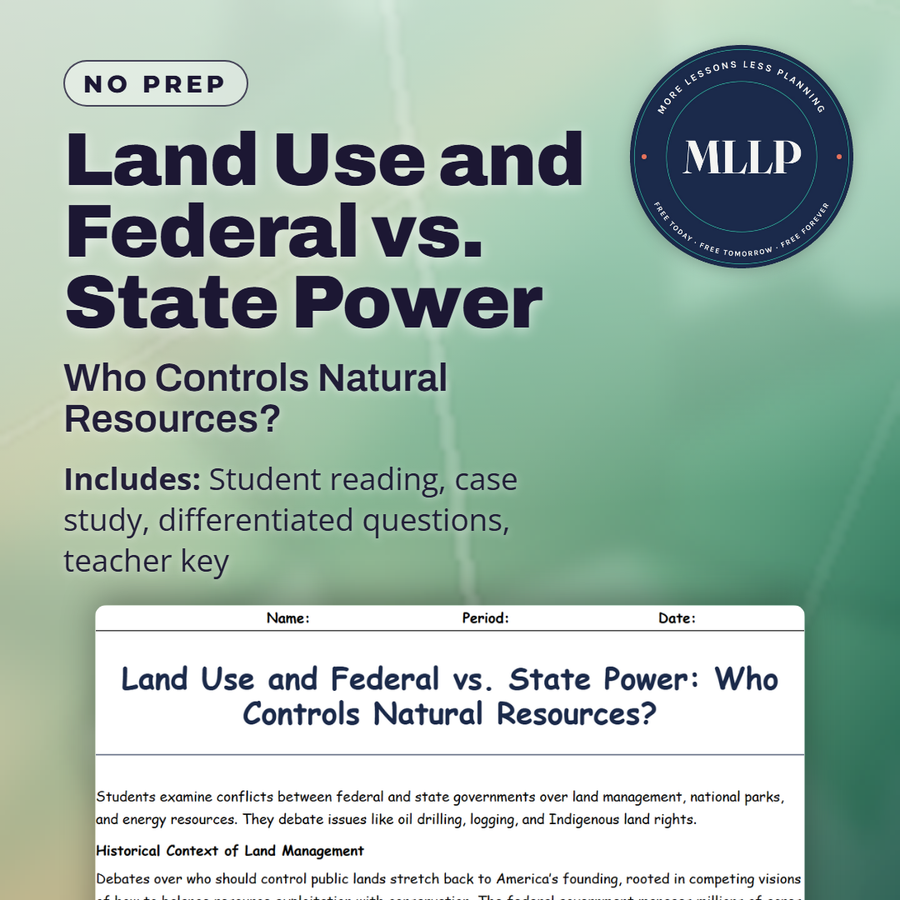
Land Use and Federal vs. State Power: Who Controls Natural Resources?
Quality reviewed September 2026
Facts verified September 9, 2026
- Subject
- Social Studies
- Grades
- Grades 9-12
- Length
- 8-page student worksheet
- Time
- About one 50-minute class period
- Great for
- Sub plans and independent work
- Includes
- Reading passage, comprehension questions + full answer key
- Format
- Print-and-go PDF
What students do
- Analyze competing arguments between federal agencies and state governments over energy development
- Evaluate how Indigenous treaty rights shape decisions about resource extraction on public lands
- Explain the ANWR drilling controversy and its environmental and economic tradeoffs
- Compare co-management approaches to traditional hierarchical control of federal lands
What it covers
- Federal and state authority in land management
- Indigenous sovereignty and treaty obligations
- Energy development and ecosystem protection
Start reading this worksheet
Students examine conflicts between federal and state governments over land management, national parks, and energy resources. They debate issues like oil drilling, logging, and Indigenous land rights.
Historical Context of Land Management
Debates over who should control public lands stretch back to America’s founding, rooted in competing visions of how to balance resource exploitation with conservation. The federal government manages millions of acres under agencies like the Bureau of Land Management (BLM), the U.S. Forest Service, and the National Park Service. States, particularly in the West, often argue they know best how to administer local territories, pointing to economic benefits such as mining, logging, and energy extraction. Supporters of federal oversight counter that these lands belong to all Americans, not just residents of one state. Over time, disputes flared over grazing rights, water access, and potential damage to fragile ecosystems. The creation of national parks in the late 19th and early 20th centuries added another dimension, prioritizing conservation and public enjoyment. Meanwhile, tensions persist regarding which government entity holds final authority over permitting and revenue distribution from resource extraction on public lands.
Energy Development and Environmental Concerns
Land use often pivots on the push to develop energy resources, such as coal, oil, natural gas, and renewables like solar or wind. Federal lands contain extensive fossil fuel deposits, fueling arguments about whether drilling leases and mining permits should be expanded or curtailed. Advocates stress economic growth, job creation, and energy independence. Opponents warn that such development risks environmental degradation, from wildlife habitat disruption to water contamination. Agencies face the challenge of drafting environmental impact statements, assessing whether proposed projects meet legal and ecological standards. In some cases, state governments encourage development for tax revenue and local employment, clashing with federal agencies that might impose stricter regulations to protect national interests. Moreover, climate change pressures policy decisions, raising questions about whether more fossil fuel extraction aligns with broader national or global goals for reducing carbon emissions. This complex web of laws, permits, and political influences makes energy development on public lands a key battleground in federal-state relations.
Like what you read? The full reading, the case study, and every question set are in the free download below, along with the answer key.
Why this matters
Who actually owns the land under a caribou herd's migration route: the federal government, the state of Alaska, or the tribes who were there before either existed? The ANWR drilling debate forces an answer, because oil development, treaty rights, and a fragile ecosystem all sit on the same acres.
Civics lessons often leave Indigenous nations out of land disputes entirely, treating federal versus state power as the whole argument. I make sure students weigh a third claim: tribal treaty rights carry real legal weight here, not just moral standing, and once they see that, they stop treating land use as a two sided argument and start noticing the claim that was there the whole time.
From one teacher to another
I built this worksheet around the ANWR debate because it forces students to wrestle with competing values: economic growth for Alaska versus habitat protection for caribou herds. The reading includes tribal perspectives, something too often left out of civics lessons. Students see how Indigenous communities aren't sideline observers. Their treaty rights carry legal weight. By the end, they understand that land use is a three-way question, with the people who have been there longest holding real legal claims.
What you get
Download
Where should I send the next one?
Everything here is free and it stays that way. Leave your email and I'll send you the new lessons as they go up. You can unsubscribe from any one of them.
Related resources
Earth Day: The 1970 Protest That Changed America
Environmental Crimes: The Forensic Science of Eco-Terrorism
Fast Fashion & the Environment: The Hidden Costs of Our Clothes
Oil Spills, Protests, and Policy: The Environmental Legacy of the 20th Century
The Carbon Footprint of Everyday Life: A Data Analysis Challenge
The Government’s Role in Protecting the Environment: A Policy Debate
Every lesson on this site is free to download and use. If one of them saved you a prep period, you can chip in a few bucks toward my three kids' daycare fund. That's genuinely where tips go.