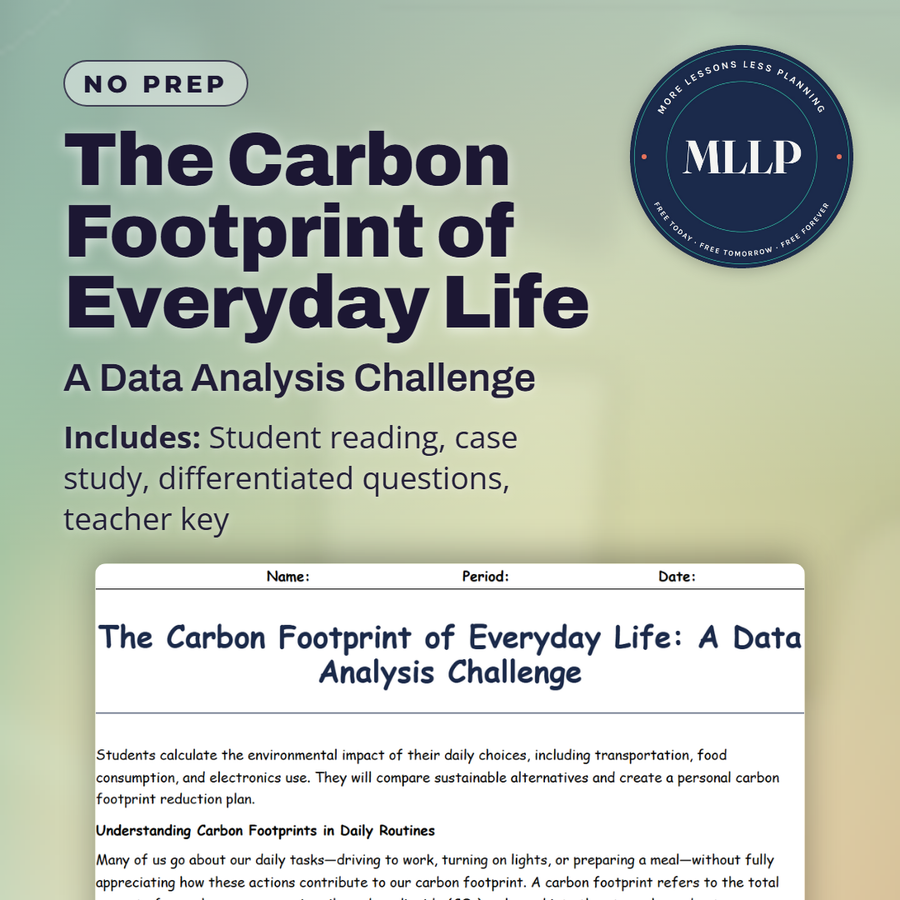
The Carbon Footprint of Everyday Life: A Data Analysis Challenge
Quality reviewed September 2026
Facts verified September 9, 2026
- Subject
- Math
- Grades
- Grades 9-12
- Length
- 8-page student worksheet
- Time
- About one 50-minute class period
- Great for
- Sub plans and independent work
- Includes
- Reading passage, comprehension questions + full answer key
- Format
- Print-and-go PDF
What students do
- Calculate carbon emissions from transportation, food, energy, and electronics in daily routines
- Compare the environmental impact of different dietary and travel choices using data
- Analyze how Green Hill High School achieved a 20% carbon reduction through targeted interventions
- Evaluate renewable energy and efficiency strategies for lowering household carbon footprints
What it covers
- Carbon emissions from everyday activities
- Data analysis and environmental tracking
- Sustainable alternatives and personal action
Start reading this worksheet
Students calculate the environmental impact of their daily choices, including transportation, food consumption, and electronics use. They will compare sustainable alternatives and create a personal carbon footprint reduction plan.
Understanding Carbon Footprints in Daily Routines
Many of us go about our daily tasks (driving to work, turning on lights, or preparing a meal) without fully appreciating how these actions contribute to our carbon footprint. A carbon footprint refers to the total amount of greenhouse gases, primarily carbon dioxide (CO₂), released into the atmosphere due to an individual’s or organization’s activities. Energy use in buildings, for instance, generates emissions from electricity production. Similarly, each car trip burns fossil fuels, releasing CO₂ through the exhaust. Over time, these routine activities accumulate, shaping global climate patterns and intensifying issues like rising sea levels, shifting weather phenomena, and the melting of polar ice caps. While major industries bear a large share of responsibility, collective individual actions significantly add up. Recognizing this fact has motivated many people to examine their habits, seeking ways to reduce energy consumption and switch to greener alternatives like public transportation or renewable energy. By connecting personal choices to larger environmental outcomes, students begin to see themselves as part of a global network of change-makers, each capable of influencing the fight against climate change.
Transportation and Food Choices
Transportation stands out as one of the most straightforward aspects to analyze when measuring personal carbon footprints. Driving a conventional gasoline-powered vehicle for a short commute can still lead to multiple kilograms of CO₂ emissions each week. Switching to carpooling, biking, or public transport can substantially cut back these emissions. Meanwhile, air travel produces large amounts of CO₂ per passenger, prompting some travelers to offset their flight-related emissions by contributing to reforestation or clean energy projects. Food consumption also plays a pivotal role. Producing beef, for example, generally has a heavier carbon footprint than growing vegetables or fruits, partly due to the resources required to raise cattle, including land, water, and feed. In contrast, plant-based diets can reduce emissions while offering health benefits. However, dietary choices are influenced by culture, availability, and personal preference. The key is understanding the hidden costs, like the resources needed to transport exotic produce over long distances. By making small shifts, such as opting for locally grown foods or reducing red meat intake, individuals can significantly lessen their carbon impact. These lifestyle tweaks not only reduce emissions but also help create demand for more sustainable products, encouraging farmers, distributors, and restaurants to follow suit.
Like what you read? The full reading, the case study, and every question set are in the free download below, along with the answer key.
Why this matters
One airplane flight can equal months of a student's daily commute in carbon terms, a comparison most have never had reason to make. Once footprint stops being a vague phrase and becomes kilograms of CO2 from a specific commute, lunch, or device, it becomes something they can calculate instead of recite from a poster.
Green Hill High School actually cut its output by 20 percent by swapping cars for buses and switching to LED bulbs, numbers students can check against their own habits. Somewhere in that comparison, a student usually realizes beef carries triple the carbon impact of chicken.
From one teacher to another
I like this worksheet because students quantify what 'carbon footprint' actually means, not some vague concept, but kilograms of CO2 from their commute, their lunch choices, their devices. The Green Hill case study shows real results: students swapped cars for buses and LED bulbs cut energy bills. I've had kids discover that one airplane flight equals months of driving, or that beef has triple the carbon impact of chicken. They leave understanding that individual choices add up globally.
What you get
Download
Where should I send the next one?
Everything here is free and it stays that way. Leave your email and I'll send you the new lessons as they go up. You can unsubscribe from any one of them.
Related resources
Earth Day: The 1970 Protest That Changed America
Environmental Crimes: The Forensic Science of Eco-Terrorism

Fast Fashion & the Environment: The Hidden Costs of Our Clothes
Land Use and Federal vs. State Power: Who Controls Natural Resources?
Oil Spills, Protests, and Policy: The Environmental Legacy of the 20th Century
The Government’s Role in Protecting the Environment: A Policy Debate
Every lesson on this site is free to download and use. If one of them saved you a prep period, you can chip in a few bucks toward my three kids' daycare fund. That's genuinely where tips go.