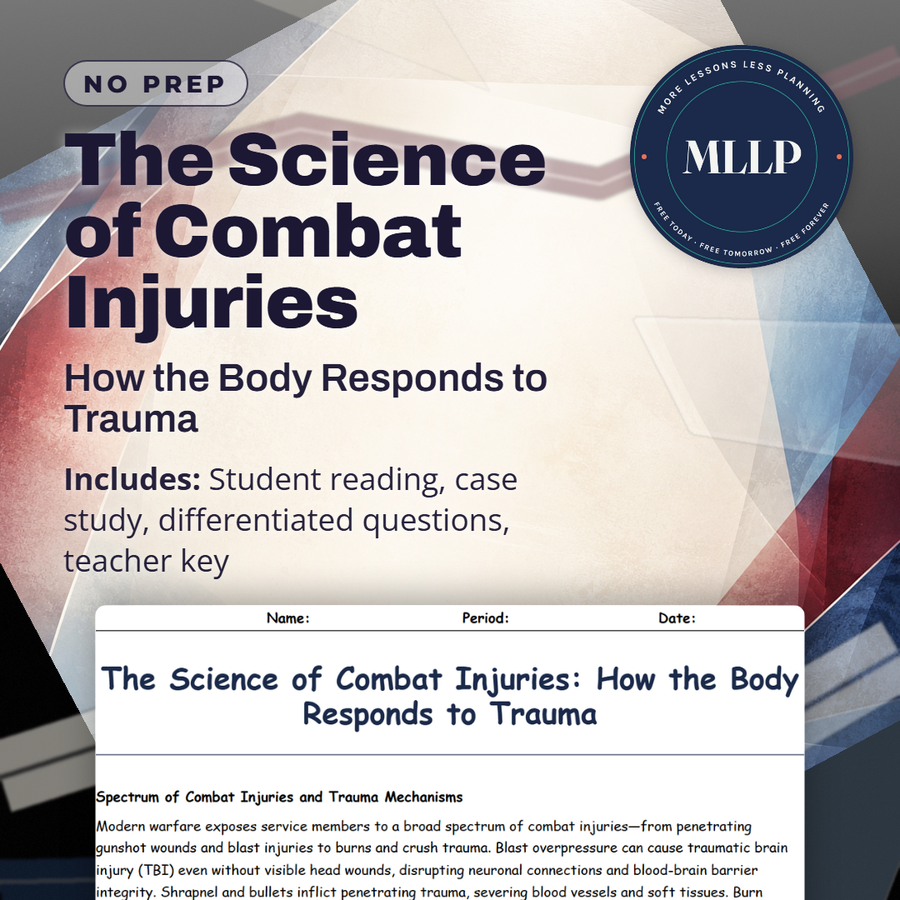
The Science of Combat Injuries: How the Body Responds to Trauma
Quality reviewed September 2026
Facts verified September 9, 2026
- Subject
- Science
- Grades
- Grades 9-12
- Length
- 7-page student worksheet
- Time
- About one 50-minute class period
- Great for
- Sub plans and independent work
- Includes
- Reading passage, comprehension questions + full answer key
- Format
- Print-and-go PDF
What students do
- Analyze blast injury mechanisms and secondary damage from uncontrolled inflammation
- Explain hemostasis and the role of hemostatic agents in field medicine
- Evaluate innovations in damage-control surgery and prosthetic technology
- Trace Specialist Ramirez's recovery from blast injury through rehabilitation
What it covers
- Spectrum of combat injuries and trauma pathophysiology
- Hemorrhage control and whole-blood transfusion protocols
- Rehabilitation innovations and adaptive prosthetics
Start reading this worksheet
Spectrum of Combat Injuries and Trauma Mechanisms
Modern warfare exposes service members to a broad spectrum of combat injuries: penetrating gunshot wounds, blast injuries, burns, and crush trauma. Blast overpressure can cause traumatic brain injury (TBI) even without visible head wounds, disrupting neuronal connections and blood-brain barrier integrity. Shrapnel and bullets inflict penetrating trauma, severing blood vessels and soft tissues. Burn injuries, whether thermal, chemical, or electrical, compromise skin’s protective barrier, increasing infection risk. Crush injuries can precipitate compartment syndrome, where rising pressure within muscle compartments impedes blood flow, leading to tissue necrosis. Each injury type triggers unique pathophysiological cascades, demanding tailored medical responses.
Physiological Responses: Hemostasis, Inflammation, and Secondary Damage
Upon injury, the body’s immediate priority is to control hemorrhage. Hemostasis involves vasoconstriction and platelet aggregation, forming a clot to staunch bleeding. Simultaneously, the inflammatory response mobilizes neutrophils and macrophages to clear debris and pathogens. While essential, inflammation can also cause secondary damage: excessive cytokine release and reactive oxygen species may exacerbate tissue injury. In TBI, neuroinflammation contributes to cerebral edema, raising intracranial pressure. Field medics use tourniquets and hemostatic agents, such as kaolin-treated gauze, to accelerate clotting, while IV fluids restore circulating volume, balancing perfusion with the risk of dilutional coagulopathy.
Innovations in Combat Medicine and Field Care
Advancements in combat medicine have markedly improved survival rates. Portable hemorrhage control kits carry hemostatic dressings and junctional tourniquets for groin or axillary bleeding. Whole-blood transfusion protocols and freeze-dried plasma allow rapid restoration of clotting factors in austere environments. Portable intracranial pressure monitors enable early detection of dangerous swelling in TBI patients. Damage-control surgery, which prioritizes hemorrhage control and contamination prevention before definitive repair, minimizes time under anesthesia and reduces mortality. Research into regenerative medicine, including stem cell therapies and bio-engineered skin substitutes, holds promise for accelerating healing of burns and blast wounds.
Like what you read? The full reading, the case study, and every question set are in the free download below, along with the answer key.
Why this matters
Specialist Ramirez's case study opens at the moment of an IED blast: a combat lifesaver applying a junctional tourniquet, whole blood restoring what his body lost, damage-control surgery stopping the bleeding before anyone considers reconstruction. Students see why uncontrolled inflammation causes damage of its own hours later.
This case earns its slot in anatomy because Ramirez's body responds as one connected system, not separate parts on a diagram. Following him to a microprocessor prosthetic that adjusts his gait forces students to trace hemostasis, immune response, and rehabilitation in a single person.
From one teacher to another
Specialist Ramirez's case study starts at the moment of an IED blast and follows him all the way to mentoring new amputees. A combat lifesaver applies a junctional tourniquet, whole blood restores volume in the field hospital, and damage-control surgery stops the bleeding before anyone attempts reconstruction. The reading explains why uncontrolled inflammation causes secondary damage and how a microprocessor prosthetic later adjusts his gait step by step. I teach this in anatomy because it shows every body system responding at once. Students trace hemostasis, immune response, and rehabilitation in one patient, with the answer key pairing each stage to the physiology behind it.
What you get
Download
Where should I send the next one?
Everything here is free and it stays that way. Leave your email and I'll send you the new lessons as they go up. You can unsubscribe from any one of them.
Related resources
Memorial Day and Environmental Impact: Waste, Travel, and Outdoor Recreation
Memorial Day: Honoring Sacrifice and Remembering History
Memorial Landscapes: How Weather, Erosion, and Time Shape War Memorials
The Biology of Healing: How the Body Repairs After Injury
The Forensics of War: Identifying the Fallen
The Psychology of Grief, Memory, and Memorializing
Every lesson on this site is free to download and use. If one of them saved you a prep period, you can chip in a few bucks toward my three kids' daycare fund. That's genuinely where tips go.