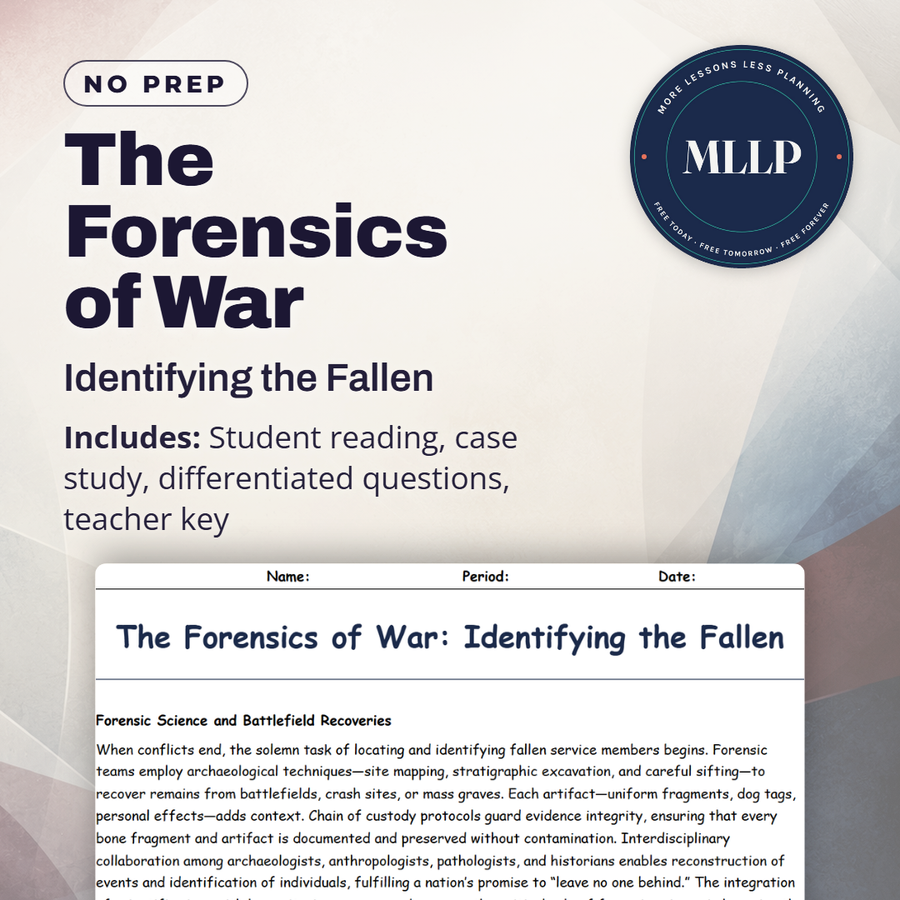
The Forensics of War: Identifying the Fallen
Quality reviewed September 2026
Facts verified September 9, 2026
- Subject
- Science
- Grades
- Grades 9-12
- Length
- 7-page student worksheet
- Time
- About one 50-minute class period
- Great for
- Sub plans and independent work
- Includes
- Reading passage, comprehension questions + full answer key
- Format
- Print-and-go PDF
What students do
- Analyze mitochondrial DNA and STR profiling for degraded remains
- Explain how dental radiographs and skeletal markers confirm identity
- Evaluate ethical challenges in exhuming graves and MIA recovery operations
- Trace the identification of an unknown sailor through multiple forensic methods
What it covers
- DNA analysis and genetic fingerprinting techniques
- Forensic anthropology and dental identification
- Chain of custody and archaeological site recovery
Start reading this worksheet
Forensic Science and Battlefield Recoveries
When conflicts end, the solemn task of locating and identifying fallen service members begins. Forensic teams employ archaeological techniques, such as site mapping, stratigraphic excavation, and careful sifting, to recover remains from battlefields, crash sites, or mass graves. Each artifact, such as a uniform fragment, dog tag, or personal effect, adds context. Chain of custody protocols guard evidence integrity, ensuring that every bone fragment and artifact is documented and preserved without contamination. Interdisciplinary collaboration among archaeologists, anthropologists, pathologists, and historians enables reconstruction of events and identification of individuals, fulfilling a nation’s promise to “leave no one behind.” The integration of scientific rigor with humanitarian purpose underscores the critical role of forensic science in honoring the fallen.
DNA Analysis and Genetic Techniques
Advances in genetic methods have transformed identification. STR analysis (short tandem repeat profiling) examines repetitive DNA sequences in nuclear DNA, producing unique genetic fingerprints. When remains are degraded, mitochondrial DNA (mtDNA), which is inherited maternally and present in multiple copies per cell, provides a more resilient option. Scientists extract DNA from dense cortical bone or tooth pulp, comparing profiles to reference samples from living relatives or personal items. Next-generation sequencing enhances sensitivity, allowing identification from highly fragmented DNA. Rigorous contamination control and statistical analysis yield match probabilities exceeding 99.9 percent, providing families with definitive answers after decades of uncertainty.
Skeletal and Dental Identification Methods
When DNA is unavailable or inconclusive, forensic anthropology and odontology fill gaps. Anthropologists estimate age, sex, ancestry, and stature by examining pelvic morphology, cranial sutures, and long-bone measurements. Dental enamel, the body’s hardest tissue, survives environmental degradation; forensic odontologists compare antemortem dental radiographs to postmortem charts, matching restorations, root forms, and wear patterns. Unique skeletal markers, such as healed fractures or surgical implants with serial numbers, further personalize remains. 3D photogrammetry and laser scanning allow non-destructive digital overlays, confirming identifications without compromising fragile specimens.
Like what you read? The full reading, the case study, and every question set are in the free download below, along with the answer key.
Why this matters
A harbor dredging operation in 2015 pulled up coral-encrusted bones, and forensic anthropologists could already estimate a man's age from the skeleton alone before any lab work began. Mitochondrial DNA from a molar was later matched against a living nephew, and STR analysis pushed the identification above 99.99 percent certain.
Students ask me why any of this matters decades after a war ends, and the Pearl Harbor case answers it better than a lecture could: a family gets a name after not knowing for most of a lifetime. I've found the ethics questions about exhuming graves and MIA recovery land completely differently once that name is attached to an actual sailor.
From one teacher to another
A 2015 harbor dredging operation pulls up coral-encrusted bones, and that opening detail hooks students before the science starts. Forensic anthropologists read the skeleton first and estimate a man of thirty to thirty-five, then mitochondrial DNA from a molar is matched against a living nephew and STR analysis puts the identification above 99.99 percent. The Pearl Harbor case study turns each technique into a step in giving a family an answer after decades of not knowing. I use it in my forensics unit because the ethics questions about exhumation and MIA recovery land differently once a name is attached.
What you get
Download
Where should I send the next one?
Everything here is free and it stays that way. Leave your email and I'll send you the new lessons as they go up. You can unsubscribe from any one of them.
Related resources
Memorial Day and Environmental Impact: Waste, Travel, and Outdoor Recreation
Memorial Day: Honoring Sacrifice and Remembering History
Memorial Landscapes: How Weather, Erosion, and Time Shape War Memorials
The Biology of Healing: How the Body Repairs After Injury
The Psychology of Grief, Memory, and Memorializing
The Science of Combat Injuries: How the Body Responds to Trauma
Every lesson on this site is free to download and use. If one of them saved you a prep period, you can chip in a few bucks toward my three kids' daycare fund. That's genuinely where tips go.