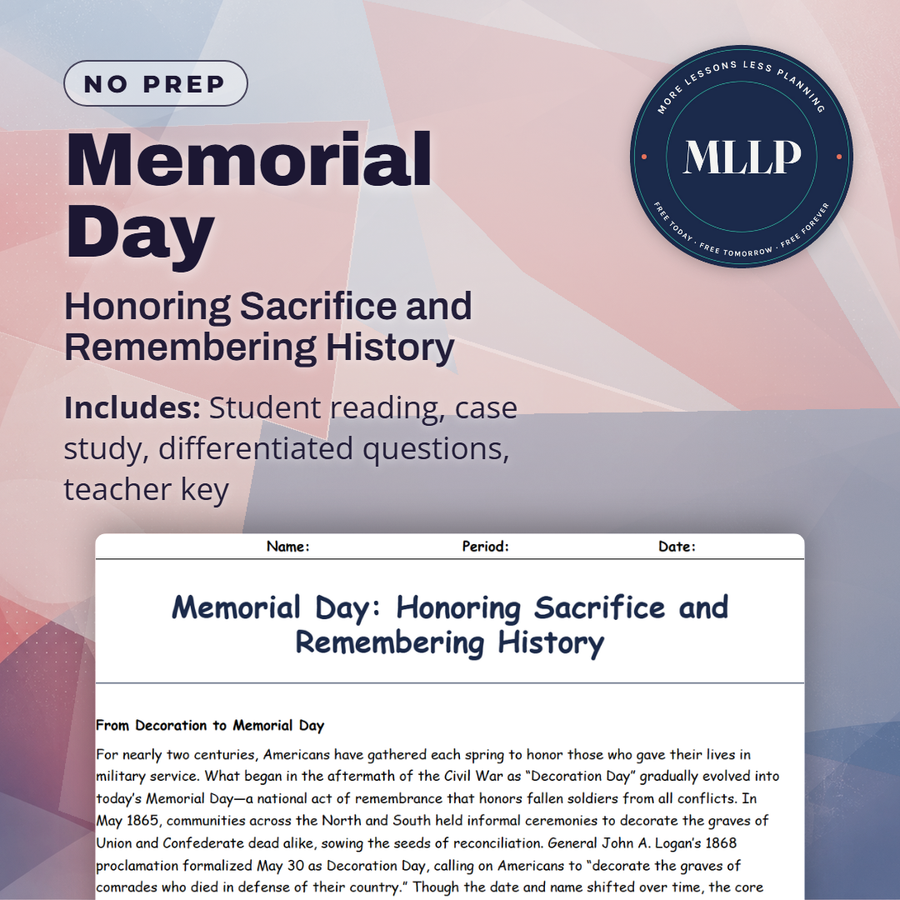
Memorial Day: Honoring Sacrifice and Remembering History
Quality reviewed September 2026
Facts verified September 9, 2026
- Subject
- Social Studies
- Grades
- Grades 9-12
- Length
- 8-page student worksheet
- Time
- About one 50-minute class period
- Great for
- Sub plans and independent work
- Includes
- Reading passage, comprehension questions + full answer key
- Format
- Print-and-go PDF
What students do
- Analyze how Decoration Day evolved into modern Memorial Day
- Trace the Uniform Monday Holiday Act's impact on holiday observance
- Evaluate tensions between leisure activities and commemoration
- Identify the symbolism of flags, poppies, and wreaths in ceremonies
What it covers
- Decoration Day origins and post-Civil War reconciliation
- Regional memorial rituals and national ceremonies
- Symbols and their historical significance
Start reading this worksheet
From Decoration to Memorial Day
For nearly two centuries, Americans have gathered each spring to honor those who gave their lives in military service. What began in the aftermath of the Civil War as “Decoration Day” gradually evolved into today’s Memorial Day, a national act of remembrance that honors fallen soldiers from all conflicts. In May 1865, communities across the North and South held informal ceremonies to decorate the graves of Union and Confederate dead alike, sowing the seeds of reconciliation. General John A. Logan’s 1868 proclamation formalized May 30 as Decoration Day, calling on Americans to “decorate the graves of comrades who died in defense of their country.” Though the date and name shifted over time, the core purpose remained: to pause, reflect, and pay tribute. This transformation from a regional observance into a federally recognized holiday illustrates how public memory can reshape national identity, and how rites of mourning can evolve into enduring traditions.
National Rituals and Regional Variations
Across the United States today, Memorial Day ceremonies follow familiar patterns (flags at half-staff until noon, wreath-laying at monuments, Taps echoing over silent crowds), but local customs color each observance. In Arlington National Cemetery, wreaths adorn the Tomb of the Unknown Soldier at sunrise; in small towns, high school bands play hymns before floral processions to every veteran’s headstone. In the South, some communities still hold Decoration Day events on multiple dates tied to local battles. Northern towns may host grand parades featuring veterans’ organizations, scout troops, and marching bands. Coastal areas sometimes combine flag-raising with Memorial Day boat runs, placing floral wreaths near sunken ship memorials offshore. Indigenous and immigrant communities add their own layers of meaning, blending traditional ceremonies with ancestral rituals of honoring the dead. Whether metropolitan or rural, Memorial Day observances unite Americans in collective grief, personal gratitude, and a shared reverence for service.
Civil War Legacy and Evolution
The Civil War’s unprecedented casualties forced Americans to confront death on an industrial scale. With more than 600 000 lives lost, the nation invented new ways to mourn collectively. Decoration Day ceremonies served as public rituals of nation-building, knitting together communities fractured by war. Widows and orphans joined veterans to sing, pray, and mourn; clergy invoked Lincoln’s Gettysburg Address as a call to “resolve that these dead shall not have died in vain.” After World War I, Decoration Day’s scope broadened: recognizing sacrifices in Europe and the Pacific, Americans sought a more inclusive name. In 1967, federal law officially renamed it Memorial Day, and a year later the Uniform Monday Holiday Act moved the observance to the last Monday in May, creating a three-day weekend. This shift reflected changing social priorities (commemoration alongside leisure), but it also risked diluting the holiday’s solemn roots. Understanding Memorial Day requires tracing its Civil War origins and recognizing how each new conflict reshaped collective memory.
Like what you read? The full reading, the case study, and every question set are in the free download below, along with the answer key.
Why this matters
A holiday that began with formerly enslaved women laying flowers on both Union and Confederate graves weeks after Appomattox now mostly registers as a three-day weekend. The Uniform Monday Holiday Act made that shift official, moving remembrance onto a fixed Monday built for convenience instead of a date tied to grief.
Flags, poppies, and wreaths read as decoration until you trace them back to the ceremonies that made them mean something. I like watching that shift happen: once a class sees how deliberately those first observances were staged right after a war that split the country in two, a folded flag starts reading as an argument about who gets remembered.
From one teacher to another
My students gravitate toward the Magnolia Cemetery story in the case study, where formerly enslaved women organized a ceremony weeks after Appomattox and laid magnolia branches on Union and Confederate graves alike. It complicates the tidy national reconciliation narrative they walk in expecting. The reading then follows Decoration Day into the modern holiday, including the Uniform Monday Holiday Act that turned remembrance into a three-day weekend. The closing questions ask why that 1865 ceremony mattered so much to both North and South, and what a flag or a poppy is supposed to say today.
What you get
Download
Where should I send the next one?
Everything here is free and it stays that way. Leave your email and I'll send you the new lessons as they go up. You can unsubscribe from any one of them.
Related resources
Memorial Day and Environmental Impact: Waste, Travel, and Outdoor Recreation
Memorial Landscapes: How Weather, Erosion, and Time Shape War Memorials
The Biology of Healing: How the Body Repairs After Injury
The Forensics of War: Identifying the Fallen
The Psychology of Grief, Memory, and Memorializing
The Science of Combat Injuries: How the Body Responds to Trauma
Every lesson on this site is free to download and use. If one of them saved you a prep period, you can chip in a few bucks toward my three kids' daycare fund. That's genuinely where tips go.