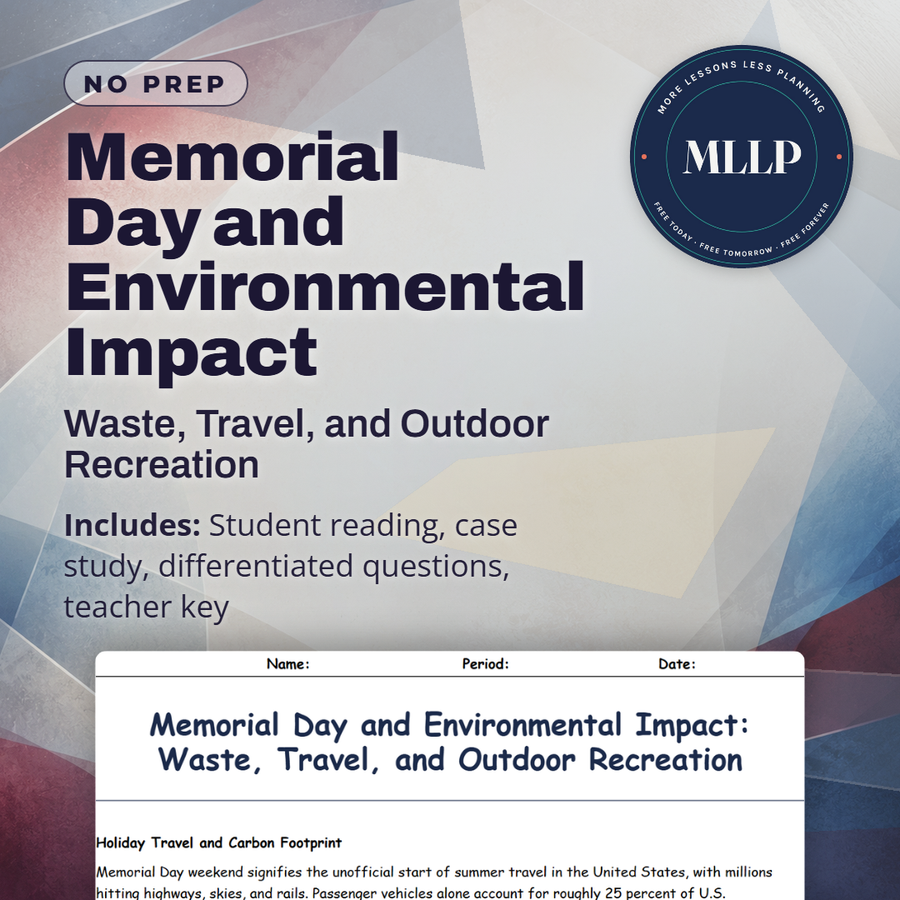
Memorial Day and Environmental Impact: Waste, Travel, and Outdoor Recreation
Quality reviewed September 2026
Facts verified September 9, 2026
- Subject
- Science
- Grades
- Grades 9-12
- Length
- 6-page student worksheet
- Time
- About one 50-minute class period
- Great for
- Sub plans and independent work
- Includes
- Reading passage, comprehension questions + full answer key
- Format
- Print-and-go PDF
What students do
- Analyze waste diversion strategies used at community events
- Explain how passenger vehicles contribute to weekend emissions spikes
- Evaluate sustainable procurement and zero-waste policies
- Trace environmental impacts of outdoor commemorations
What it covers
- Holiday travel carbon emissions
- Waste management and recycling contamination
- Environmental restoration of parks and memorials
Start reading this worksheet
Holiday Travel and Carbon Footprint
Memorial Day weekend signifies the unofficial start of summer travel in the United States, with millions hitting highways, skies, and rails. Passenger vehicles alone account for roughly 25 percent of U.S. transportation emissions, and daily travel spikes during holiday weekends can increase greenhouse gas outputs by 20–30 percent. Air travel adds high-altitude emissions that exacerbate climate warming. While public transit and ride-sharing offer lower per-passenger footprints, infrastructure limitations and service gaps often deter widespread adoption. Some communities publish “green travel guides” for Memorial Day that promote carpool apps, regional train passes, and shuttle services, helping travelers reduce their carbon footprint and honor veterans by protecting the very freedoms they defended.
Waste Generation and Management Challenges
Outdoor commemorations, including cookouts, parades, and concerts, produce vast quantities of single-use waste: plastic plates, cutlery, cups, and wrappers. A city of 100 000 people can generate over 50 tons of solid waste during Memorial Day festivities. Contaminated recyclables, soiled by food residue, often end up in landfills, compounding disposal costs and environmental harm. Sanitation departments must deploy extra collection crews and trucks, increasing fuel consumption and emissions. Some municipalities combat this by implementing zero-waste policies: mandating compostable service ware, installing multi-stream collection bins, and incentivizing vendors to minimize packaging. Educational signage and volunteer “waste ambassadors” guide attendees to sort materials properly, boosting diversion rates and reducing landfill dependence.
Environmental Impacts of Outdoor Activities
Parks and historic sites hosting Memorial Day services face soil compaction, vegetation trampling, and wildlife disturbance from heavy foot traffic. Off-road vehicles in parades or demonstrations can damage trails and spread invasive species. Fireworks displays, while visually stirring, deposit toxic residues, including metals and perchlorates, into waterways and soils. Noise pollution from amplified speakers and engine revving stresses local fauna. To mitigate impacts, park managers employ designated pathways, temporary boardwalks over sensitive turf, and timed entry slots that limit crowd density. Post-event restoration teams reseed damaged lawns, aerate compacted soil, and remove leftover debris, ensuring that these hallowed grounds remain healthy for future generations.
Like what you read? The full reading, the case study, and every question set are in the free download below, along with the answer key.
Why this matters
Passenger vehicles spike emissions on any travel holiday, and a single park can generate enough trash in one crowded weekend to overwhelm a normal collection system. Pine Valley's pilot treated that as a solvable problem instead of an accepted cost, testing shuttles, temporary boardwalks, and sorted waste stations against an ordinary crowd.
Three-stream sorting cutting landfill waste down to just 20 percent of what the event produced is the kind of detail that makes recycling stop feeling symbolic. The boardwalks matter too: keeping foot traffic off open turf protected soil a crowded weekend could otherwise compact for years.
From one teacher to another
I use this one when I want to tie current environmental practice to an actual holiday. Pine Valley's pilot shows students how a real event, barbecues, shuttles, temporary boardwalks, gets the science to work. Three-stream waste stations reduced landfill to just 20 percent, and boardwalks kept soil compaction out of sensitive turf. The case study feels lived-in, not generic.
What you get
Download
Where should I send the next one?
Everything here is free and it stays that way. Leave your email and I'll send you the new lessons as they go up. You can unsubscribe from any one of them.
Related resources
Memorial Day: Honoring Sacrifice and Remembering History
Memorial Landscapes: How Weather, Erosion, and Time Shape War Memorials

The Biology of Healing: How the Body Repairs After Injury
The Forensics of War: Identifying the Fallen

The Psychology of Grief, Memory, and Memorializing
The Science of Combat Injuries: How the Body Responds to Trauma
Every lesson on this site is free to download and use. If one of them saved you a prep period, you can chip in a few bucks toward my three kids' daycare fund. That's genuinely where tips go.