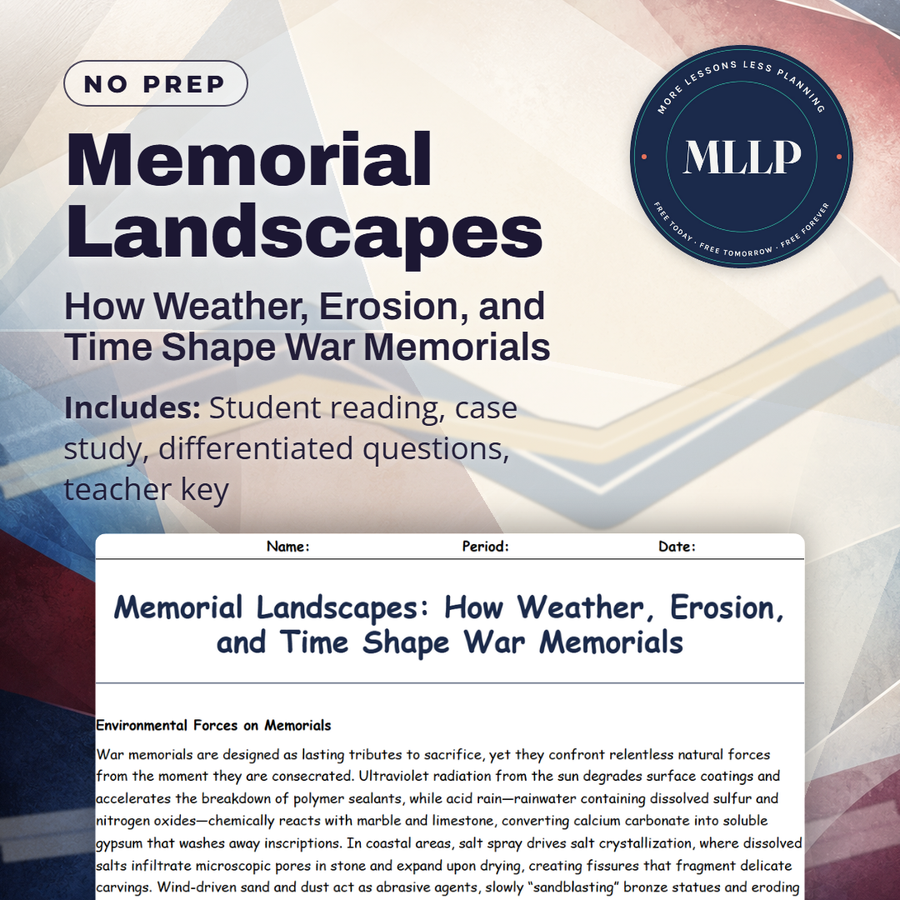
Memorial Landscapes: How Weather, Erosion, and Time Shape War Memorials
Quality reviewed September 2026
Facts verified September 9, 2026
- Subject
- Science
- Grades
- Grades 9-12
- Length
- 8-page student worksheet
- Time
- About one 50-minute class period
- Great for
- Sub plans and independent work
- Includes
- Reading passage, comprehension questions + full answer key
- Format
- Print-and-go PDF
What students do
- Analyze freeze-thaw cycles and salt crystallization damage to limestone
- Explain how acid rain and biological growth weaken memorial surfaces
- Evaluate conservation methods like cathodic protection and laser cleaning
- Trace the multi-phase restoration of the Vimy Ridge Memorial
What it covers
- Physical weathering and environmental forces on stone
- Conservation and restoration techniques
- Material selection and protective design strategies
Start reading this worksheet
Environmental Forces on Memorials
War memorials are designed as lasting tributes to sacrifice, yet they confront relentless natural forces from the moment they are consecrated. Ultraviolet radiation from the sun degrades surface coatings and accelerates the breakdown of polymer sealants, while acid rain, which is rainwater containing dissolved sulfur and nitrogen oxides, chemically reacts with marble and limestone, converting calcium carbonate into soluble gypsum that washes away inscriptions. In coastal areas, salt spray drives salt crystallization, where dissolved salts infiltrate microscopic pores in stone and expand upon drying, creating fissures that fragment delicate carvings. Wind-driven sand and dust act as abrasive agents, slowly “sandblasting” bronze statues and eroding fine details. Seasonal thermal stress, caused by daily temperature swings, makes materials expand and contract, propagating microcracks. Even biological growth, such as lichen, moss, and algae, colonizes damp surfaces, secreting organic acids that further weaken stone. Over decades, these interacting processes can render once-crisp memorials into weathered silhouettes, demanding vigilant stewardship if they are to endure for future generations.
Physical Weathering and Erosion Processes
Physical weathering dismantles materials without altering their chemistry. In colder climates, the freeze-thaw cycle is devastating: water seeps into existing cracks, freezes overnight, and expands by approximately nine percent, widening fractures and causing spalling. In arid environments, rapid daytime heating followed by cool nights triggers thermal shock, where differential expansion between surface and interior minerals fractures stone. Wind erosion transports fine particulates that abrade exposed surfaces, a phenomenon amplified during sandstorms or high-wind events. Gravity contributes too: unstable stone blocks can fracture along weakened planes and collapse under their own weight in rockfall events. Even urban memorials face erosion from vehicular pollution. Tiny soot particles combine with moisture to form a corrosive “black crust” on stone. Conservators now employ non-destructive techniques, such as ultrasound testing and 3D laser scanning, to map these mechanical damages early, allowing targeted interventions before small defects become structural failures.
Conservation and Preservation Strategies
Maintaining memorial integrity requires a combination of monitoring, preventive measures, and restoration. Water-repellent coatings, which are silicone-based yet vapor-permeable, reduce moisture penetration while allowing trapped water to evaporate, mitigating freeze-thaw damage. Cathodic protection systems on bronze elements apply a small electric current that makes the memorial the cathode, preventing electrochemical corrosion. Proper site grading and drainage installations, such as French drains and gravel-filled trenches, divert runoff away from foundations, preventing water pooling. For biological growth, laser cleaning uses focused light pulses to remove lichens and algae without mechanical abrasion. When inscriptions fade irreversibly, conservators may employ re-engraving techniques or cast high-fidelity molds to create replacement panels, preserving originals in climate-controlled archives. All interventions follow the Burra Charter principles of minimal, reversible action and thorough documentation, ensuring that preservation honors both the memorial’s authenticity and its commemorative purpose.
Like what you read? The full reading, the case study, and every question set are in the free download below, along with the answer key.
Why this matters
Stone looks permanent, which is exactly why it gets chosen for memorials, but the Vimy Ridge limestone carved in 1936 was already showing two-millimeter fissures by the 1990s, opened by nitrate salts, freeze-thaw cycles, and decades of ultraviolet light working on it at once.
Weighing cathodic protection against laser cleaning is a real decision with a cost attached, not something a textbook diagram can settle. Matching new stone to the original's mineral makeup instead of just patching it is the detail that turns Vimy Ridge into a live materials science problem instead of a static monument.
From one teacher to another
Vimy Ridge gives students a timeline they can measure. The limestone was carved in 1936, and by the 1990s conservators were tracking fissures two millimeters wide, opened by nitrate salts, freeze-thaw cycles, and decades of UV exposure working together. I use the reading in my weathering unit because a war memorial makes erosion feel like something at stake instead of a diagram. The case study follows the restoration crew choosing new limestone that matched the original's mineral profile rather than patching, and students weigh cathodic protection and laser cleaning as real conservation choices with costs attached.
What you get
Download
Where should I send the next one?
Everything here is free and it stays that way. Leave your email and I'll send you the new lessons as they go up. You can unsubscribe from any one of them.
Related resources
Memorial Day and Environmental Impact: Waste, Travel, and Outdoor Recreation
Memorial Day: Honoring Sacrifice and Remembering History
The Biology of Healing: How the Body Repairs After Injury
The Forensics of War: Identifying the Fallen
The Psychology of Grief, Memory, and Memorializing
The Science of Combat Injuries: How the Body Responds to Trauma
Every lesson on this site is free to download and use. If one of them saved you a prep period, you can chip in a few bucks toward my three kids' daycare fund. That's genuinely where tips go.