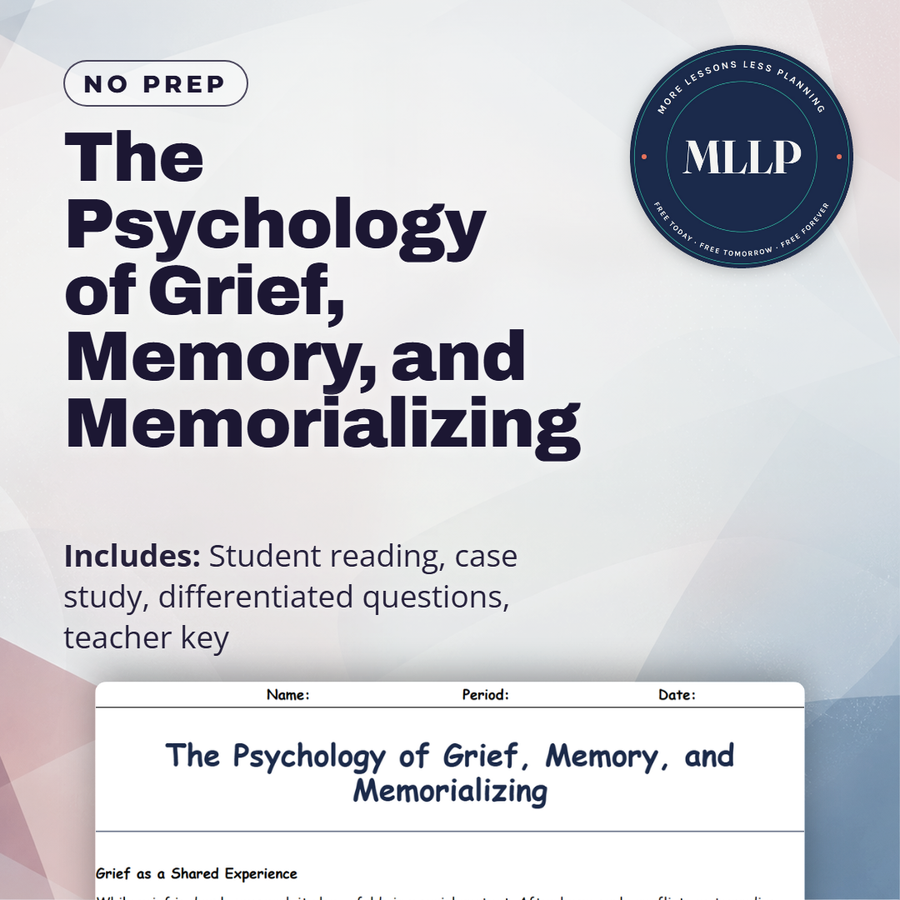
The Psychology of Grief, Memory, and Memorializing
Quality reviewed September 2026
Facts verified September 9, 2026
- Subject
- Social Studies
- Grades
- Grades 9-12
- Length
- 6-page student worksheet
- Time
- About one 50-minute class period
- Great for
- Sub plans and independent work
- Includes
- Reading passage, comprehension questions + full answer key
- Format
- Print-and-go PDF
What students do
- Analyze emotion-focused and problem-focused coping strategies in mourning
- Explain how repetition and ritual strengthen shared memory across generations
- Evaluate inclusive practices that ensure all communities feel represented
- Trace the healing impact of The Wall That Heals traveling memorial tour
What it covers
- Collective grief and shared mourning rituals
- Memory consolidation through symbols and ceremonies
- Adaptive memorial practices and community resilience
Start reading this worksheet
Grief as a Shared Experience
While grief is deeply personal, it also unfolds in a social context. After large-scale conflicts or tragedies, individuals seek comfort not only in private mourning but in collective rituals: funerals, memorial services, and public commemorations. Psychologists distinguish between individual grief, marked by emotional pain and introspection, and collective grief, where communities honor loss together, reinforcing social bonds. Memorial Day ceremonies (placing wreaths, lowering flags, and observing moments of silence) offer structured outlets for sorrow, validating personal feelings and fostering unity. Research shows that communal rituals can accelerate healing by promoting emotional expression, reducing isolation, and providing a sense of shared purpose.
Collective Memory and Rituals
The concept of collective memory examines how societies remember and reinterpret past events, transmitting meaning across generations. Memorial rituals serve as mnemonic devices, embedding historical narratives in symbols and practices. The reading of names at memorial walls, the playing of Taps, or the scattering of poppies all reinforce remembrance in visceral ways. Cognitive studies reveal that repetition strengthens memory consolidation, ensuring that the significance of sacrifice endures even as eyewitnesses fade. The physical spaces, including cemeteries, monuments, and living history museums, act as memory anchors, tying abstract concepts to tangible locations.
Psychological Coping Mechanisms
Grief coping strategies generally fall into two categories: emotion-focused and problem-focused. Emotion-focused methods, such as journaling, artistic expression, and meditation, help individuals process intense feelings. Problem-focused approaches, such as volunteering with veteran support groups or organizing remembrance events, channel grief into purposeful action. A study of Vietnam veterans’ families found that those who combined both approaches reported lower levels of complicated grief and depression. Memorial Day activities often mirror this duality: laying flowers (emotion-focused) and participating in community service (problem-focused) each contribute to healthier long-term outcomes.
Like what you read? The full reading, the case study, and every question set are in the free download below, along with the answer key.
Why this matters
Evelyn Peterson waits two hours to find her brother's name on a traveling wall, then sets one poppy at its base while volunteers run grief circles nearby. That scene is the reading in miniature: private mourning turning shared and visible as the memorial moves through sixty towns.
My students already know the vocabulary of coping without realizing it, so naming emotion-focused and problem-focused strategies gives language to what they have watched relatives do at funerals. The harder question comes last: who gets included in a community memorial, and who gets left out.
From one teacher to another
Evelyn Peterson waits two hours to find her brother's name on The Wall That Heals, then places a poppy at the base while volunteers run grief circles a few yards away. The case study follows the traveling Vietnam memorial through sixty towns and shows how private mourning becomes a shared, visible thing. The reading pairs that with the coping vocabulary my psychology students need, emotion-focused and problem-focused strategies, and asks why repeating a ritual every year strengthens memory across generations. The last questions push on who gets included in a community memorial and who gets left out.
What you get
Download
Where should I send the next one?
Everything here is free and it stays that way. Leave your email and I'll send you the new lessons as they go up. You can unsubscribe from any one of them.
Related resources
Memorial Day and Environmental Impact: Waste, Travel, and Outdoor Recreation
Memorial Day: Honoring Sacrifice and Remembering History
Memorial Landscapes: How Weather, Erosion, and Time Shape War Memorials
The Biology of Healing: How the Body Repairs After Injury
The Forensics of War: Identifying the Fallen
The Science of Combat Injuries: How the Body Responds to Trauma
Every lesson on this site is free to download and use. If one of them saved you a prep period, you can chip in a few bucks toward my three kids' daycare fund. That's genuinely where tips go.