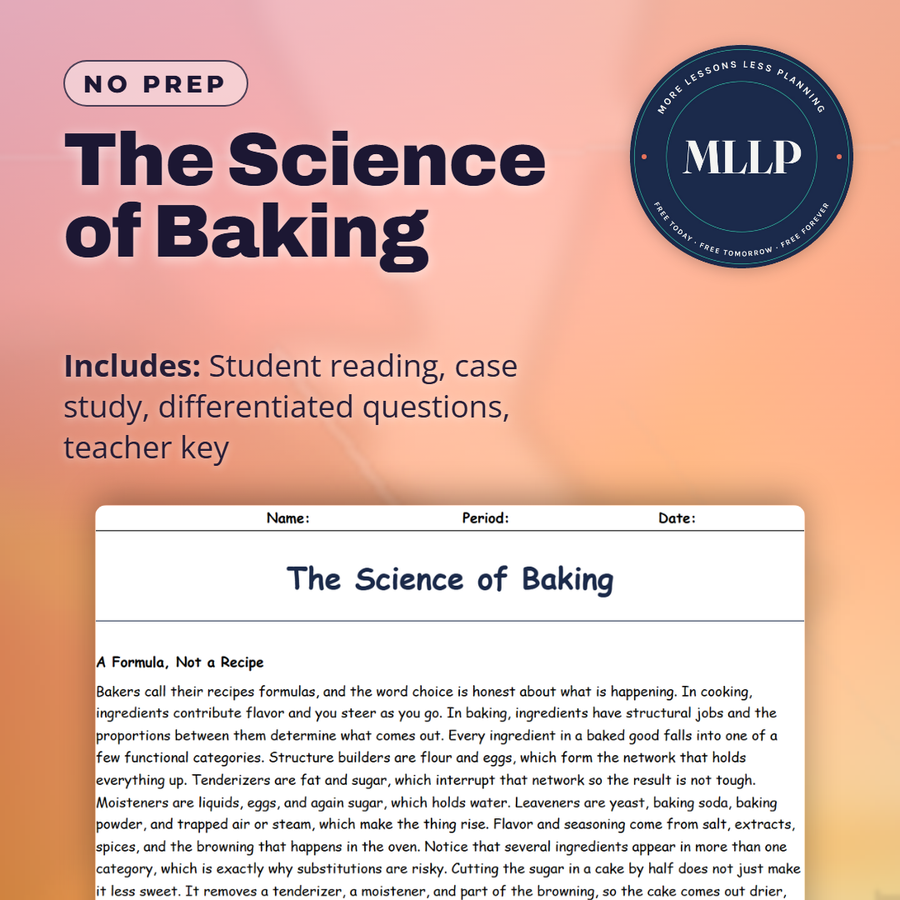
The Science of Baking
Quality reviewed September 2026
Facts verified September 23, 2026
- Subject
- Career & Life Skills
- Grades
- Grades 9-12
- Length
- 9-page student worksheet
- Time
- About one 50-minute class period
- Great for
- Sub plans and independent work
- Includes
- Reading passage, comprehension questions + full answer key
- Format
- Print-and-go PDF
What students do
- Every ingredient in a formula does a structural job, from flour building gluten to sugar holding onto water
- Match gluten, baking soda, shortening, oven spring, and gelatinization to the definition each one earns
- Whitney mixes her muffin batter until it turns smooth and glossy, and the tunnels inside tell her exactly what that extra mixing built
- Explain why opening the oven door early risks collapsing a cake before the structure has set
What it covers
- Why bakers call recipes formulas, and what structure, tenderizer, moistener, and leavener each mean
- The three ways a bubble actually forms in a batter or dough, biological, chemical, and mechanical
- What happens inside the oven in order, from oven spring through gelatinization to a browned crust
Start reading this worksheet
A Formula, Not a Recipe
Bakers call their recipes formulas, and the word choice is honest about what is happening. In cooking, ingredients contribute flavor and you steer as you go. In baking, ingredients have structural jobs and the proportions between them determine what comes out. Every ingredient in a baked good falls into one of a few functional categories. Structure builders are flour and eggs, which form the network that holds everything up. Tenderizers are fat and sugar, which interrupt that network so the result is not tough. Moisteners are liquids, eggs, and again sugar, which holds water. Leaveners are yeast, baking soda, baking powder, and trapped air or steam, which make the thing rise. Flavor and seasoning come from salt, extracts, spices, and the browning that happens in the oven. Notice that several ingredients appear in more than one category, which is exactly why substitutions are risky. Cutting the sugar in a cake by half does not just make it less sweet. It removes a tenderizer, a moistener, and part of the browning, so the cake comes out drier, tougher, and paler. Understanding the categories is what lets a baker predict a result instead of hoping for one, and it explains why baking rewards precision. Professional bakers push this idea further with baker's percentage, a system in which every ingredient is expressed as a percentage of the flour weight and flour is always one hundred percent. Written that way a formula scales to any batch size with no fractions at all, and the ratios between ingredients stay visible at a glance.
Gluten Is the Skeleton
Wheat flour contains two proteins, glutenin and gliadin, that do nothing interesting on their own. Add water and work the mixture, and they link into long elastic strands called gluten. Gluten is the skeleton of almost everything made from wheat. It traps the gas that leaveners produce, and it gives bread its chew and its ability to hold a shape. How much gluten develops is controlled by three things: the protein content of the flour, the amount of water, and how much the dough is worked. Bread flour has the most protein, around twelve to fourteen percent, so it builds strong gluten for chewy, structured loaves. All-purpose sits in the middle. Cake flour is lowest, around seven to nine percent, which is why cakes made with it come out tender rather than chewy. This is also the reason muffin and pancake batters are stirred only until the dry ingredients disappear and are supposed to look lumpy. Every extra stir develops more gluten, and a smooth, well-mixed muffin batter bakes into something tough with long tunnels running through it. Bread wants the opposite treatment: kneading for eight to ten minutes deliberately builds the gluten network that will trap carbon dioxide during the rise. Resting does some of the work that mixing would. Letting a batter sit a few minutes lets the flour fully absorb its liquid, and letting a bread dough rest before kneading, a step called autolyse, develops gluten with no effort at all. Time can substitute for mixing, and unlike mixing it can never overwork the dough.
Three Ways to Make a Bubble
Leavening is the production of gas inside a batter or dough, and there are only three mechanisms. Biological leavening is yeast, a living organism that eats sugars and releases carbon dioxide and alcohol. It is slow, taking hours, and it produces flavor as a byproduct, which is why bread tastes like more than flour and water. Chemical leavening is baking soda and baking powder, which produce carbon dioxide through an acid-base reaction and work in minutes. Baking soda is a pure base and requires an acidic ingredient in the recipe to react with, such as buttermilk, yogurt, brown sugar, honey, or cocoa. Baking powder already contains its own acid in dry form, so it needs only moisture and heat, and most modern baking powder is double acting, releasing some gas when it gets wet and the rest when it gets hot. Substituting one for the other without adjusting the acid produces either a flat result or a soapy, metallic taste from unreacted soda. Mechanical leavening is physical: air beaten into creamed butter and sugar or into egg whites, and steam generated from the water in the batter. Steam is the primary leavener in popovers, cream puffs, and puff pastry, where the lift comes from water turning to vapor and forcing layers apart. Yeast is the one leavener with a comfort range. It works best between roughly 75 and 85 degrees Fahrenheit, slows down when cold, and dies above about 140. That single fact explains why dough rises faster in a warm kitchen, why an overnight rise in the refrigerator builds more flavor, and why liquid that is too hot kills a batch outright.
Like what you read? The full reading, the case study, and every question set are in the free download below, along with the answer key.
Why this matters
A cake that sinks or a muffin that comes out chewy instead of tender usually has a specific, findable cause once a student knows what gluten and leavening are actually doing, rather than a vague sense that baking is just harder than cooking. This reading turns baking from something that either works or does not into something a student can actually diagnose, which is the difference between giving up on a recipe and fixing it the next time.
From one teacher to another
Bakers call their recipes formulas, and the reading takes that word seriously, sorting every ingredient into a job, structure, tenderizer, moistener, leavener, or flavor, and showing why cutting one ingredient changes more than a single trait. It spends a full passage on gluten, the elastic network flour builds when it meets water and gets worked, and why bread wants that network strong while a muffin batter is stirred only until the dry streaks disappear. From there it covers the three ways a bubble forms, yeast, chemical leaveners, and mechanical air or steam, and walks through what actually happens once a pan goes into the oven, in order, from the first fast rise to a browned crust. Whitney's case study is a batch of muffins mixed two extra minutes past lumpy, and the tunnels running through the crumb show exactly what that mixing built. I give this reading out before the first baking unit, so the vocabulary is already sitting there when something rises or falls.
What you get
Download
Where should I send the next one?
Everything here is free and it stays that way. Leave your email and I'll send you the new lessons as they go up. You can unsubscribe from any one of them.
Related resources
Cooking Methods: Dry Heat vs. Moist Heat
Herbs, Spices, and Building Flavor
How to Read and Follow a Recipe
Kitchen Tools and Equipment
Knife Skills and the Basic Cuts
Measuring Techniques: Dry, Liquid, and Weight
Every lesson on this site is free to download and use. If one of them saved you a prep period, you can chip in a few bucks toward my three kids' daycare fund. That's genuinely where tips go.