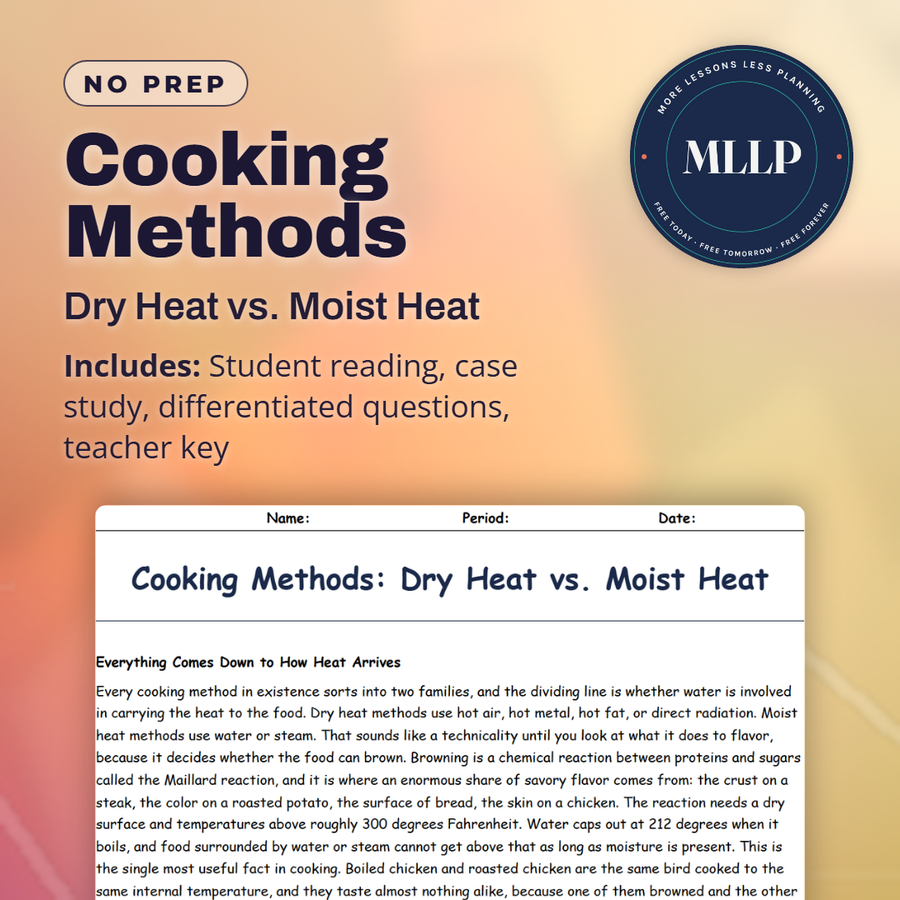
Cooking Methods: Dry Heat vs. Moist Heat
Quality reviewed September 2026
Facts verified September 23, 2026
- Subject
- Career & Life Skills
- Grades
- Grades 9-12
- Length
- 8-page student worksheet
- Time
- About one 50-minute class period
- Great for
- Sub plans and independent work
- Includes
- Reading passage, comprehension questions + full answer key
- Format
- Print-and-go PDF
What students do
- The five passages trace why browning only happens above 300 degrees, and why water blocks it every time
- Match Maillard reaction, collagen, braising, and poaching to what each one actually does to food
- Jordan's two identical chuck roasts split into a fast roast and a three-hour braise, and only one turns tender
- Explain what a sear contributes to a braise that the long simmer by itself cannot
What it covers
- Why moist heat methods cap out near 212 degrees and can never brown a surface
- How collagen in tough cuts like chuck breaks down into gelatin under long, low heat
- The reasoning behind searing before braising instead of skipping straight to the liquid
Start reading this worksheet
Everything Comes Down to How Heat Arrives
Every cooking method in existence sorts into two families, and the dividing line is whether water is involved in carrying the heat to the food. Dry heat methods use hot air, hot metal, hot fat, or direct radiation. Moist heat methods use water or steam. That sounds like a technicality until you look at what it does to flavor, because it decides whether the food can brown. Browning is a chemical reaction between proteins and sugars called the Maillard reaction, and it is where an enormous share of savory flavor comes from: the crust on a steak, the color on a roasted potato, the surface of bread, the skin on a chicken. The reaction needs a dry surface and temperatures above roughly 300 degrees Fahrenheit. Water caps out at 212 degrees when it boils, and food surrounded by water or steam cannot get above that as long as moisture is present. This is the single most useful fact in cooking. Boiled chicken and roasted chicken are the same bird cooked to the same internal temperature, and they taste almost nothing alike, because one of them browned and the other could not. Choosing a method is choosing whether the dish gets that layer of flavor, and no amount of seasoning added later substitutes for it. It is worth separating browning into its two chemistries, since recipes use the words loosely. The Maillard reaction involves proteins and sugars together and produces the savory, roasted flavors of seared meat and bread crust. Caramelization is sugar browning on its own, which is what happens to onions cooked slowly and to the top of a creme brulee.
The Dry Heat Family
Dry heat methods differ mostly in how the heat reaches the surface and how much fat is present. Sauteing cooks small pieces quickly in a small amount of fat over relatively high heat, with the food moving in the pan. Searing is related but sits still: a piece of meat goes into a hot pan and is left alone until a crust forms, because moving it interrupts the browning. Pan frying uses more fat, enough to come partway up the food, and deep frying submerges it completely, usually between 350 and 375 degrees. Frying is technically dry heat even though the food is in liquid, because oil is not water and can exceed 212 degrees easily. Roasting and baking are the same process of cooking with hot air in an oven, with roasting the word usually used for meats and vegetables and baking for breads and pastries. Broiling puts the heat source directly above the food and grilling puts it directly below, both cooking fast by radiation at very high temperatures. What ties the family together is that surfaces dry out and brown, which is why dry heat suits foods that are already tender: a steak, a chicken breast, a fish fillet, a sheet of vegetables. These foods do not need time, they need color. One rule governs the entire family: the surface has to be dry before it meets the heat. Meat coming out of a package is wet, and that surface moisture has to boil off before any browning can begin, which costs both time and pan temperature. Patting food dry with a paper towel is a thirty-second step that changes the result.
The Moist Heat Family
Moist heat methods are separated mostly by temperature, and the differences are larger than they sound. Boiling holds water at a full 212 degrees with rolling bubbles, which is aggressive: it is right for pasta and for hardy vegetables, and wrong for almost anything delicate, because the turbulence tears food apart. Simmering holds water just below boiling, roughly 185 to 205 degrees, with small bubbles rising occasionally, and it is the correct setting for most soups, stocks, and stews. Poaching is gentler still, around 160 to 180 degrees with barely any movement at all, and it is how eggs, fish, and chicken breast are cooked when the goal is a tender, moist result with no browning. Steaming suspends food above boiling water so only the vapor touches it, which cooks vegetables quickly while keeping more of the water-soluble vitamins that boiling would leach out into the water and pour down the drain. Because no moist heat method browns, dishes built on them get their flavor from the liquid instead, which is why stocks, aromatics, herbs, and salt matter so much here. The liquid is not a cooking medium that gets discarded. In most moist heat dishes the liquid becomes part of what is served. Two related techniques belong here. Blanching drops a vegetable into boiling water briefly to set its color and partly cook it, and shocking follows immediately by plunging it into ice water to stop the cooking cold. Together they are how green vegetables reach a plate bright green instead of a dull olive drab.
Like what you read? The full reading, the case study, and every question set are in the free download below, along with the answer key.
Why this matters
A student who understands this table stops wasting a good piece of meat and stops babying a cheap one. The cut a family can actually afford, shoulder, shank, chuck, is exactly the cut that needs the long, moist method this reading explains, while a quick weeknight piece of chicken or fish wants the opposite. That is a real grocery decision, not a classroom abstraction, and it is the kind of judgment that keeps dinner from turning out chewy or dry for a reason nobody in the room can name.
From one teacher to another
Every cooking method sorts into two families, and the split comes down to whether water carries the heat. Dry heat, in a hot pan or oven, dries the surface enough to brown it, while moist heat caps out near 212 degrees and never gets there no matter how long it runs. The reading walks through sauteing, searing, and roasting on one side, then simmering, poaching, and steaming on the other, before landing on braising, which uses both. Jordan's case study puts two identical chuck roasts through a fast roast and a slow braise, and the difference in texture explains why tough, collagen-rich cuts want time in liquid instead of a hot pan. I use this one right before we cook a braise ourselves, so students already know why the sear at the start matters.
What you get
Download
Where should I send the next one?
Everything here is free and it stays that way. Leave your email and I'll send you the new lessons as they go up. You can unsubscribe from any one of them.
Related resources
Herbs, Spices, and Building Flavor
How to Read and Follow a Recipe
Kitchen Tools and Equipment
Knife Skills and the Basic Cuts
Measuring Techniques: Dry, Liquid, and Weight
Mise en Place and Kitchen Workflow
Every lesson on this site is free to download and use. If one of them saved you a prep period, you can chip in a few bucks toward my three kids' daycare fund. That's genuinely where tips go.