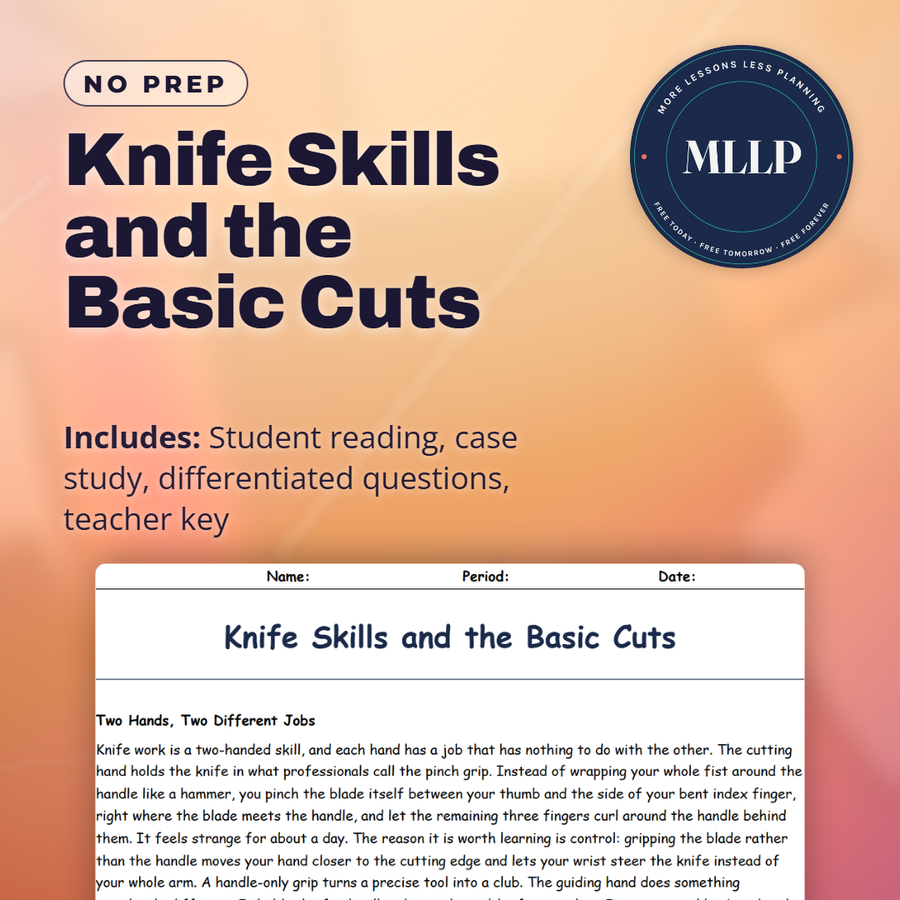
Knife Skills and the Basic Cuts
Quality reviewed September 2026
Facts verified September 23, 2026
- Subject
- Career & Life Skills
- Grades
- Grades 9-12
- Length
- 8-page student worksheet
- Time
- About one 50-minute class period
- Great for
- Sub plans and independent work
- Includes
- Reading passage, comprehension questions + full answer key
- Format
- Print-and-go PDF
What students do
- The pinch grip and the claw hand each do a separate job, one steering the blade and one setting slice width
- Write what happens to a pan of vegetables when the pieces on it are not cut to the same size
- Tyler rushes his potato cuts before a roast, and the pan comes out burned at the edges and raw in the middle
- Explain the difference between honing a knife every session and sharpening it every few months
What it covers
- Why a chef's knife rocks forward with the tip on the board instead of chopping straight down
- How julienne, brunoise, and the other named cuts are built from the same square off and stack method
- Why cutting every piece the same size is a cooking-time decision, not a plating preference
Start reading this worksheet
Two Hands, Two Different Jobs
Knife work is a two-handed skill, and each hand has a job that has nothing to do with the other. The cutting hand holds the knife in what professionals call the pinch grip. Instead of wrapping your whole fist around the handle like a hammer, you pinch the blade itself between your thumb and the side of your bent index finger, right where the blade meets the handle, and let the remaining three fingers curl around the handle behind them. It feels strange for about a day. The reason it is worth learning is control: gripping the blade rather than the handle moves your hand closer to the cutting edge and lets your wrist steer the knife instead of your whole arm. A handle-only grip turns a precise tool into a club. The guiding hand does something completely different. It holds the food still and sets the width of every slice. Fingertips curl back under the knuckles into a claw, and the flat side of the blade rests against the wall those knuckles make, riding along it like a fence. The knife never has to think about where to cut, because the knuckles decide, and they move backward a few millimeters between cuts. Whatever gap the knuckles retreat is exactly the thickness of the next slice. Knife choice matters less than most people assume, with one exception: the knife has to fit the hand using it. A ten-inch chef's knife in a small hand is unwieldy, and an eight-inch blade handles nearly everything a student will ever cut. Weight and balance matter more than brand, and the only real test is holding it.
The Blade Rocks, It Does Not Chop
The most common beginner habit is lifting the knife completely off the board and bringing it down like an axe. It is slow, it is loud, it scatters food, and it is far less accurate than the alternative. A chef's knife has a curved belly for a reason. The tip stays in contact with the board while the heel of the blade lifts and falls, so the knife rocks forward through the food in an arc rather than dropping onto it. The blade is always touching the board, which means the knife never has to be re-aimed between cuts. For long vegetables there is a second motion worth learning, a forward slicing push where the blade moves down and away from you at the same time, which shears cleanly through fibrous items instead of crushing them. Speed is not the goal and never should be at first. Uniformity is the goal, and speed arrives on its own once the motion stops requiring thought. There is also housekeeping that makes the work possible: the board is stabilized with a damp towel underneath, the food is given a flat side to sit on before anything else happens, and cut pieces are cleared into a bowl rather than allowed to pile up under the blade. A crowded board forces bad angles. Board height belongs with the rest of the setup. A counter that is too high forces the elbow up and the wrist to bend, which costs both accuracy and endurance over a long prep session. Professional cooks compensate by standing differently, and students in a lab can usually find a lower surface to work on.
Why Every Piece Should Be the Same Size
The reason chefs obsess over uniform cuts is not that a plate of identical cubes looks impressive, although it does. It is that food cooks from the outside in, and the time it takes to cook through is set by the thickness of the piece. Put a half-inch cube of potato and a quarter-inch cube in the same pan and they finish at different moments. There is no heat setting that fixes that. By the time the large ones are tender, the small ones have gone to mush or burned, and the dish contains both problems at once. Every uneven pan of roasted vegetables that came out simultaneously raw and scorched is a knife problem being blamed on an oven. Uniformity also controls texture in the mouth and speed on the line. A soup where every dice is the same size gives the same bite each time. A mirepoix, the standard mix of onion, carrot, and celery that starts an enormous number of soups and sauces, is cut to a size chosen to match how long the dish will cook: large rough cuts for a stock that simmers for hours, fine dice for a sauce that has twenty minutes. The cut is not decoration. It is a cooking-time decision made in advance with a blade. Uniformity also makes a cook faster in a way that is easy to miss. When every piece is the same, you stop making a separate decision about each one and the hand settles into a rhythm. Most of the speed that looks impressive in a professional kitchen is the absence of hesitation rather than raw hand quickness.
Like what you read? The full reading, the case study, and every question set are in the free download below, along with the answer key.
Why this matters
A pan of vegetables that comes out burned on the outside and raw in the middle is almost never an oven problem, and this reading gives students the actual reason, since food cooks from the outside in and uneven pieces finish at different moments no matter the heat setting. That is a fact a student carries straight into their own kitchen the next time dinner comes out wrong in two directions at once, instead of blaming the stove for what the knife actually decided.
From one teacher to another
Knife work is a two-handed job, and the reading spends its first passage on what each hand is actually doing, the cutting hand pinches the blade for control, while the guiding hand curls into a claw that sets the width of every slice. From there it moves through the rocking motion that keeps a chef's knife tip on the board, the named cuts like julienne and brunoise that come from squaring off a vegetable and cutting it down in stages, and the difference between honing an edge and actually sharpening one. Tyler's case study is a tray of roasted potatoes cut fast and unevenly, some pieces burned before others finished cooking through. I hand this one out before the first real knife lab, since the vocabulary here is what lets me give quick instructions once blades are out.
What you get
Download
Where should I send the next one?
Everything here is free and it stays that way. Leave your email and I'll send you the new lessons as they go up. You can unsubscribe from any one of them.
Related resources
Cooking Methods: Dry Heat vs. Moist Heat
Herbs, Spices, and Building Flavor
How to Read and Follow a Recipe
Kitchen Tools and Equipment
Measuring Techniques: Dry, Liquid, and Weight
Mise en Place and Kitchen Workflow
Every lesson on this site is free to download and use. If one of them saved you a prep period, you can chip in a few bucks toward my three kids' daycare fund. That's genuinely where tips go.