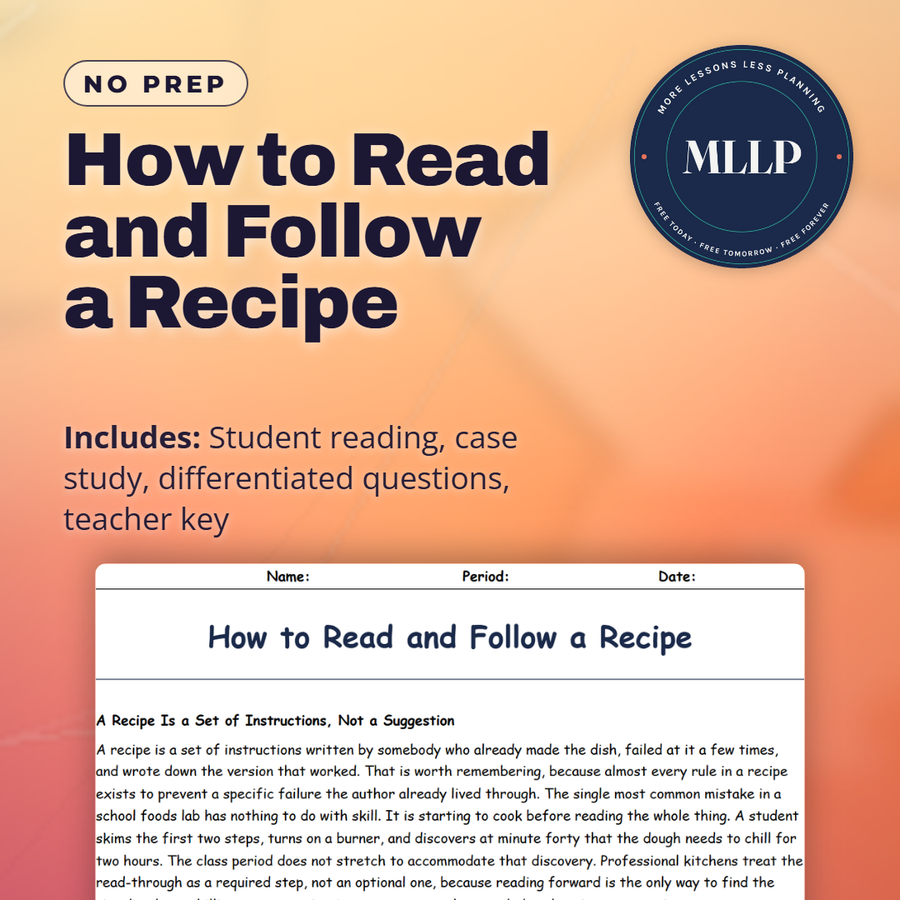
How to Read and Follow a Recipe
Quality reviewed September 2026
Facts verified September 23, 2026
- Subject
- Career & Life Skills
- Grades
- Grades 9-12
- Length
- 8-page student worksheet
- Time
- About one 50-minute class period
- Great for
- Sub plans and independent work
- Includes
- Reading passage, comprehension questions + full answer key
- Format
- Print-and-go PDF
What students do
- A recipe's ingredient order and its commas both carry real instructions, and the reading shows how a missed comma changes an amount
- Trace why active time and total time on the same recipe card can be hours apart
- Marisol creams her butter and sugar with nineteen minutes gone before she finds the two-hour chill buried in step six
- Compare what fold, cream, sear, and simmer each actually ask a cook to do with their hands
What it covers
- Why reading a recipe twice before starting catches waiting steps and missing tools early
- How a comma changes what gets measured, as in walnuts chopped versus chopped walnuts
- The difference between a printed cook time and the sensory cue that actually signals doneness
Start reading this worksheet
A Recipe Is a Set of Instructions, Not a Suggestion
A recipe is a set of instructions written by somebody who already made the dish, failed at it a few times, and wrote down the version that worked. That is worth remembering, because almost every rule in a recipe exists to prevent a specific failure the author already lived through. The single most common mistake in a school foods lab has nothing to do with skill. It is starting to cook before reading the whole thing. A student skims the first two steps, turns on a burner, and discovers at minute forty that the dough needs to chill for two hours. The class period does not stretch to accommodate that discovery. Professional kitchens treat the read-through as a required step, not an optional one, because reading forward is the only way to find the time bombs: a chilling step, a marinating step, an oven that needed preheating twenty minutes ago, or a pan size nobody has. Reading the whole recipe first also tells you whether you actually have the ingredients, which is a much better thing to learn while standing at the pantry than while standing over a half-mixed bowl. The habit is simple. Read it once for the shape of the dish. Read it a second time with a pencil, marking every step that involves waiting, and every tool you do not already have on the counter. Two minutes of reading routinely saves a class period. There is one more reason the read-through matters in a school lab specifically. Recipes are written for home kitchens with a full pantry and no bell, so a recipe that quietly assumes softened butter or a rested dough is assuming time a class period does not have. Reading forward is how you catch that assumption while you can still choose a different recipe.
Yield and Time Are Where People Get Fooled
Every well-written recipe declares its yield, which is how much finished food it produces, stated either as a count or a volume. A yield of twenty-four cookies and a yield of one nine-inch pie are both useful, but they are not interchangeable information. Yield matters because it is the number you scale from. If a recipe yields four servings and you need ten, you are not guessing, you are multiplying, and you cannot multiply without knowing the starting point. Yield also tells you whether the pan on your counter is the right pan. A batter that yields one nine-by-thirteen pan will overflow an eight-inch square, and the failure happens in the oven where you cannot fix it. Time is the other number people misread, because recipes usually print two of them. Active time, sometimes called prep time or hands-on time, is how long you are actually working. Total time includes everything you spend waiting: chilling, rising, marinating, roasting, cooling. A recipe can honestly say fifteen minutes of active time and still take three hours from start to finish. Students who plan around the small number are the ones who get caught. In a fifty-minute lab, total time is the only number that decides whether the dish is possible today, and reading it is the difference between serving food and cleaning up an unfinished project. There is one more number worth finding before you start, and it is the pan size, which is usually buried in the middle of a step rather than printed at the top. A recipe that says pour into a prepared nine-by-thirteen pan has just told you something you needed to know fifteen minutes earlier.
The Ingredient List Is Written in Order for a Reason
Ingredients are conventionally listed in the order they are used, which turns the list into a rough preview of the procedure before you read a single step. That ordering is a courtesy, and it is also a checking tool. If you have measured your way down the list and there is an ingredient left over that never got called for, you missed a step. Far more consequential than the order is the punctuation, because a comma changes what you measure. The phrase one cup walnuts, chopped means measure one cup of whole walnuts and then chop them. The phrase one cup chopped walnuts means chop first, then measure one cup of the chopped pieces. Those are genuinely different amounts, because chopped nuts settle and pack into a cup far more densely than whole halves do. The same rule governs one cup sifted flour versus one cup flour, sifted, and the difference there can be twenty percent of the flour in a cake. Read the modifier and read which side of the comma it sits on. Recipes also specify the form and temperature of ingredients for real reasons: room-temperature butter creams and traps air, cold butter makes flaky layers, and melted butter does neither. When a recipe specifies a state, that state is doing a job. One more convention is worth knowing. The word divided appears after an ingredient that gets used in more than one step, as in one cup sugar, divided. It is a warning not to add the whole amount at once, and missing it is how a streusel topping ends up mixed into the batter instead of sitting on top of it.
Like what you read? The full reading, the case study, and every question set are in the free download below, along with the answer key.
Why this matters
Every student in this room is going to follow a set of instructions again long after the unit ends, whether it is a recipe, a lease, or a job application, and the habit this reading teaches is reading the whole thing before acting on the first line. The two-hour chill that sank Marisol's lab period is a small, low-stakes version of a mistake that costs a lot more outside a classroom, and catching it here is cheaper than catching it later.
From one teacher to another
A recipe is written by someone who already made the dish, failed at a version of it, and wrote down what fixed the failure, so most of its rules exist to stop a specific mistake. The reading walks through why a full read-through catches chilling steps and missing pans before they become a problem mid-lab, why yield is the number every scaling decision starts from, and why active time and total time on the same card can be hours apart. It spends real space on the ingredient list itself, since a comma placed before or after a word changes how much of an ingredient actually ends up in the bowl. Marisol's case study is a forty-eight minute lab period run headfirst into a two-hour chilling step nobody read past minute nineteen. I like this one early in the unit, before students start losing time to recipes they only skimmed.
What you get
Download
Where should I send the next one?
Everything here is free and it stays that way. Leave your email and I'll send you the new lessons as they go up. You can unsubscribe from any one of them.
Related resources
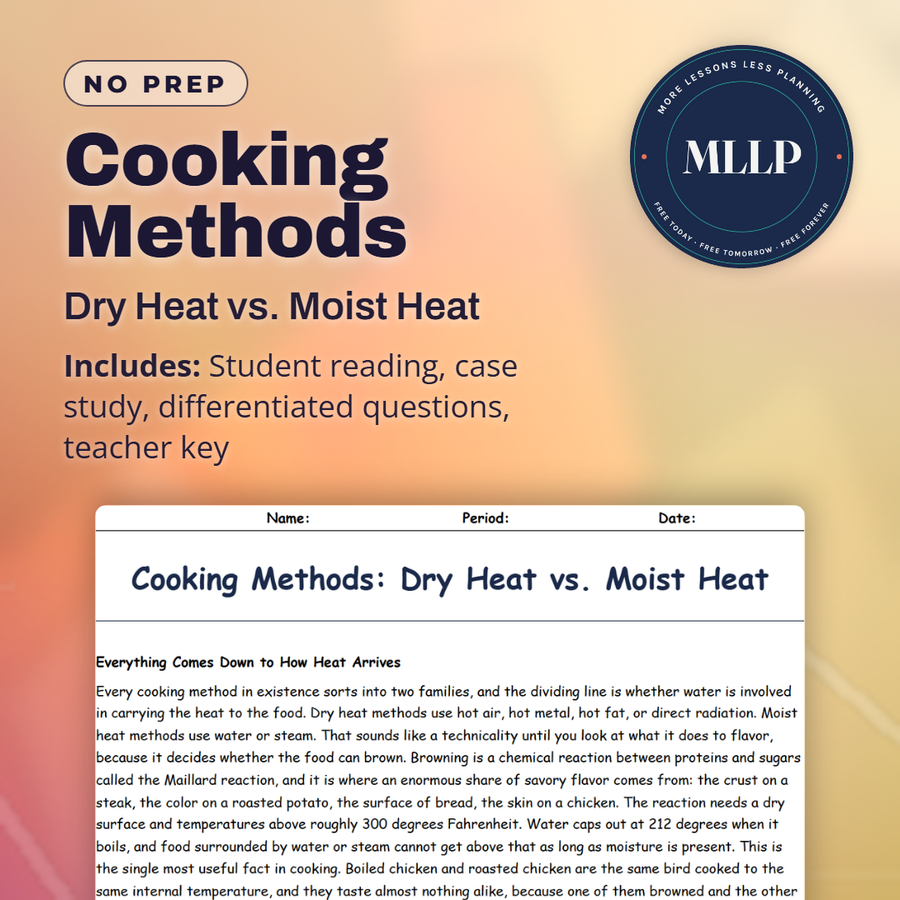
Cooking Methods: Dry Heat vs. Moist Heat
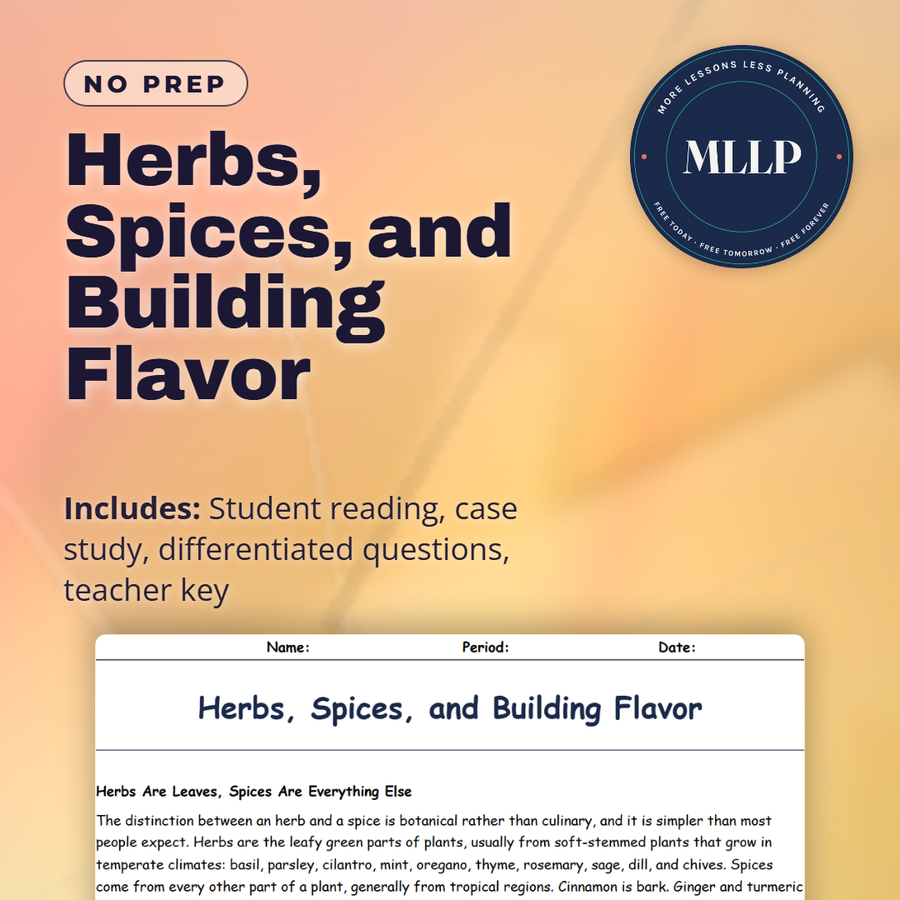
Herbs, Spices, and Building Flavor
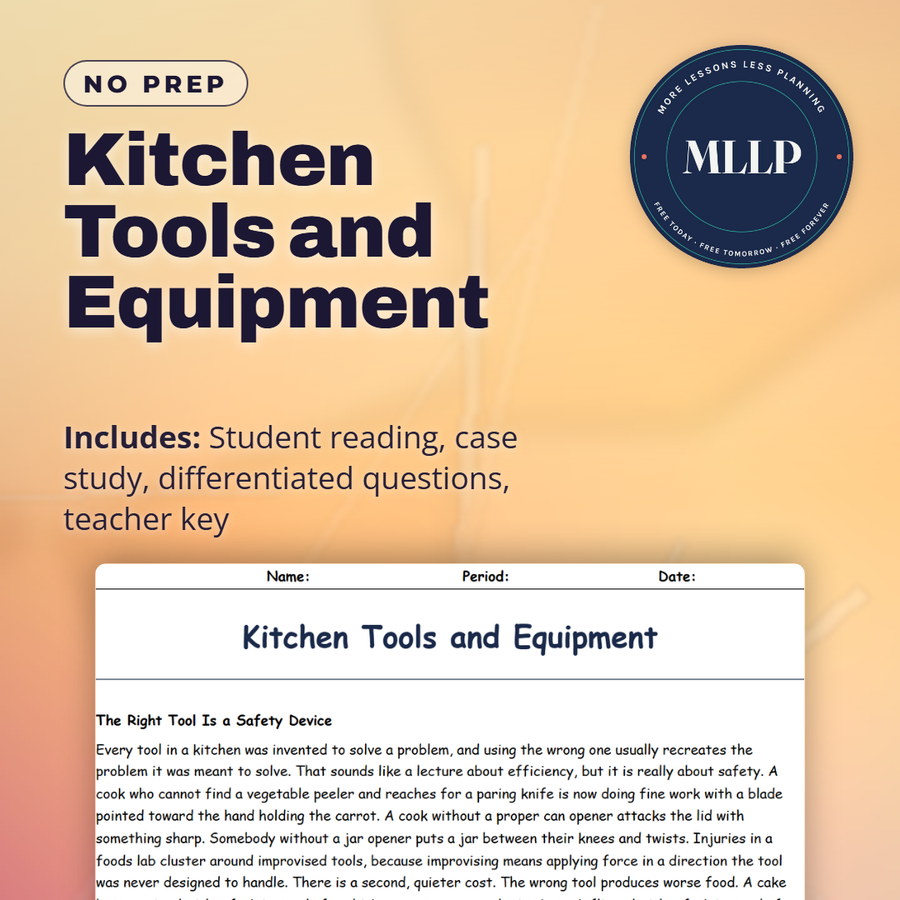
Kitchen Tools and Equipment
Knife Skills and the Basic Cuts
Measuring Techniques: Dry, Liquid, and Weight
Mise en Place and Kitchen Workflow
Every lesson on this site is free to download and use. If one of them saved you a prep period, you can chip in a few bucks toward my three kids' daycare fund. That's genuinely where tips go.