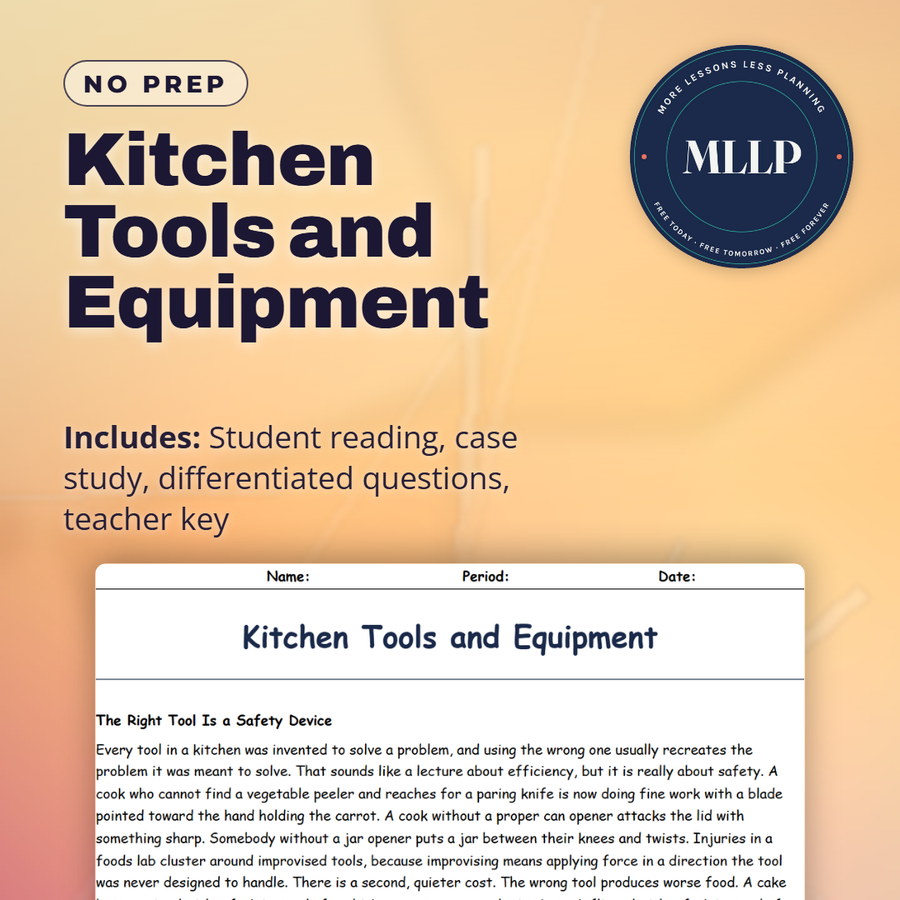
Kitchen Tools and Equipment
Quality reviewed September 2026
Facts verified September 23, 2026
- Subject
- Career & Life Skills
- Grades
- Grades 9-12
- Length
- 8-page student worksheet
- Time
- About one 50-minute class period
- Great for
- Sub plans and independent work
- Includes
- Reading passage, comprehension questions + full answer key
- Format
- Print-and-go PDF
What students do
- Chef's, paring, and serrated knives each solve a different cutting job, and the reading explains why swapping them creates a hazard
- Explain why glass and stone cutting boards destroy a knife's edge on contact
- Andre sears two steaks in a tall saucepan instead of a skillet, and the shape of the pan decides how they turn out
- Decide which pot or pan shape suits searing, simmering, or roasting based on how each traps or releases steam
What it covers
- Why the wrong tool in a kitchen is usually a safety problem before it is a quality problem
- How pan shape, tall and narrow versus wide and shallow, decides whether food browns or steams
- The care rules that keep cast iron, nonstick, and knives from being ruined or made dangerous
Start reading this worksheet
The Right Tool Is a Safety Device
Every tool in a kitchen was invented to solve a problem, and using the wrong one usually recreates the problem it was meant to solve. That sounds like a lecture about efficiency, but it is really about safety. A cook who cannot find a vegetable peeler and reaches for a paring knife is now doing fine work with a blade pointed toward the hand holding the carrot. A cook without a proper can opener attacks the lid with something sharp. Somebody without a jar opener puts a jar between their knees and twists. Injuries in a foods lab cluster around improvised tools, because improvising means applying force in a direction the tool was never designed to handle. There is a second, quieter cost. The wrong tool produces worse food. A cake batter mixed with a fork instead of a whisk never traps enough air. A steak flipped with a fork instead of tongs gets punctured, and the juice you were trying to keep inside runs out onto the pan. Tools are also the vocabulary of a kitchen, which matters the moment somebody else is giving instructions. When a teacher says hand me the offset spatula and three students hand over three different objects, the lab slows down. Knowing what things are called and what each one is actually for is genuinely part of learning to cook. None of this is an argument for owning more equipment. Most well-run kitchens are deliberately small in their tool count, because a drawer holding six tools you know beats a drawer holding thirty you have to dig through. The goal is knowing each tool well enough to reach for the right one without stopping to think.
The Cutting Tools You Actually Need
Most kitchens own far more knives than they use, and most cooking is done with three. The chef's knife, usually eight or ten inches, is the workhorse that handles roughly ninety percent of cutting: chopping, slicing, dicing, and mincing. Its curved belly is designed to rock against the board so the tip can stay in contact while the heel lifts. The paring knife is short, three or four inches, and is for work done in the hand or on small items, like hulling strawberries or peeling an apple. The serrated knife, with its toothed edge, saws through anything with a firm exterior and a soft interior, which means bread and tomatoes. Using a chef's knife on a crusty loaf compresses the loaf instead of cutting it. Beyond knives, the cutting board is equipment and not scenery. Wood and plastic boards are both acceptable, but glass and stone boards destroy a knife edge on contact and should never be used for cutting. A board that slides is a hazard, so a damp paper towel or a rubber mat goes underneath it. Kitchen shears handle the jobs a knife handles badly: snipping herbs, cutting parchment, breaking down poultry. Every one of these tools does its job better than the improvised alternative, and does it with the force pointed somewhere safe. One habit protects all of them. Knives are stored so nothing touches the edge, which means a block, a magnetic strip, or an in-drawer sheath rather than loose among other tools. An edge that bangs against a whisk every time a drawer opens will be dull long before it has done any real work.
Measuring, Mixing, and the Tools That Handle Heat
Measuring tools split into two families that are not interchangeable, a distinction covered in depth in the measuring reading but worth stating here. Dry measuring cups are sized to be filled to the rim and leveled off. Liquid measuring cups are clear, have a spout, and carry extra headspace above the top line so liquid can be carried without sloshing. Measuring spoons serve both. Mixing bowls should nest and should come in at least three sizes, and stainless steel is preferred in labs because it will not hold odors, will not stain, and will not crack when dropped. For combining, a whisk incorporates air into liquids and batters, a wooden spoon or silicone spatula stirs and scrapes, and a rubber spatula gets the last of a batter out of the bowl, which is the difference between twelve muffins and eleven. Heat tools have their own rules. Tongs are an extension of your hand for turning and lifting without piercing. A fish spatula, thin and flexible and slotted, slides under delicate items that a thick spatula would tear. Oven mitts must be dry, because a wet mitt conducts heat straight through and creates a steam burn. A colander drains, a fine-mesh sieve strains and sifts, and a thermometer is the only tool in the kitchen that reports a fact instead of an impression. Two more tools belong on any serious list. A digital scale settles the whole measuring-cup argument by weighing ingredients directly, and a timer removes the assumption that anyone can track four things by memory. Both are inexpensive, and both prevent the specific failures that ruin the most food in a school lab.
Like what you read? The full reading, the case study, and every question set are in the free download below, along with the answer key.
Why this matters
A kitchen full of the wrong tool for the job is where a surprising number of small injuries happen, a slip with a paring knife instead of a peeler, a jar twisted between the knees because nobody owns a jar opener. This reading is really about recognizing what a tool is actually for before reaching for whatever is closest, a habit that keeps a first apartment kitchen, borrowed or secondhand, from turning ordinary cooking into a string of near misses.
From one teacher to another
Every tool in a kitchen was built to solve one problem, and reaching for the wrong one usually recreates that problem with a sharper edge pointed somewhere unsafe. The reading covers the three knives that handle almost all cutting, the boards that ruin them on contact, and the difference a pan's shape makes once it hits the stove, since a saucepan's high sides trap steam that a skillet's low sides let escape. It also spends time on care, knives washed by hand instead of run through a dishwasher, cast iron dried and oiled, nonstick pans kept away from metal utensils. Andre finds out the hard way that a saucepan is not a skillet with taller sides, when his steaks come out gray and steamed instead of browned. I use this one before the first knife lab, so the vocabulary is already in place.
What you get
Download
Where should I send the next one?
Everything here is free and it stays that way. Leave your email and I'll send you the new lessons as they go up. You can unsubscribe from any one of them.
Related resources
Cooking Methods: Dry Heat vs. Moist Heat
Herbs, Spices, and Building Flavor
How to Read and Follow a Recipe
Knife Skills and the Basic Cuts
Measuring Techniques: Dry, Liquid, and Weight
Mise en Place and Kitchen Workflow
Every lesson on this site is free to download and use. If one of them saved you a prep period, you can chip in a few bucks toward my three kids' daycare fund. That's genuinely where tips go.