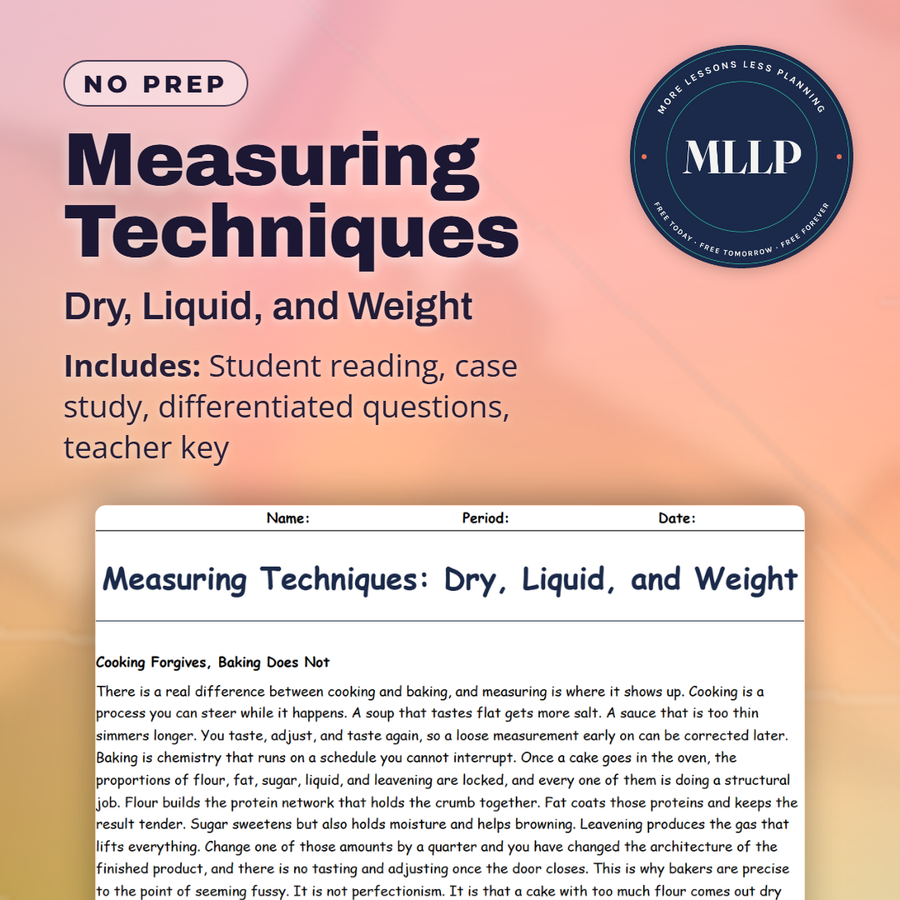
Measuring Techniques: Dry, Liquid, and Weight
Quality reviewed September 2026
Facts verified September 23, 2026
- Subject
- Career & Life Skills
- Grades
- Grades 9-12
- Length
- 8-page student worksheet
- Time
- About one 50-minute class period
- Great for
- Sub plans and independent work
- Includes
- Reading passage, comprehension questions + full answer key
- Format
- Print-and-go PDF
What students do
- Dry and liquid measuring cups are built differently because they get read differently, and swapping one for the other adds error every time
- Trace how scooping packed flour instead of spooning it in can add a quarter more than a recipe calls for
- Priya's class weighs two cups of flour measured two different ways, and one comes in almost a quarter heavier than the other
- Explain why weight is more reliable than volume for measuring flour
What it covers
- Why a dry measuring cup and a liquid measuring cup are not interchangeable tools
- The spoon and level method for flour, and how scooping instead can add a quarter more
- Why weight stays identical from kitchen to kitchen while a cup of flour never does
Start reading this worksheet
Cooking Forgives, Baking Does Not
There is a real difference between cooking and baking, and measuring is where it shows up. Cooking is a process you can steer while it happens. A soup that tastes flat gets more salt. A sauce that is too thin simmers longer. You taste, adjust, and taste again, so a loose measurement early on can be corrected later. Baking is chemistry that runs on a schedule you cannot interrupt. Once a cake goes in the oven, the proportions of flour, fat, sugar, liquid, and leavening are locked, and every one of them is doing a structural job. Flour builds the protein network that holds the crumb together. Fat coats those proteins and keeps the result tender. Sugar sweetens but also holds moisture and helps browning. Leavening produces the gas that lifts everything. Change one of those amounts by a quarter and you have changed the architecture of the finished product, and there is no tasting and adjusting once the door closes. This is why bakers are precise to the point of seeming fussy. It is not perfectionism. It is that a cake with too much flour comes out dry and tough, a cake with too little comes out sunken, and neither problem can be fixed after the fact. The measuring cup is doing more work in baking than any other tool on the counter. This is also why baking is the better teacher of the two. A soup hides a sloppy measurement inside a bowl of competing flavors, so the cook never learns what the error cost. A cake reports every error honestly in its texture, its height, and its crumb, which makes it the fastest feedback a beginning cook can get.
Dry Cups and Liquid Cups Are Not the Same Cup
A cup is a cup as a unit of volume, but the two tools are built differently because they are read differently, and swapping them introduces error every single time. Dry measuring cups come in a nested set and are designed to be filled past the rim and then leveled off with the flat back of a knife. There is no line to read, because the rim itself is the line. Liquid measuring cups are clear, usually glass or marked plastic, with a pour spout and printed graduations, and critically they include extra space above the highest line so a full cup can be carried without spilling. That headspace is exactly why you cannot accurately measure a liquid in a dry cup: filling a dry cup to the very brim means carrying a cup that is going to slosh, so people underfill it. Read a liquid measure at eye level on a flat surface, not held in the air, and read the bottom of the curved surface of the liquid, which is called the meniscus. Reading from above makes you overfill, and reading from below makes you underfill. Measuring spoons are the exception to the whole argument. They serve dry and liquid ingredients equally, because the volumes are small enough that the difference does not accumulate. Measuring spoons do have one rule of their own. They are leveled, not heaped. A heaping teaspoon of baking powder can be nearly double a level one, and leavening is the least forgiving ingredient in the kitchen about that kind of error. Level a spoon exactly as you level a cup, with a flat edge swept across the top.
The Right Way to Measure Flour
Flour is the ingredient that ruins the most baked goods, and the reason is that flour compresses. Sitting in a bag or canister, flour settles and packs. If you push a measuring cup down into that packed flour and scoop, you can collect twenty to twenty-five percent more flour than the recipe intended. In a batch of cookies that is the difference between chewy and dry, and in a cake it can be the difference between a tender crumb and something closer to bread. The correct method is called spoon and level. Stir or fluff the flour in its container first to loosen it. Spoon the loosened flour lightly into the dry measuring cup, letting it mound above the rim without packing it. Then sweep the flat back of a knife across the rim to level it off. Never tap or shake the cup to settle the flour, because settling is exactly what you are trying to avoid. Brown sugar is the deliberate exception and the reason recipes say firmly packed. Brown sugar is moist and clumpy, so it is pressed into the cup hard enough to hold the cup's shape when turned out. Sticky ingredients like honey, molasses, or shortening measure more cleanly if the cup is first coated with a thin film of oil or cooking spray. A related instruction is to sift, which is not about appearance. Powdered sugar, cocoa, and cake flour compact into clumps that will not disperse evenly through a batter, and an unsifted lump of cocoa stays a lump in the finished cake. Sift before measuring only when the recipe puts the word sifted first.
Like what you read? The full reading, the case study, and every question set are in the free download below, along with the answer key.
Why this matters
A cup of flour is not a fixed amount, it depends on who scooped it and how, and that single fact explains a lot of baking failures a student has probably already had at home without knowing why. Reading this once means the next batch of cookies that comes out dry and tough gets traced back to a scooping habit instead of blamed on a recipe that was never actually wrong.
From one teacher to another
Cooking forgives a loose measurement because a cook can taste and adjust as it goes, but baking locks its proportions the moment the pan goes into the oven, which is why this reading treats measuring as its own skill rather than a formality. It walks through why a dry cup gets filled above the rim and leveled while a liquid cup gets read at eye level from the bottom of its curve, why scooping packed flour can add a quarter more than spooning it in loosely, and why professional bakers weigh ingredients on a scale instead of trusting a cup at all. Priya's class runs the comparison directly, weighing two cups of flour measured two different ways and getting two different numbers from the same bag. The biscuits that come out of each batch tell the rest of the story without anyone needing to say much. I like handing this one out right before the first baking lab of the year.
What you get
Download
Where should I send the next one?
Everything here is free and it stays that way. Leave your email and I'll send you the new lessons as they go up. You can unsubscribe from any one of them.
Related resources
Cooking Methods: Dry Heat vs. Moist Heat
Herbs, Spices, and Building Flavor
How to Read and Follow a Recipe
Kitchen Tools and Equipment
Knife Skills and the Basic Cuts
Mise en Place and Kitchen Workflow
Every lesson on this site is free to download and use. If one of them saved you a prep period, you can chip in a few bucks toward my three kids' daycare fund. That's genuinely where tips go.