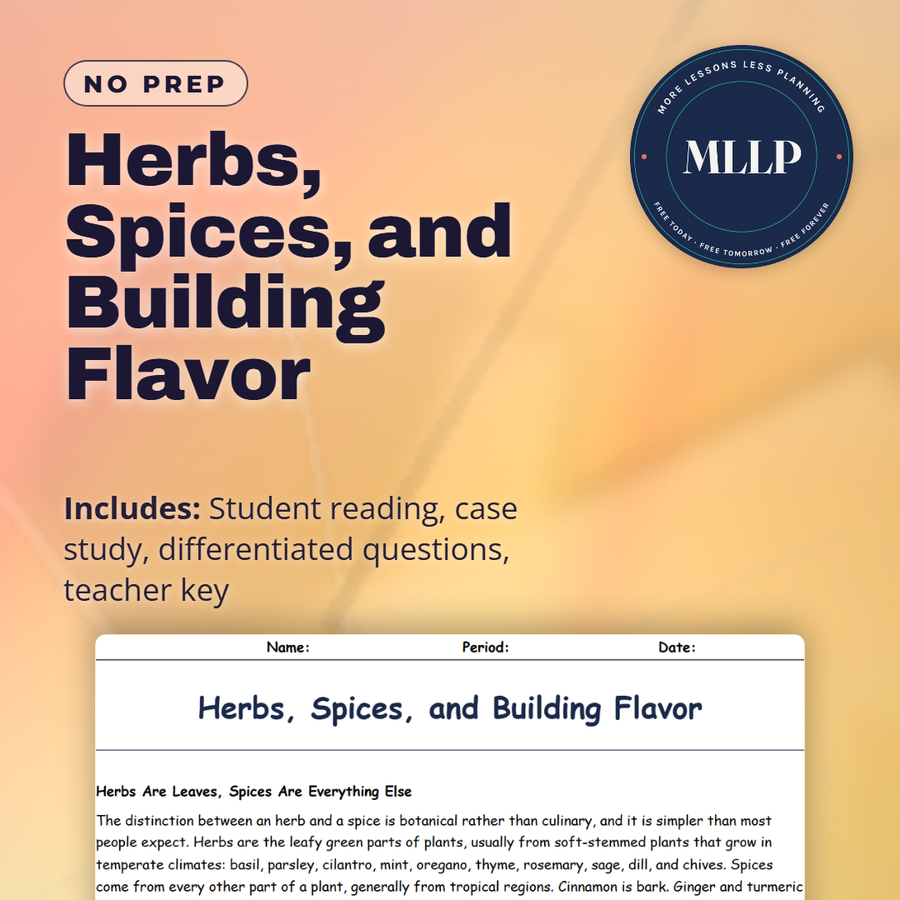
Herbs, Spices, and Building Flavor
Quality reviewed September 2026
Facts verified September 23, 2026
- Subject
- Career & Life Skills
- Grades
- Grades 9-12
- Length
- 9-page student worksheet
- Time
- About one 50-minute class period
- Great for
- Sub plans and independent work
- Includes
- Reading passage, comprehension questions + full answer key
- Format
- Print-and-go PDF
What students do
- Herbs and spices split by which part of the plant they come from, and the reading tracks how that changes when each goes into the pot
- Explain why a cook tastes and adjusts a sauce one element at a time instead of changing everything at once
- Alina's flat tomato sauce gets fixed by salt first and a squeeze of lemon second, not another spoonful of oregano
- Identify what toasting and blooming actually do to a spice sitting asleep in a jar
What it covers
- The difference between an herb and a spice, and why the two behave differently under heat
- Why dried herbs go into a dish early while fresh basil goes in at the very end
- A four-step tasting order for fixing a flat dish, salt first, then acid, then fat, then a touch of sweetness
Start reading this worksheet
Herbs Are Leaves, Spices Are Everything Else
The distinction between an herb and a spice is botanical rather than culinary, and it is simpler than most people expect. Herbs are the leafy green parts of plants, usually from soft-stemmed plants that grow in temperate climates: basil, parsley, cilantro, mint, oregano, thyme, rosemary, sage, dill, and chives. Spices come from every other part of a plant, generally from tropical regions. Cinnamon is bark. Ginger and turmeric are roots. Cumin, coriander, and mustard are seeds. Cloves are dried flower buds. Peppercorns are dried berries. Nutmeg is a seed and mace is the lacy covering around that same seed. A few plants provide both, which is where the confusion usually comes from: coriander seed is a spice and the leaves of the same plant are the herb cilantro, while dill weed is an herb and dill seed is a spice. The practical value of the distinction is that the two groups behave differently under heat. Leaves are delicate and their aromatic compounds are volatile, so they fade quickly. Seeds, barks, and roots are dense and hold their flavor through long cooking, which is why a stew can simmer for three hours with a cinnamon stick in it and still taste of cinnamon. Storage follows from the same logic. Dried herbs and ground spices keep best in sealed containers away from light and, importantly, away from the stove, since heat and steam are exactly what drive their aromatics off. The rack mounted above the range is the worst place in the kitchen for them, however convenient it looks.
Fresh, Dried, and the Question of When
Drying an herb removes water and concentrates what remains, so dried herbs are stronger by volume than fresh ones. The working conversion is roughly three to one: one tablespoon of a chopped fresh herb equals about one teaspoon of the same herb dried. Getting the direction of that ratio backward is a common and expensive mistake, since tripling dried oregano instead of dividing it will overwhelm a dish. Drying does not affect all herbs equally. Sturdy, resinous herbs such as oregano, thyme, rosemary, sage, and bay dry well and remain genuinely useful. Delicate, high-moisture herbs such as basil, cilantro, parsley, chives, and mint lose most of what makes them worth using, and dried parsley in particular contributes color and very little else. Timing follows directly from durability. Dried herbs and whole spices go in early, because they need time and moisture to rehydrate and release their flavor into the dish. Delicate fresh herbs go in at the very end or are scattered on top after the heat is off, because their aromatic compounds evaporate within minutes of hitting a hot pan. Hardy fresh herbs like rosemary and thyme sit in between and can be added partway through. How an herb is cut matters more than it sounds. Delicate herbs bruise when chopped with a dull blade, which turns basil dark and muddy within minutes, so they are cut with a sharp knife in as few strokes as possible. For basil and mint, tearing the leaves by hand is often better than chopping them at all.
Waking Up a Spice
Ground spices sitting in a jar are asleep, and there are two standard techniques for waking them. Toasting applies dry heat to whole spices in a pan over medium heat until they become fragrant, usually thirty to sixty seconds, at which point they are ground. Heat drives off residual moisture and triggers reactions that create new aromatic compounds, and the difference between toasted and untoasted cumin is not subtle. Blooming is the same idea using fat instead of dry heat: ground spices are stirred into hot oil or butter for fifteen to thirty seconds before the liquid ingredients arrive. This works because most aromatic compounds in spices are fat-soluble rather than water-soluble, so they dissolve into the oil and then distribute through the entire dish. A curry, chili, or tomato sauce where the spices were bloomed in oil tastes deeper and more unified than one where the same spices were stirred into the liquid at the end, which tends to taste dusty and raw. Both techniques have a narrow window, because the compounds that make spices taste good turn bitter when scorched. Thirty seconds is the target and ninety seconds is a ruined pan. Whole spices also keep far longer than ground ones, which lose potency within about six months to a year. Buying whole and grinding as needed is the single upgrade that changes the most. An inexpensive spice grinder or a mortar and pestle turns whole cumin, coriander, or peppercorns into something noticeably brighter than anything that has been sitting ground in a jar. It also lets a cook build blends deliberately instead of buying a premixed one.
Like what you read? The full reading, the case study, and every question set are in the free download below, along with the answer key.
Why this matters
Most teenage cooking happens off a phone screen, and the herbs and spices in this reading are the ones sitting in almost every kitchen cabinet already. Knowing that dried oregano is roughly three times stronger than fresh, or that a flat dish is usually under salted rather than under seasoned, changes what a student actually does the next time dinner tastes off at home. It also explains why a recipe someone found online never quite tastes like the video, since fresh herb amounts rarely translate cleanly to dried ones.
From one teacher to another
Herbs and spices split botanically, not by flavor, leaves on one side and every other plant part on the other, and that split decides how each behaves in a pot. A cinnamon stick can simmer in a stew for three hours and still taste like cinnamon, while fresh basil loses its aroma within minutes of hitting a hot pan. The reading covers toasting and blooming, the two ways cooks wake up a sleepy spice jar, and it ends with salt, which gets its own passage because it amplifies flavor rather than adding one. Alina's case study follows a flat tomato sauce she keeps dumping dried herbs into before her instructor asks a simpler question, how much salt is actually in it. I hand this one out before we build a sauce from scratch, so nobody reaches for the spice rack before the salt.
What you get
Download
Where should I send the next one?
Everything here is free and it stays that way. Leave your email and I'll send you the new lessons as they go up. You can unsubscribe from any one of them.
Related resources
Cooking Methods: Dry Heat vs. Moist Heat
How to Read and Follow a Recipe
Kitchen Tools and Equipment
Knife Skills and the Basic Cuts
Measuring Techniques: Dry, Liquid, and Weight
Mise en Place and Kitchen Workflow
Every lesson on this site is free to download and use. If one of them saved you a prep period, you can chip in a few bucks toward my three kids' daycare fund. That's genuinely where tips go.