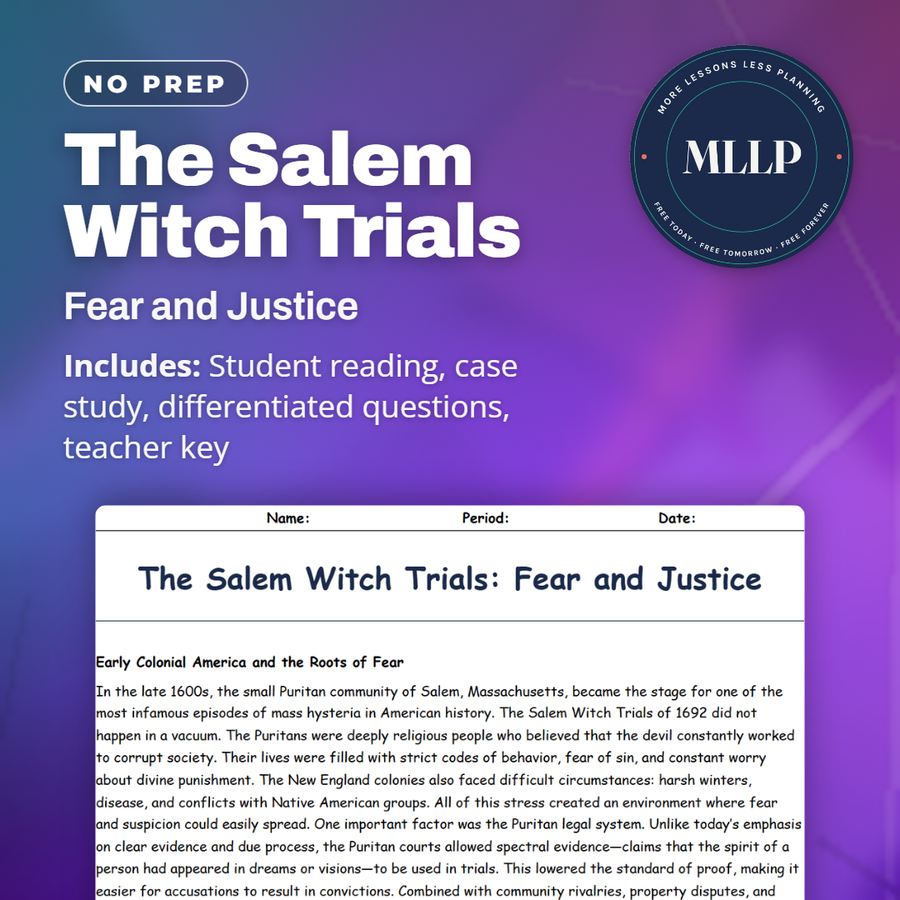
The Salem Witch Trials: Fear and Justice
Quality reviewed September 2026
Facts verified September 9, 2026
- Subject
- Social Studies
- Grades
- Grades 9-12
- Length
- 8-page student worksheet
- Time
- About one 50-minute class period
- Great for
- Sub plans and independent work
- Includes
- Reading passage, comprehension questions + full answer key
- Format
- Print-and-go PDF
What students do
- Analyze how spectral evidence lowered legal standards and enabled wrongful convictions
- Evaluate the role of mass hysteria and community tensions in the trials
- Trace the escalation from initial accusations to executions and legal reversals
- Compare Salem's justice system to modern protections for the accused
What it covers
- Spectral evidence and colonial courts
- Mass hysteria and fear in legal systems
- Civil liberties and the presumption of innocence
Start reading this worksheet
Early Colonial America and the Roots of Fear
In the late 1600s, the small Puritan community of Salem, Massachusetts, became the stage for one of the most infamous episodes of mass hysteria in American history. The Salem Witch Trials of 1692 did not happen in a vacuum. The Puritans were deeply religious people who believed that the devil constantly worked to corrupt society. Their lives were filled with strict codes of behavior, fear of sin, and constant worry about divine punishment. The New England colonies also faced difficult circumstances: harsh winters, disease, and conflicts with Native American groups. All of this stress created an environment where fear and suspicion could easily spread. One important factor was the Puritan legal system. Unlike today’s emphasis on clear evidence and due process, the Puritan courts allowed spectral evidence (claims that the spirit of a person had appeared in dreams or visions) to be used in trials. This lowered the standard of proof, making it easier for accusations to result in convictions. Combined with community rivalries, property disputes, and personal grudges, accusations of witchcraft became a weapon that could destroy lives. The result was a society primed to interpret illness, misfortune, and conflict as signs of witchcraft, and a court prepared to act on unverifiable testimony.
The Escalation of Hysteria
In January 1692, two young girls, Betty Parris and Abigail Williams, began experiencing strange fits and claimed they were being tormented by invisible spirits. Local ministers and doctors could not explain their symptoms, and the community quickly concluded that witchcraft was to blame. Soon, the accusations spread, with other girls in Salem Village displaying similar behaviors. Once the courts became involved, the situation spiraled. Within months, dozens of people had been accused. Nineteen were hanged, one man (Giles Corey) was crushed to death under heavy stones for refusing to enter a plea, and more than a hundred others were imprisoned. Fear fed on itself. People who spoke out against the trials risked being accused themselves. Many villagers believed that rooting out witches was the only way to save their community from God’s wrath. The courtroom became a place where fear outweighed justice, and ordinary people could suddenly find themselves facing execution. The presence of spectral evidence meant that the loudest voices, rather than the most reliable facts, often won the day. As neighbors recalled old disputes over land boundaries, inheritance, or church membership, those tensions surfaced in the form of accusations, turning the court into a battleground of community grievances cloaked in religious language.
Like what you read? The full reading, the case study, and every question set are in the free download below, along with the answer key.
Why this matters
A legal system that accepts a neighbor's claim of a vision as evidence will eventually execute someone innocent, and Salem proves it. Rebecca Nurse was a respected woman, hanged anyway because spectral evidence outweighed the witnesses who spoke for her character.
I teach this not to frighten students but to show why due process exists: evidence requirements, presumption of innocence, protection for dissent, all built to stop a panic like Salem's from repeating. Comparing colonial standards to modern protections makes those safeguards feel earned, not assumed.
From one teacher to another
Salem is darker than most Halloween content, but it's essential. Students see how fear can override reason, how good people can become accusers, how a legal system without safeguards becomes dangerous. Rebecca Nurse's story. A respected woman executed because her neighbors' claims of visions outweighed character witnesses, always hits hard. I teach this not to scare them, but to show why due process matters, why we need evidence, why dissent must be protected even when community panic is high.
What you get
Download
Where should I send the next one?
Everything here is free and it stays that way. Leave your email and I'll send you the new lessons as they go up. You can unsubscribe from any one of them.
Related resources

Every lesson on this site is free to download and use. If one of them saved you a prep period, you can chip in a few bucks toward my three kids' daycare fund. That's genuinely where tips go.