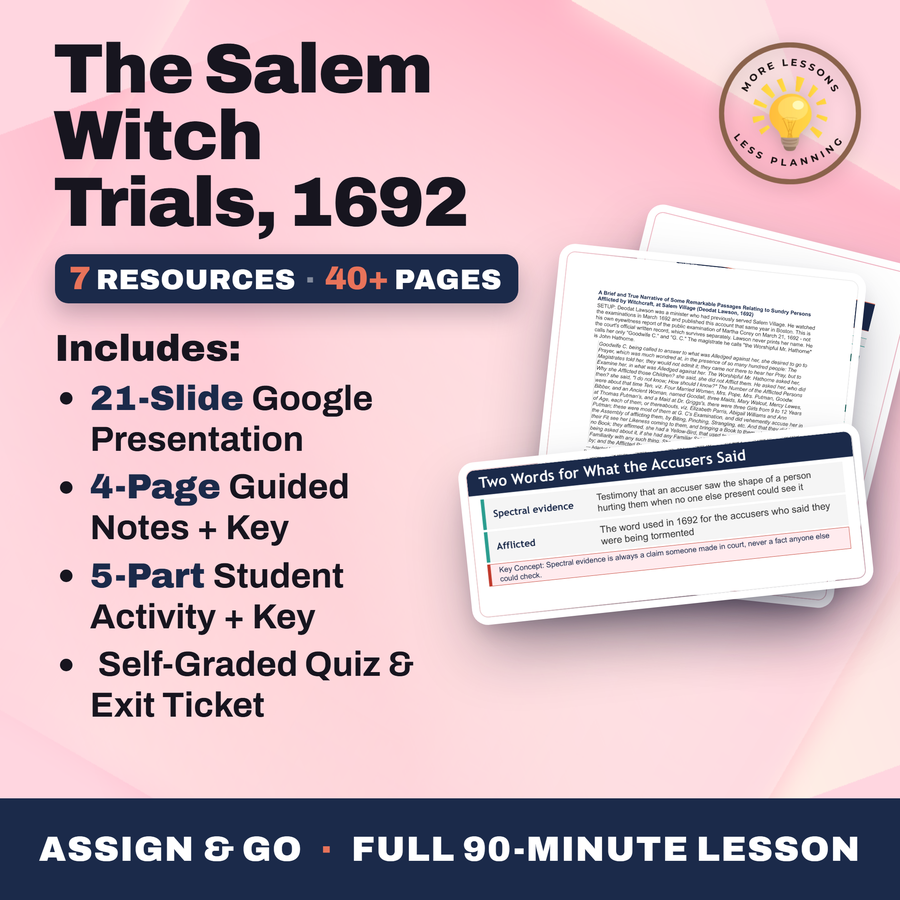
The Salem Witch Trials, 1692
- Slide deck
- Guided notes
- Guided notes teacher key
- Activity + answer key
- Quiz + answer key
- Exit ticket + answer key
- Teacher guide
- Teacher presentation notes
Where should I send the next one?
Everything here is free and it stays that way. Leave your email and I'll send you the new lessons as they go up. You can unsubscribe from any one of them.
Every file in this toolkit
Related resources
Bound Labor: How Servitude Became Slavery
Puritan New England Life
The Great Awakening: Preaching That Crossed the Colonies

Three Colonial Regions, Three Economies

Washington's First Command: The Ohio Valley, 1754

Cliff Palace and the Ancestral Puebloans
What students do
- Trace one accusation from a minister's household to an examination inside the meetinghouse
- Explain what spectral evidence was, and why ministers eventually forced the court to stop accepting it
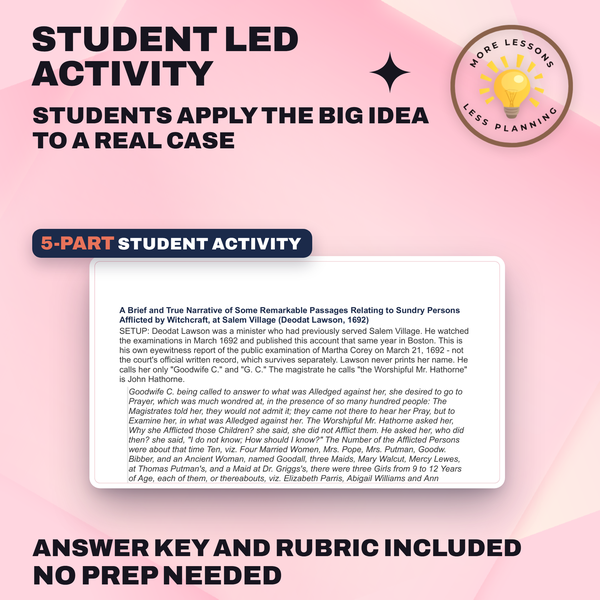
- Read Deodat Lawson's eyewitness account of an examination and judge what it can and cannot prove
- Compare the outcomes for the accused who confessed against those who denied the charges
What it covers
- How a community already under strain turned a household illness into an accusation
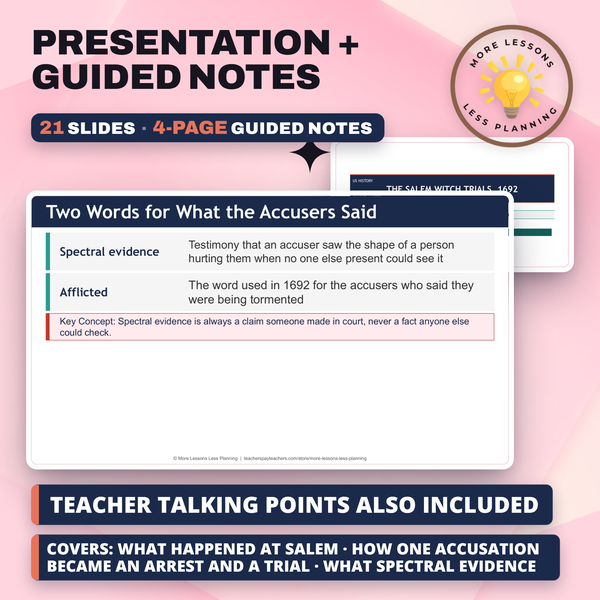
- What spectral evidence let a court accept as proof, and why that became the trials' undoing
- How later Americans pictured 1692, using an 1853 painting nobody who was there ever saw
- What officials admitted once the trials ended, and how long the apologies took to arrive
Learning targets
- Explain what happened at Salem in 1692, and why it began.
- Describe how one accusation became an arrest and a trial.
- Explain what spectral evidence was, and why judges later barred it.
- Judge how fear and gossip shaped who was accused.
- Explain how the trials ended, and what officials later admitted.
From one teacher to another
Early in 1692, an illness inside a minister's household in Salem Village turned into an accusation, and that's the single thread I trace all the way to a meetinghouse examination. Students read Deodat Lawson's own eyewitness account and notice that the first question a magistrate asked already assumed guilt, then weigh what spectral evidence let a court accept as proof before ministers finally forced it out. By the time they reach an 1853 painting, made more than a hundred and sixty years after the events themselves, I want them asking what an artist that far removed could actually have known.
Every lesson on this site is free to download and use. If one of them saved you a prep period, you can chip in a few bucks toward my three kids' daycare fund. That's genuinely where tips go.