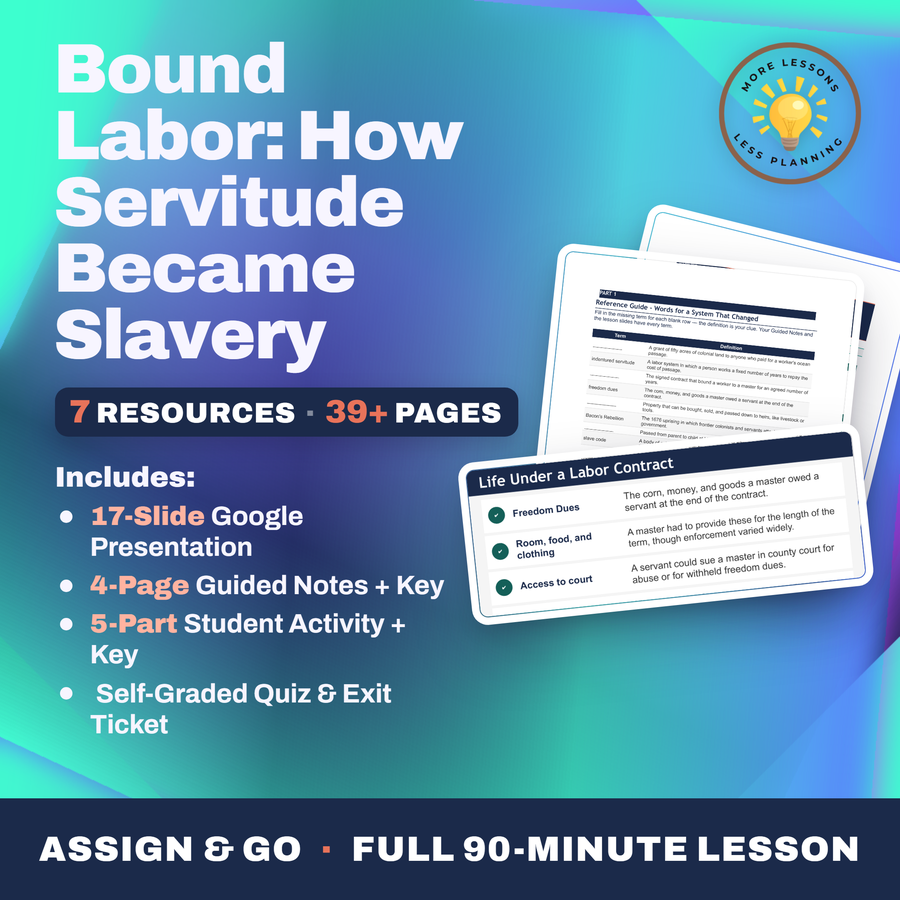
Bound Labor: How Servitude Became Slavery
- Slide deck
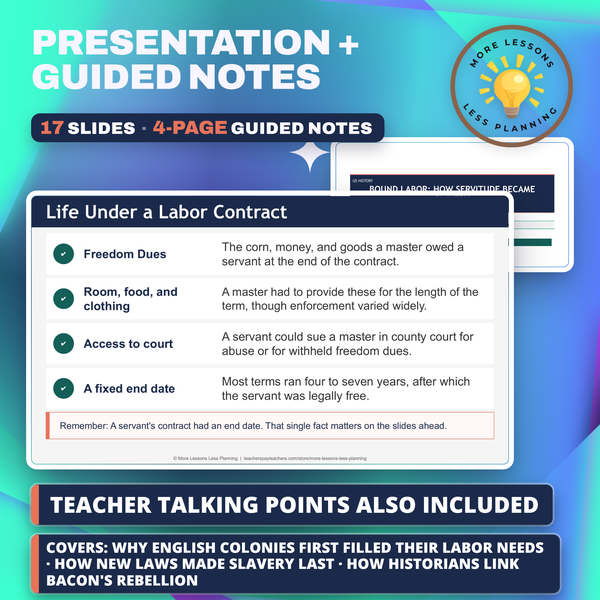
- Guided notes
- Guided notes teacher key
- Activity + answer key
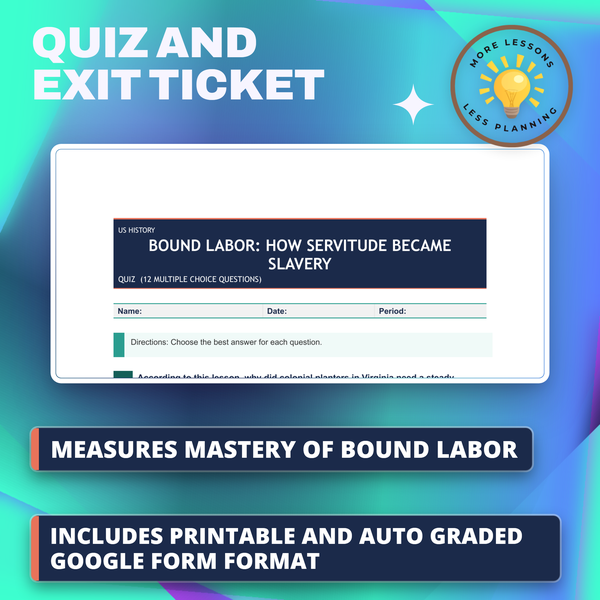
- Quiz + answer key
- Exit ticket + answer key
- Teacher guide
- Teacher presentation notes
Where should I send the next one?
Everything here is free and it stays that way. Leave your email and I'll send you the new lessons as they go up. You can unsubscribe from any one of them.
Every file in this toolkit
Related resources
Puritan New England Life
The Great Awakening: Preaching That Crossed the Colonies
The Salem Witch Trials, 1692
Three Colonial Regions, Three Economies
Washington's First Command: The Ohio Valley, 1754
Cliff Palace and the Ancestral Puebloans
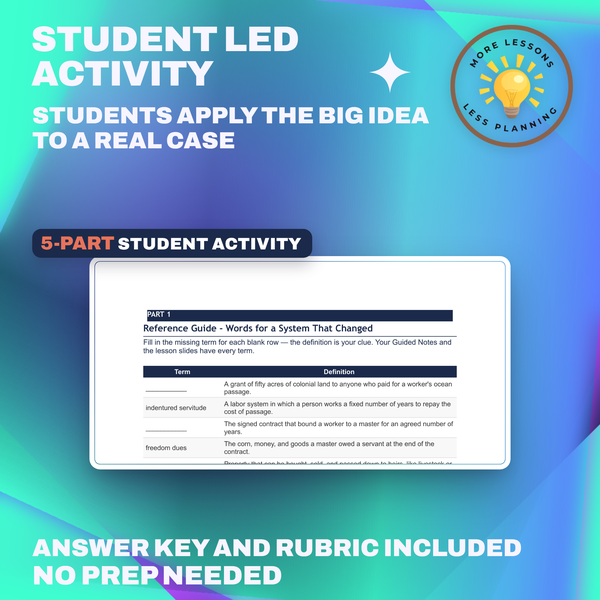
What students do
- Trace how Virginia's laws turned a labor contract with an end date into slavery for life
- Read the 1705 Virginia slave code and identify exactly what it made legal
- Argue whether Bacon's Rebellion caused the laws that followed, using the historians' interpretation the lesson presents
- Compare a servant's freedom dues against the chattel status the 1705 law assigned to enslaved people
What it covers
- How the headright system paid land to whoever financed a worker's passage, not to the worker
- What changed in Virginia law in 1662 and 1667, and what path out of bondage each law closed
- Why historians connect Bacon's Rebellion of 1676 to the laws that followed it
- How enslaved people resisted a system built and defended by others, from slowed work to open uprising
Learning targets
- Explain why English colonies first filled their labor needs from Europe.
- Trace how new laws made slavery last for life and pass to children.
- Explain how historians link Bacon's Rebellion to the laws that followed.
- Read a 1705 Virginia law and identify what it made legal.
- Describe how enslaved people resisted a system people chose to build.
From one teacher to another
Most colonial-labor units hand students two vocabulary words, servitude and slavery, and never show the mechanism that connects them. Virginia law closes one door after another here, 1662 and then 1667 and then the 1705 statute itself, so students can name specifically what changed instead of gesturing at a single origin point. The closing slides on resistance aren't an afterthought either; a lesson about a system people built has to show the people who refused it.
Every lesson on this site is free to download and use. If one of them saved you a prep period, you can chip in a few bucks toward my three kids' daycare fund. That's genuinely where tips go.