Franklin's Philadelphia
Quality reviewed September 2026
- Grades
- Grades 9-12
- Time
- About two 50-minute class periods
- Includes
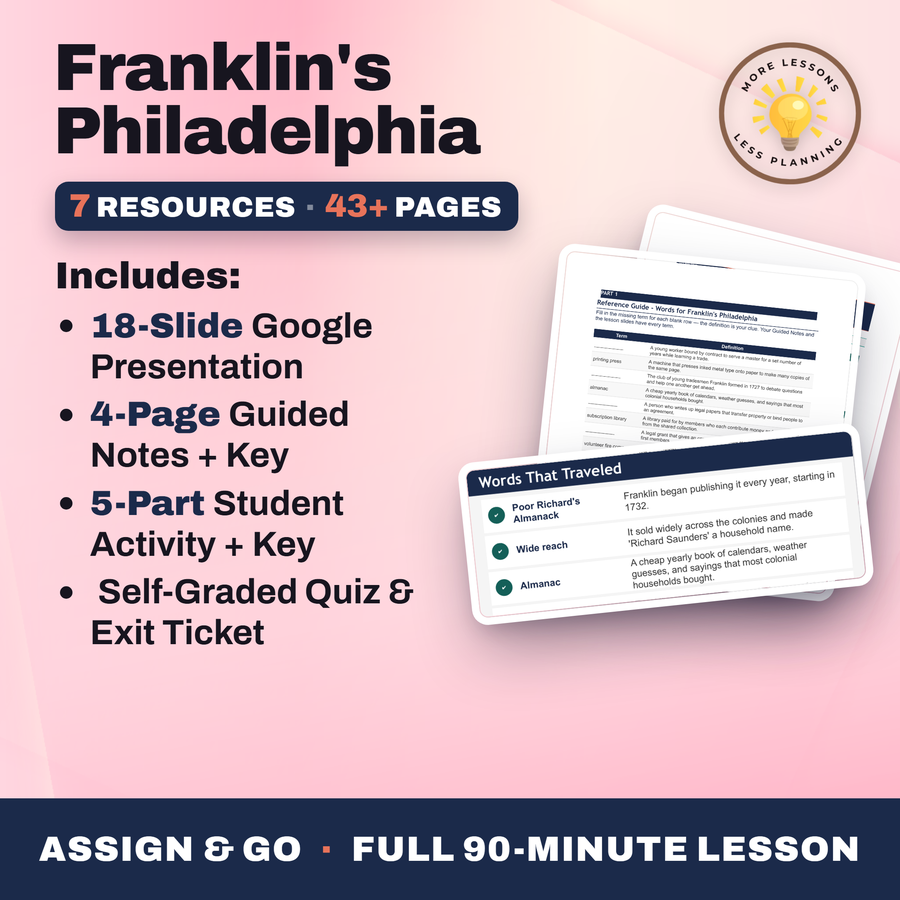
- 11 ready-to-teach files
- Format
- Word (.docx) · PowerPoint (.pptx)
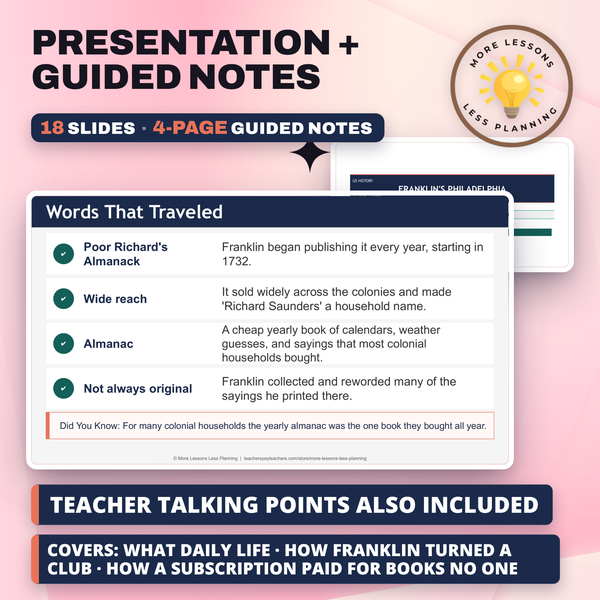
- Slide deck
- Guided notes
- Guided notes teacher key
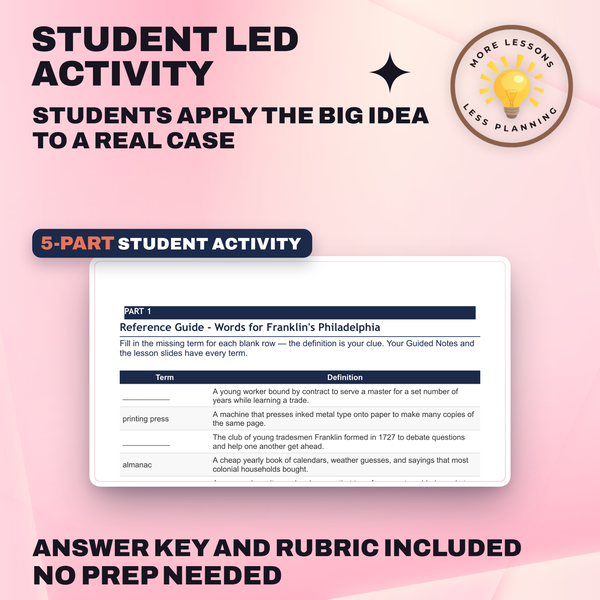
- Activity + answer key
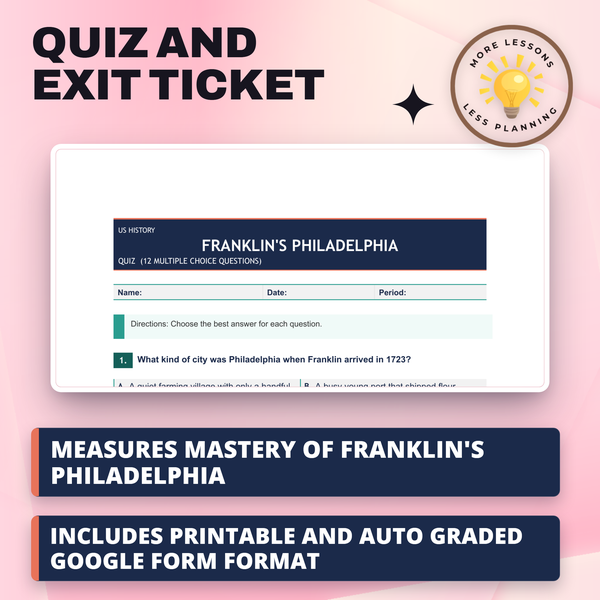
- Quiz + answer key
- Exit ticket + answer key
- Teacher guide
- Teacher presentation notes
What students do
- Trace how Franklin's Junto club grew into Philadelphia's first subscription library, funded by fifty subscribers
- Read an excerpt from Franklin's own 1784 Autobiography and judge it as a memoir written decades after the fact
- Name three civic institutions Franklin helped start, from the library to the volunteer fire company
- Weigh Franklin's civic building against the fact that he and his wife enslaved at least seven people
What it covers
- How a shelf of damaged club books turned into a fifty-subscriber public library, chartered in 1731
- The fundraising method Franklin reused for the fire company, hospital, academy, and paved streets
- Franklin's own account of founding the library, written in 1784, more than fifty years after the events
- That Franklin and his wife Deborah enslaved at least seven people, and his newspaper ran ads for both sale and recapture
Learning targets
- Describe what daily life was like in a colonial city.
- Explain how Franklin turned a club into a public library.
- Explain how a subscription paid for books no one could buy alone.
- Name three civic institutions Franklin helped start.
- Explain how Franklin built the city and also enslaved people.
Peek inside
A planned city
Founded in 1682 by William Penn on the Delaware River.
Laid out on a strict grid between two rivers.
Named for the Greek words for 'brotherly love.'
A busy young port
Founded in 1682 by on the Delaware River.
Named for the words for 'brotherly love.'
1. A teenage boy signs papers promising to work for a shoemaker for seven years in exchange for learning the trade and receiving room and board.
What is he called?
Why this matters
Franklin's civic record reads like a checklist: a subscription library chartered in 1731, a volunteer fire company, a hospital, an academy, and paved streets. Each one got built through the same fundraising approach, applied again and again, and that repetition is worth naming before anyone starts treating him as simply generous.
Franklin's own newspaper ran ads for both the sale of enslaved people and their recapture. At least seven people were enslaved by Franklin and his wife Deborah. Holding those two facts next to the civic checklist, instead of stopping at the checklist alone, is the actual point of the reading.
From one teacher to another
This one asks students to hold two true things about the same person at the same time: Franklin built a genuinely useful set of civic institutions in Philadelphia, and he and his wife Deborah enslaved at least seven people while he was doing it. I don't treat the slavery as a footnote, it gets its own slide, and the closing part of the activity requires students to use specific evidence for both sides before they're allowed to take a position. The library story itself is the fun part to teach: a damaged shelf of Junto club books turns into a real plan, Franklin can only scrape together about a dozen interested members before he lands fifty subscribers at forty shillings each, and that exact playbook gets reused for the fire company, the hospital, and the academy. Students also read Franklin's own account of it all from his 1784 Autobiography and have to notice he's writing more than fifty years after the fact, which makes for a good first lesson in reading a memoir as a source instead of a transcript.
Every file in this toolkit
-
Activity (Student)
Franklin's 1784 Autobiography excerpt drives this activity: students judge it as a memoir written more than fifty years after the events, then weigh his civic building in Philadelphia against the fact that he and his wife Deborah enslaved at least seven people.
-
Activity (Answer Key)
Grading guidance here focuses on the Autobiography's fifty-year distance from the events it describes and on the civic-building-versus-enslavement weighing exercise, crediting any answer that holds both the library story and the enslavement fact at once.
-
Exit Ticket (Student)
Five minutes, one page: students name a civic institution Franklin helped fund and one fact about the people he and Deborah enslaved, a fast check on whether both halves of this Philadelphia lesson actually landed.
-
Exit Ticket (Answer Key)
Any combination of the library, the fire company, or the hospital paired with the Deborah Franklin detail satisfies this exit ticket, and this key spells out which pairings count as complete.
-
Guided Notes (Student)
A damaged shelf of Junto club books opens these fill-in-the-blank notes, which follow that shelf into a fifty-subscriber library chartered in 1731 and then into the fire company, hospital, and academy, in the order the slide deck presents each institution.
-
Guided Notes (Teacher Key)
The Junto's damaged books, the fifty subscribers at forty shillings, and the 1731 charter all come filled in here, matched to the student notes so confirming the fundraising pattern across the library, fire company, and hospital takes a single glance.
-
Quiz (Student)
Three civic institutions Franklin helped start show up on this short paper quiz, where students name each one and explain the subscription method that funded it, drawing only on what the guided notes and slides taught about his Philadelphia.
-
Quiz (Answer Key)
Question by question, this key covers the civic-institutions and subscription-method items with the specific detail behind each correct answer, letting grading move at a glance instead of sending a teacher back into the Autobiography excerpt.
-
Slides
A damaged Junto bookshelf leads off this projectable deck, which builds into the fifty-subscriber library, the fire company, and the hospital before closing on the enslavement facts and Franklin's own 1784 account, matching the guided notes step for step.
-
Teacher Guide
The fifty-subscriber library gets a full pacing block of its own before the fire company and hospital speed up, since that's where students want to linger, and the guide flags exactly where the enslavement slide needs to land as its own moment.
-
Teacher Presentation Notes
Telling the library-founding story with real energy is the first job of these slide-by-slide notes, which then cue the enslavement slide so it lands as its own moment and frame Franklin's own 1784 account before students read it themselves.
Download
Where should I send the next one?
Everything here is free and it stays that way. Leave your email and I'll send you the new lessons as they go up. You can unsubscribe from any one of them.
Related resources
Bound Labor: How Servitude Became Slavery
Puritan New England Life
The Great Awakening: Preaching That Crossed the Colonies
The Mayflower Compact
The Salem Witch Trials, 1692
Three Colonial Regions, Three Economies
Every lesson on this site is free to download and use. If one of them saved you a prep period, you can chip in a few bucks toward my three kids' daycare fund. That's genuinely where tips go.