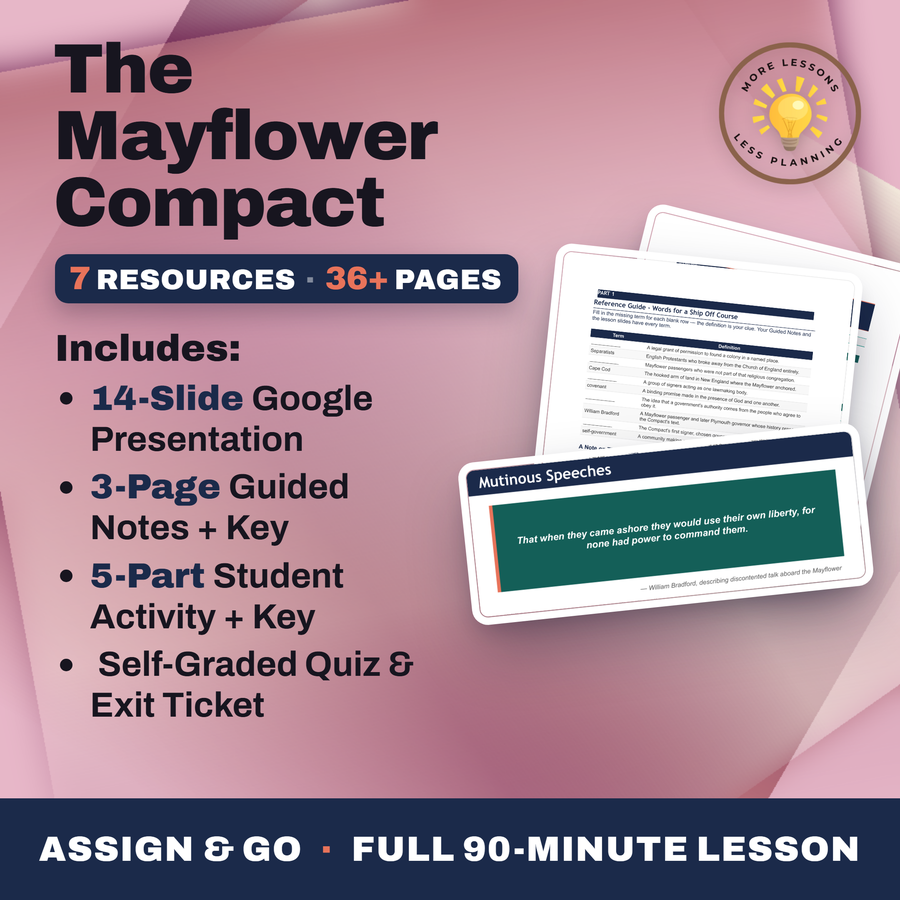
The Mayflower Compact
Quality reviewed September 2026
- Grades
- Grades 9-12
- Time
- About two 50-minute class periods
- Includes
- 11 ready-to-teach files
- Format
- Word (.docx) · PowerPoint (.pptx)
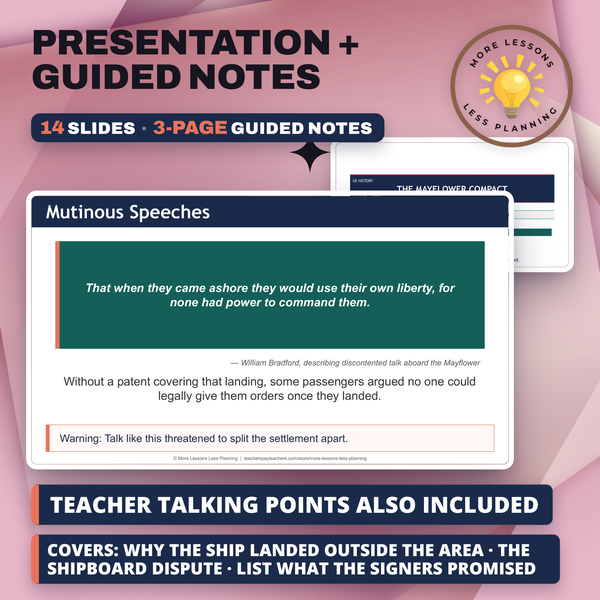
- Slide deck
- Guided notes
- Guided notes teacher key
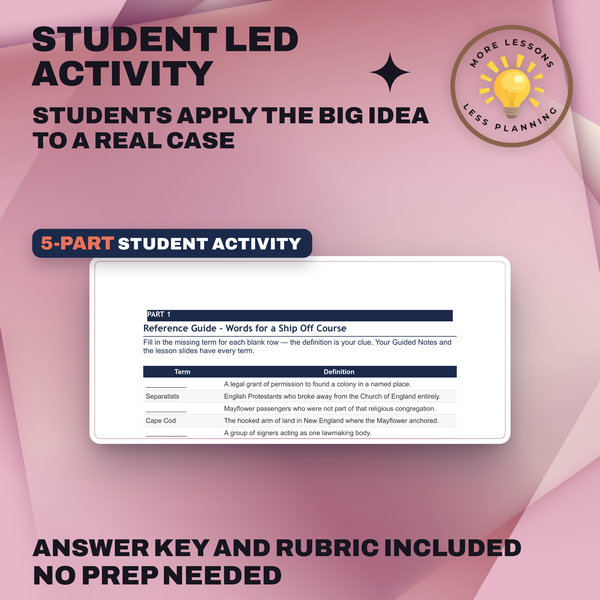
- Activity + answer key
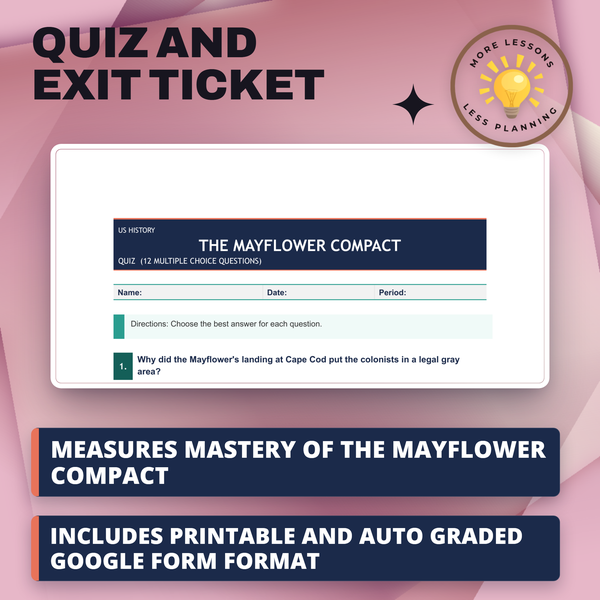
- Quiz + answer key
- Exit ticket + answer key
- Teacher guide
- Teacher presentation notes
What students do
- Explain how a voided Virginia patent and mutinous talk aboard ship led the passengers to draft a compact
- Read William Bradford's own account of the Compact's drafting and answer sourcing, comprehension, and analysis questions
- Fill a comparison grid connecting Separatists, Strangers, and John Carver to what each meant for the new government
- Write a verdict weighing the Compact's consent-of-the-governed achievement against the roughly 41 men who actually signed it
What it covers
- Why the Mayflower's anchorage off Cape Cod fell outside its Virginia patent and what that legal gap threatened
- The mutinous speeches Bradford recorded and how they pushed leaders to draft a combination before anyone went ashore
- The Compact's own wording - covenant, civil body politic, just and equal laws - read from Bradford's history
- Who signed and who didn't, since only about 41 adult men bound roughly 100 passengers to the agreement
Learning targets
- Explain why the ship landed outside the area its patent covered.
- Describe the shipboard dispute that led the passengers to draft a compact.
- List what the signers promised each other in the Compact.
- Explain how the Compact built a government on the consent of the governed.
- Evaluate the Compact's limits by asking who signed it and who did not.
Peek inside
In September 1620, the Mayflower left England bound for northern Virginia.
Storms and shoal waters pushed the ship north of its planned course.
Cape Cod is the hooked arm of land in New England where the Mayflower anchored.
The landing site lay outside the territory the Virginia Company had granted.
The passengers now faced land no charter covered and no law governed.
is the hooked arm of land in New England where the Mayflower anchored.
1620, the Mayflower left England bound for northern Virginia.
1. The passengers who had broken away from the Church of England entirely, hoping to worship freely in America, were known as the .
Why this matters
About 41 adult men signed the Mayflower Compact, and their agreement bound roughly 100 passengers who had no vote in it, women and children included. The document only exists because the Mayflower anchored somewhere its Virginia patent never covered, and mutinous talk on board convinced the leaders they needed a plan before anyone went ashore.
Students want to treat this as a tidy origin story for American democracy, and the numbers won't let them. I have them read Bradford's own wording on covenant and civil body politic and then sit with the gap between what the Compact promised and who actually got to agree to it, because both things are true at once.
From one teacher to another
I start this one with the legal problem, not the patriotic ending, because the Compact only makes sense once students see the Mayflower had anchored somewhere its patent never covered. Students read William Bradford's own account of what happened next, the mutinous talk about nobody having power to command them ashore, and work through his actual wording on covenant and civil body politic rather than a paraphrase. The comparison grid makes them place Separatists, Strangers, and John Carver against what each meant for the new government, so the vocabulary does real work instead of sitting in a list. Where I push hardest is the closing verdict, because I want students holding two true things at once: the Compact really is an early document of consent of the governed, and only about 41 adult men signed it while every woman and child aboard had no line to sign at all. That tension, not a clean civics-class moral, is what the lesson is actually built around.
Every file in this toolkit
-
Activity (Student)
A comparison grid asks students to connect Separatists, Strangers, and John Carver to what each meant for the new government, then write a verdict on the roughly forty-one men who actually signed the Compact.
-
Activity (Answer Key)
Scoring the forty-one-signers verdict gets easier with the model response included here, next to sample entries for the Separatists-Strangers-Carver grid, so partial credit isn't a judgment call.
-
Exit Ticket (Student)
Five minutes before the bell, students put consent of the governed into their own words, using nothing but what today's notes and slides on the Compact's covenant language already gave them to work with.
-
Exit Ticket (Answer Key)
What counts as a full answer on consent of the governed is spelled out here, short enough to score between periods while the Compact's covenant and civil body politic language is still fresh from class.
-
Guided Notes (Student)
A voided Virginia patent opens these fill-in-the-blank notes, tracking the mutinous talk Bradford recorded and the Compact's own wording on covenant and civil body politic in the order the slides present it.
-
Guided Notes (Teacher Key)
Everything Bradford wrote about the mutinous talk and the Compact's covenant language is filled in on this key, letting you check a student's blank against his actual words in seconds.
-
Quiz (Student)
Why anchor outside a Virginia patent that didn't cover the spot: that question anchors this quiz, alongside items on what the Compact's signers actually promised each other and how many of them there were.
-
Quiz (Answer Key)
The patent question and the signers'-promises question both get walked through here in order, keyed straight back to Bradford's own account for each one, so the reasoning behind each answer is visible.
-
Slides
The projectable deck follows the guided notes in order, from the voided patent and shipboard dispute through Bradford's own wording to the closing question of who signed and who didn't.
-
Teacher Guide
Open with the legal problem, a patent that didn't cover where the ship actually anchored, before Bradford's account and the Compact's own wording take over the middle of the period.
-
Teacher Presentation Notes
Notes for each slide cover how to frame the mutinous talk Bradford recorded, when to bring in John Carver, and how to set up the closing forty-one-signers discussion before it starts.
Download
Where should I send the next one?
Everything here is free and it stays that way. Leave your email and I'll send you the new lessons as they go up. You can unsubscribe from any one of them.
Related resources
Bound Labor: How Servitude Became Slavery
Franklin's Philadelphia
Puritan New England Life
The Great Awakening: Preaching That Crossed the Colonies
The Salem Witch Trials, 1692
Three Colonial Regions, Three Economies
Every lesson on this site is free to download and use. If one of them saved you a prep period, you can chip in a few bucks toward my three kids' daycare fund. That's genuinely where tips go.