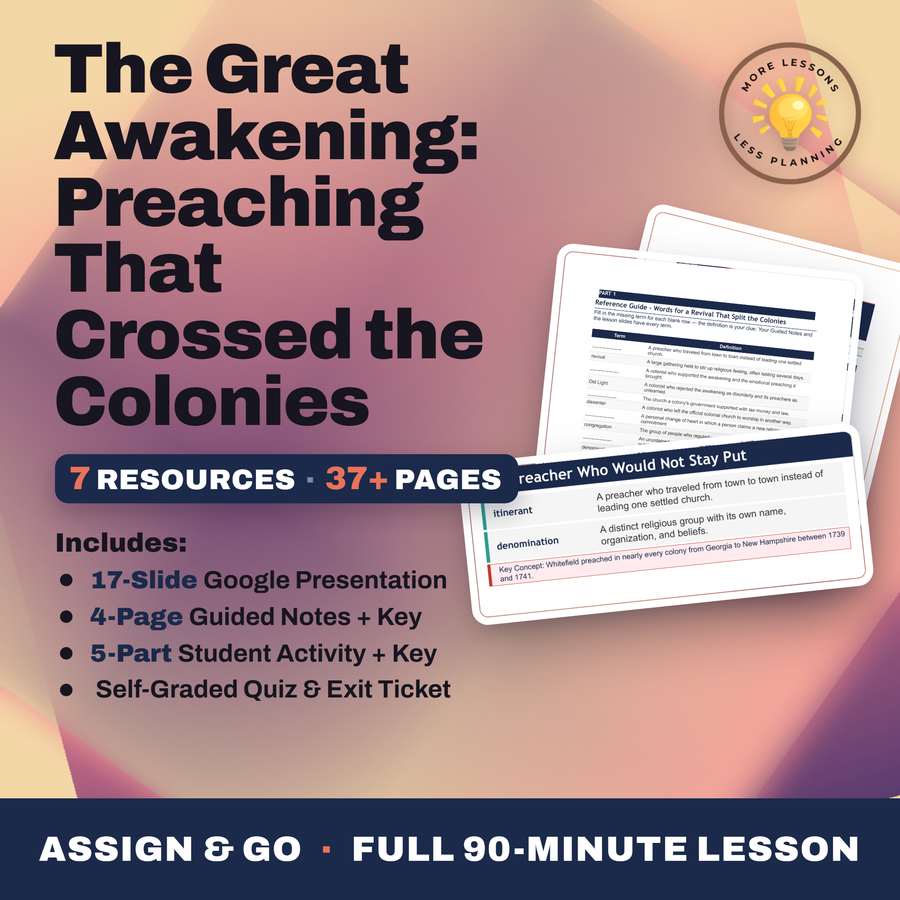

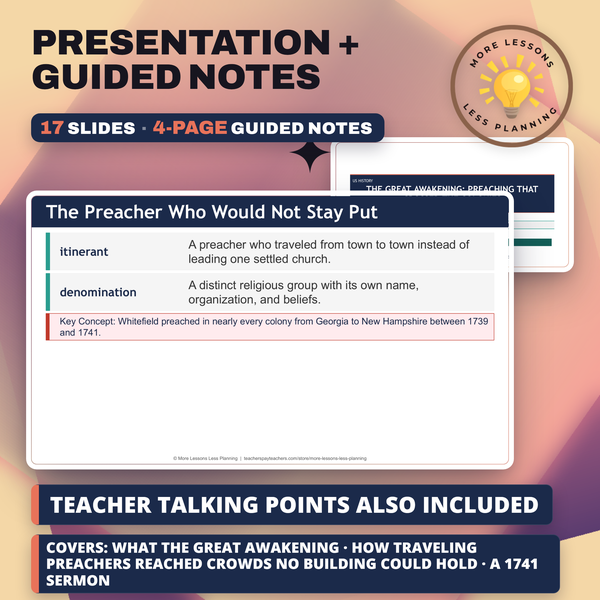
The Great Awakening: Preaching That Crossed the Colonies
Quality reviewed September 2026
- Grades
- Grades 9-12
- Time
- About two 50-minute class periods
- Includes
- 11 ready-to-teach files
- Format
- Word (.docx) · PowerPoint (.pptx)
- Slide deck
- Guided notes
- Guided notes teacher key
- Activity + answer key
- Quiz + answer key
- Exit ticket + answer key
- Teacher guide
- Teacher presentation notes
What students do
- Explain how itinerant preachers and cheap printed sermons carried a religious revival between colonies
- Sort the New Light and Old Light positions using evidence from both sides
- Read Jonathan Edwards's 1741 Enfield sermon and identify the persuasion techniques it uses
- Judge what a sermon can prove about a preacher's own words, and what it cannot prove about the people listening
What it covers
- Why an established, tax-funded church made a traveling preacher controversial
- What happened in Northampton starting in 1734, and how Edwards counted its converts
- How the New Light and Old Light split reshaped colonial denominations
- Why colonists arguing about the same sermon in the same month was new in the 1730s and 1740s
Learning targets
- Explain what the Great Awakening was and when it swept the colonies.
- Describe how traveling preachers reached crowds no building could hold.
- Analyze a 1741 sermon for the techniques that moved its listeners.
- Explain why the new preaching split colonists into two rival camps.
- Evaluate how one shared event helped link the colonies together.
Peek inside
- The church a colony's government supported with tax money and law.
- The group of people who regularly worship at one particular church.
1. A minister preached at a different meetinghouse nearly every week in 1740, never settling in to lead one congregation full-time. Colonists used one word for a preacher who worked this way: an minister.
Why this matters
Northampton is where the story actually starts, in 1734, when Jonathan Edwards began counting the converts his own preaching produced. That count is worth pausing on before students reach the fight between New Lights and Old Lights, because a preacher tallying his own results is a claim worth questioning, not a settled fact.
Arguing about the very same sermon in the very same month was new in the 1730s and 1740s. Print is what made it possible: cheap printed copies of sermons let a revival move between colonies faster than any single preacher could travel, so a sermon delivered once in one town became a shared argument everywhere the copies reached.
From one teacher to another
A tax-funded, established church had no way to handle a preacher who ignored parish lines, and that's the friction everything that follows is built on. Students trace how cheap printed sermons let traveling preachers reach farther than they could ever walk, and they work out where each camp in the New Light and Old Light fight actually stood from the arguments themselves. I have them close by reading Edwards's own words from the 1741 Enfield sermon and asking what a sermon can prove about a preacher, and what it can never prove about the people sitting in the pews.
Every file in this toolkit
-
Activity (Student)
Jonathan Edwards's own 1741 Enfield sermon anchors this activity: students sort the New Light and Old Light positions from evidence on both sides, then identify the specific persuasion techniques Edwards used on listeners who had never heard the sermon coming.
-
Activity (Answer Key)
This key shows which evidence belongs on the New Light side and which belongs on the Old Light side, plus grading guidance for the Enfield sermon analysis, so a partial list of persuasion techniques still earns credit instead of an automatic zero.
-
Exit Ticket (Student)
This exit ticket gives students five minutes to name one thing Jonathan Edwards's 1741 sermon can prove about the preacher and one thing it cannot prove about the people listening.
-
Exit Ticket (Answer Key)
A sermon can prove things about its speaker and nothing about its listeners, and this key draws that line clearly so grading the exit ticket doesn't require guessing at partial credit.
-
Guided Notes (Student)
An established, tax-funded church that couldn't handle a traveling preacher opens these fill-in-the-blank notes, which move through Northampton's 1734 conversions to the New Light and Old Light split, following the revival's spread in the same order as the slides.
-
Guided Notes (Teacher Key)
Northampton's 1734 conversion count, the established church's objections, and the New Light versus Old Light split all come filled in here, matched to the student notes so scanning for the revival's sequence takes one pass instead of a full regrade.
-
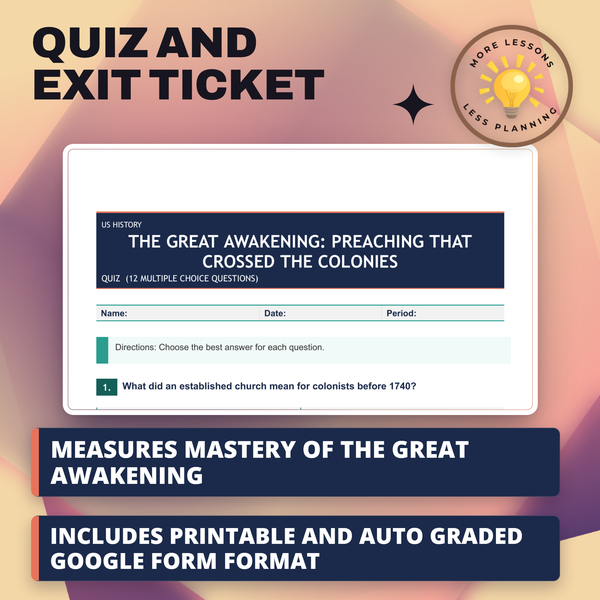
Quiz (Student)
An established church's objection to itinerant preachers is the hinge of this short paper quiz, which has students explain that conflict and place the New Light and Old Light camps correctly, using only material the notes and slides already taught.
-
Quiz (Answer Key)
The established-church and New-Light-versus-Old-Light answers are laid out question by question, with the reasoning behind each correct choice included, so this key turns grading into a quick check rather than a search through the sermon excerpt again.
-
Slides
The established church's objections to itinerant preachers lead off this projectable deck, building through Northampton's 1734 conversions into the New Light and Old Light split before ending on Edwards's own 1741 sermon, in step with the guided notes.
-
Teacher Guide
Northampton's 1734 conversions get their own pacing block before the New Light and Old Light split, because that's where students usually confuse the two camps, and the guide shows how the Enfield sermon activity resolves the argument at the end.
-
Teacher Presentation Notes
Setting up the established church's conflict with itinerant preachers comes first in these slide-by-slide notes, followed by cues for walking into the Enfield sermon excerpt and pausing so students separate the New Light and Old Light camps before the activity.
Download
Where should I send the next one?
Everything here is free and it stays that way. Leave your email and I'll send you the new lessons as they go up. You can unsubscribe from any one of them.
Related resources
Bound Labor: How Servitude Became Slavery
Franklin's Philadelphia
Puritan New England Life
The Mayflower Compact

The Salem Witch Trials, 1692
Three Colonial Regions, Three Economies
Every lesson on this site is free to download and use. If one of them saved you a prep period, you can chip in a few bucks toward my three kids' daycare fund. That's genuinely where tips go.