Puritan New England Life
Quality reviewed September 2026
- Grades
- Grades 9-12
- Time
- About two 50-minute class periods
- Includes
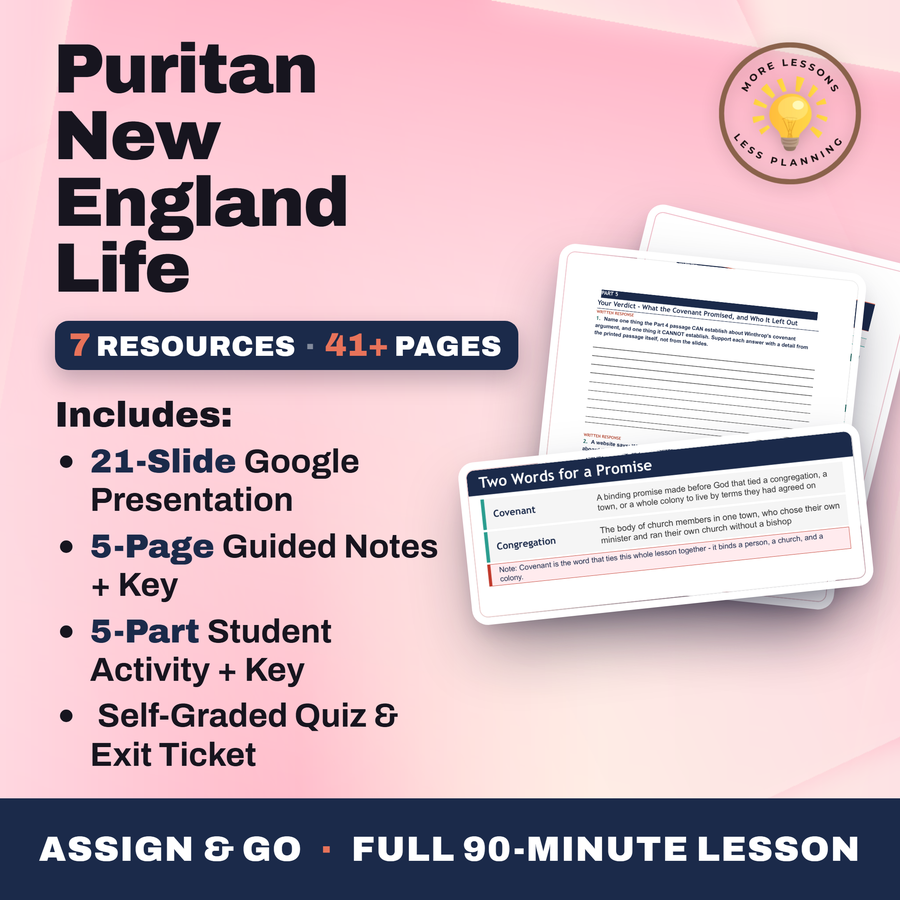
- 11 ready-to-teach files
- Format
- Word (.docx) · PowerPoint (.pptx)
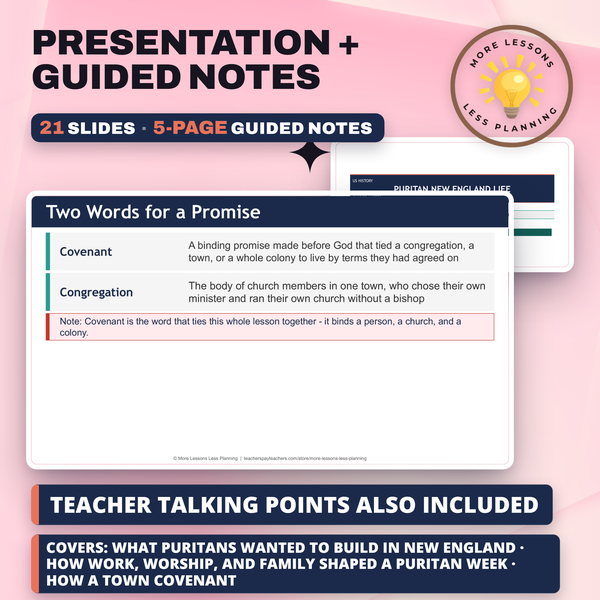
- Slide deck
- Guided notes
- Guided notes teacher key
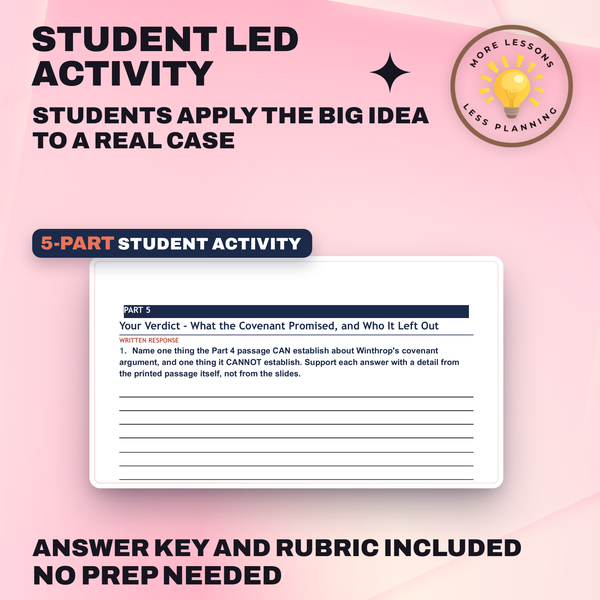
- Activity + answer key
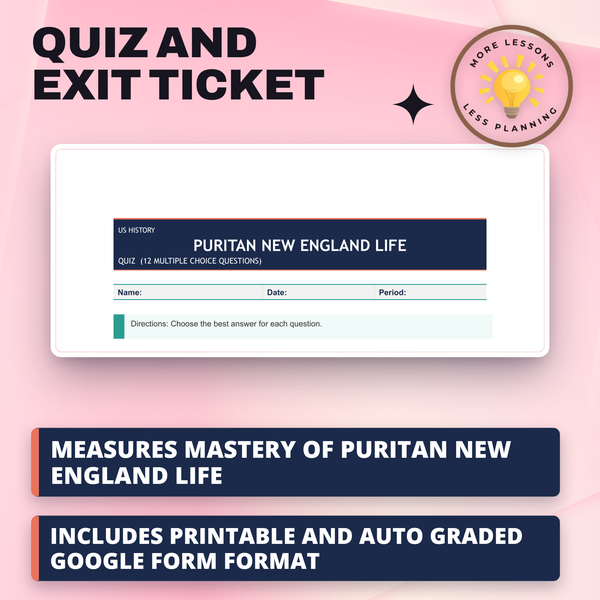
- Quiz + answer key
- Exit ticket + answer key
- Teacher guide
- Teacher presentation notes
What students do
- Compare Puritans and Pilgrims and locate where each group actually settled
- Trace a New England town from its signed covenant to its meetinghouse and its selectmen
- Read John Winthrop's 1630 "city upon a hill" passage and judge what the covenant actually promised
- Sort a Puritan week's work, worship, and rest against the Sabbath rules a tithingman enforced
What it covers
- What Puritans wanted to build in New England, and why they never meant to leave the Church of England
- How a signed covenant and a plain meetinghouse held a town together
- What the "city upon a hill" sermon can and cannot prove about how people actually lived
- Who the covenant left out, dissenters and Native nations included
Learning targets
- Explain what Puritans wanted to build in New England, and why.
- Describe how work, worship, and family shaped a Puritan week.
- Explain how a town covenant and a meetinghouse held a town together.
- Judge what Winthrop's 1630 covenant promised, and who it left out.
- Tell Puritans and Pilgrims apart, and say where each one lived.
Peek inside
Puritans
Stayed inside the Church of England.
Wanted to purify its worship of Catholic leftovers.
Sailed mostly to Massachusetts Bay after 1629.
Pilgrims (Separatists)
Landed at , not Massachusetts Bay.
Every Puritan wanted a purer church; only wanted a different one.
1. After supper her father put the same question to her that he had put every evening that winter - 'What is the chief end of man?' - and she gave back the words she had been taught, in the order she had been taught them. What her father was taking her through was the .
Why this matters
Puritans and Pilgrims are two different groups who settled two different places, and most students walk in using the names interchangeably. Straightening that out first matters here, because everything after it, the signed covenant, the meetinghouse, six days of labor followed by a Sabbath the town enforced by law, only makes sense once students know which group actually built it.
Winthrop's "city upon a hill" sermon shows up only after students already know what daily life under that covenant looked like, so they read it as a claim to test rather than a slogan to admire. What earns the lesson its real weight is the last question: naming exactly who a signed covenant left standing outside it, dissenters and Native nations both.
From one teacher to another
Every class mixes up Puritans and Pilgrims, and since the difference is the whole point here, this lesson spends real time sorting it out properly. One full week of Puritan life comes first, six days of labor and a Sabbath the town enforced by law, and Winthrop's sermon doesn't show up until students already know what daily life under a covenant actually looked like. Then comes the harder ask: read a covenant meant to bind a community together and name exactly who it left standing outside it.
Every file in this toolkit
-
Activity (Student)
Students sort a Puritan week's labor, worship, and rest against the Sabbath rules a tithingman enforced, then read Winthrop's covenant and name specifically who it left standing outside it.
-
Activity (Answer Key)
Sample entries for the week-sorting task sit here next to a model answer on who Winthrop's covenant excluded, with notes on how to credit a partial response on dissenters or Native nations.
-
Exit Ticket (Student)
Before the bell rings, students name one thing Winthrop's covenant promised and one group, dissenters or Native nations, it left standing outside it, a quick check that the closing discussion actually landed.
-
Exit Ticket (Answer Key)
Naming what the covenant promised and who it excluded correctly looks like this, a short key you can grade fast while Winthrop's city-upon-a-hill sermon is still the last thing students read in class.
-
Guided Notes (Student)
Puritans and Pilgrims get sorted apart right away in these fill-in-the-blank notes, which then follow a full week of labor, worship, and Sabbath rules before Winthrop's sermon ever shows up on a slide.
-
Guided Notes (Teacher Key)
This key spells out what belongs in each blank on the Puritan week, tithingman rules and Winthrop's own sermon language both included, so nothing requires a trip back to the source text.
-
Quiz (Student)
Sorting a Puritan week's labor and worship from a Pilgrim's separate story is the spine of this quiz, plus questions on what a town covenant and meetinghouse actually held together.
-
Quiz (Answer Key)
Why the Puritan-Pilgrim item and the covenant-and-meetinghouse item are scored the way they are gets explained here, tied back to the exact lines in Winthrop's sermon students had to read.
-
Slides
Puritans and Pilgrims get separated first on this deck, then a full week of town life, work, worship, and Sabbath rules, and it closes on Winthrop's sermon, same order as the guided notes throughout.
-
Teacher Guide
Expect the Puritan-Pilgrim mix-up on day one, since almost every class makes it, then give the week-of-labor-and-worship section room to breathe before Winthrop's sermon closes things out.
-
Teacher Presentation Notes
What to say slide by slide is here, including how to introduce the tithingman, when Winthrop's city-upon-a-hill sermon should land in the sequence, and how to steer the closing covenant-exclusion question.
Download
Where should I send the next one?
Everything here is free and it stays that way. Leave your email and I'll send you the new lessons as they go up. You can unsubscribe from any one of them.
Related resources
Bound Labor: How Servitude Became Slavery
Franklin's Philadelphia
The Great Awakening: Preaching That Crossed the Colonies
The Mayflower Compact
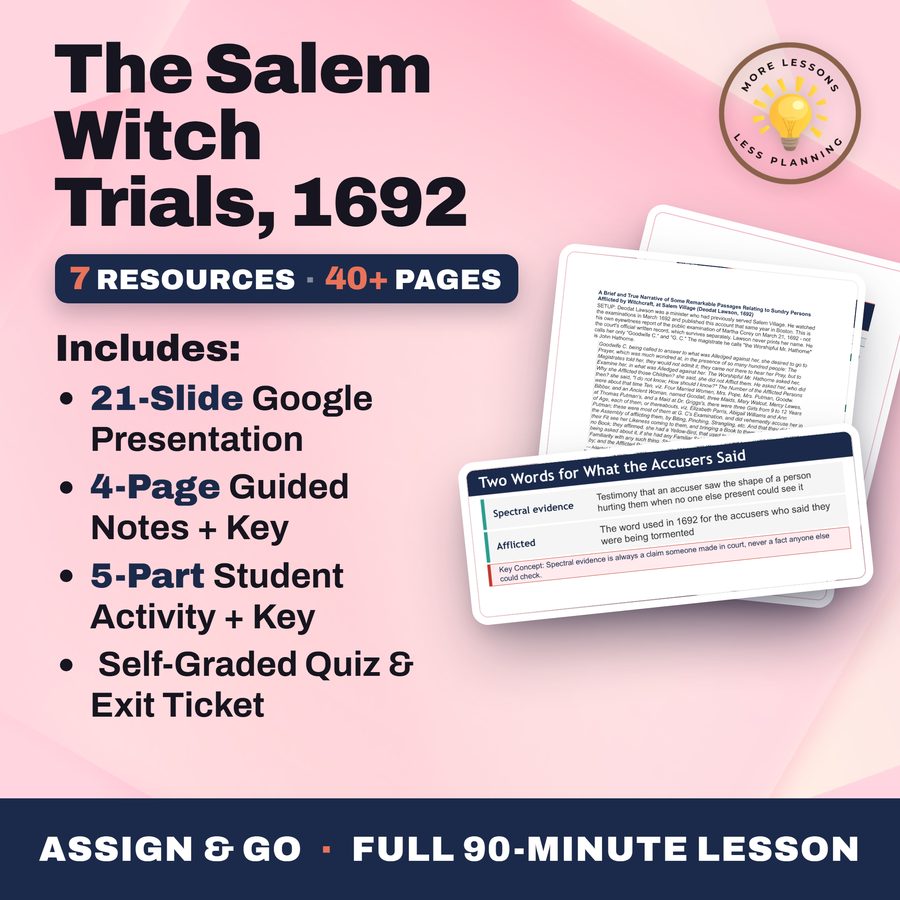
The Salem Witch Trials, 1692
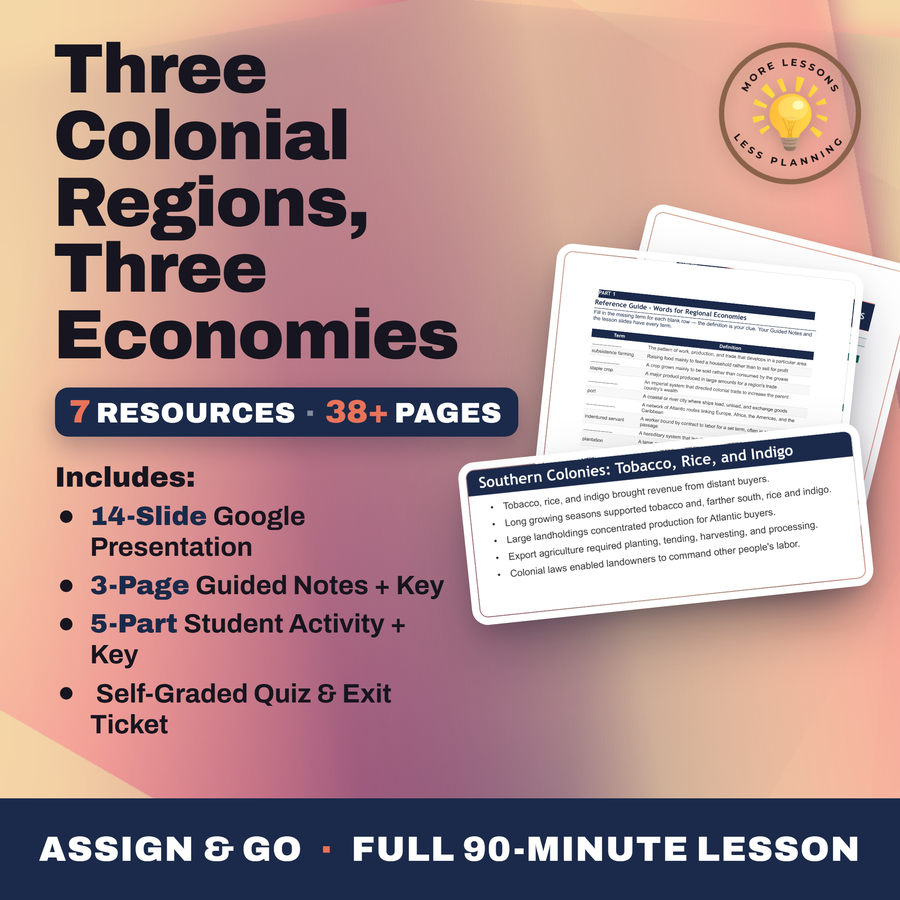
Three Colonial Regions, Three Economies
Every lesson on this site is free to download and use. If one of them saved you a prep period, you can chip in a few bucks toward my three kids' daycare fund. That's genuinely where tips go.