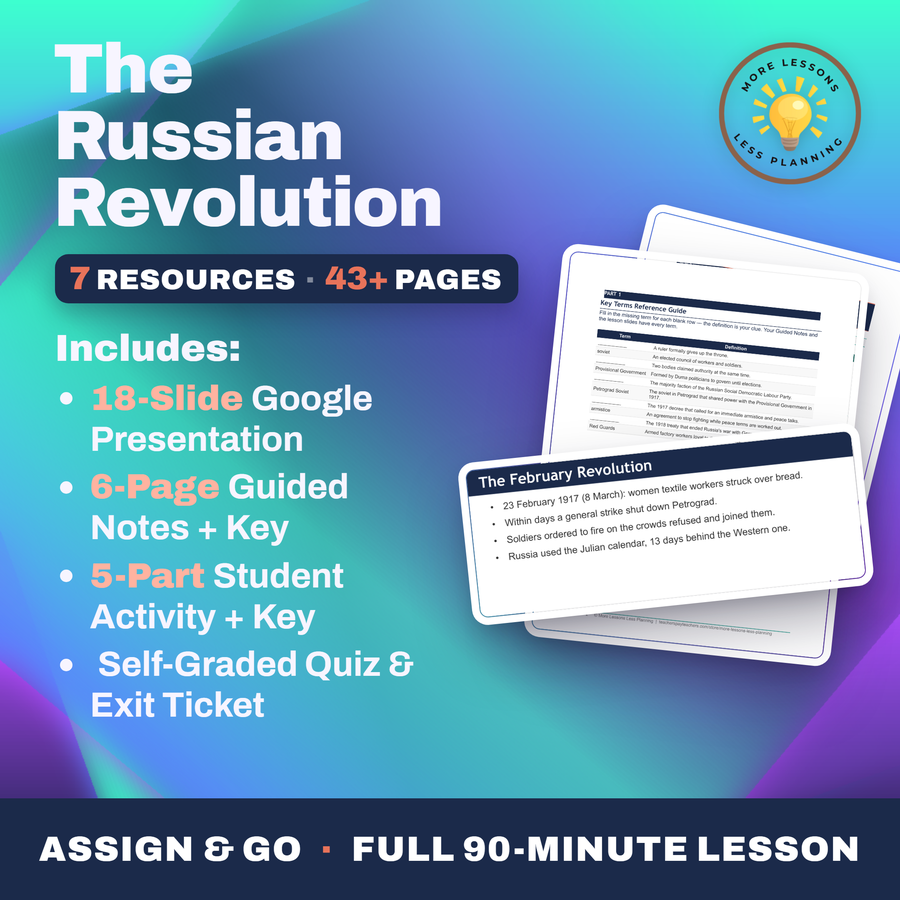
The Russian Revolution
Quality reviewed September 2026
- Grades
- Grades 9-12
- Time
- About two 50-minute class periods
- Includes
- 11 ready-to-teach files
- Format
- Word (.docx) · PowerPoint (.pptx)
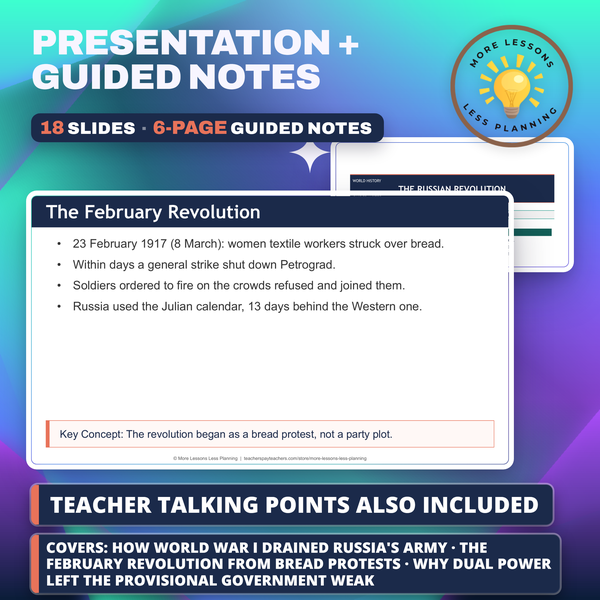
- Slide deck
- Guided notes
- Guided notes teacher key
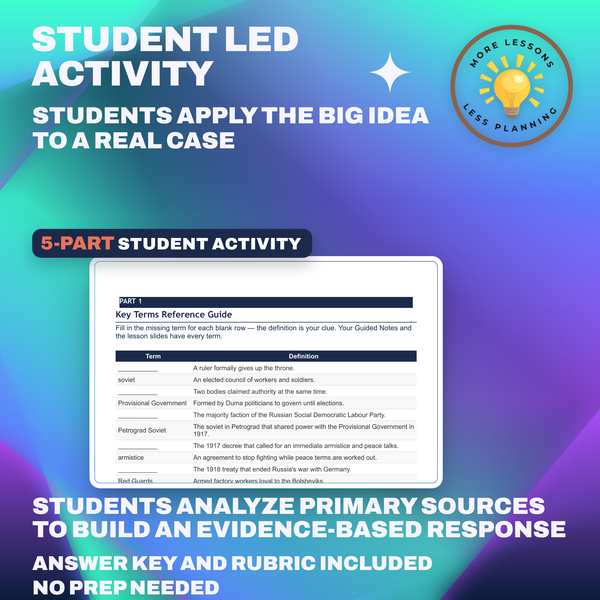
- Activity + answer key
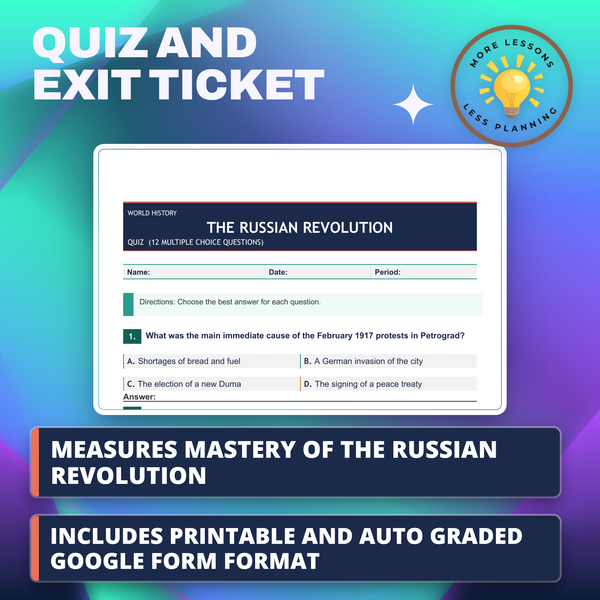
- Quiz + answer key
- Exit ticket + answer key
- Teacher guide
- Teacher presentation notes
What students do
- Trace Nicholas II's abdication and the period of "dual power" between the Provisional Government and the Petrograd Soviet
- Compare who formed each government, what each actually controlled, and what each wanted to do about the war
- Read an excerpt from the Decree on Peace and identify the two conditions it sets for ending World War I
- Write an evidence-based verdict on why the Provisional Government fell in October 1917, citing dual power and the decision to stay in the war
What it covers
- The fall of the Romanovs and the period of dual power between the Provisional Government and the Petrograd Soviet
- A side-by-side comparison of who led each government, what each controlled, and what each wanted for the war
- A primary source excerpt from the 1917 Decree on Peace, the new Bolshevik government's first major public act, with sourcing, comprehension, and analysis questions
- The Treaty of Brest-Litovsk and the territory Russia gave up to leave the war
Learning targets
- Explain how World War I drained Russia's army, food supply, and railroads.
- Trace the February Revolution from bread protests to the tsar's abdication.
- Explain why dual power left the Provisional Government weak and divided.
- Explain how the Bolsheviks took power and moved to end Russia's war.
Peek inside
Russia entered World War I in 1914 with Europe's largest army.
By 1917 millions of Russian soldiers were dead, wounded, or captured.
Factories could not supply enough rifles, boots, or shells.
Defeats at the front turned soldiers against their officers.
Key Concept: Russia's army was huge but poorly supplied and poorly led.
What the war cost Russia
Russia entered World War I in with Europe's largest army.
By 1917 millions of Russian were dead, wounded, or captured.
Factories could not supply enough rifles, , or shells for the front.
Defeats at the front turned soldiers against their and against the tsar.
1. Eight days of strikes ended 300 years of Romanov rule: Nicholas II signed his on 2 March 1917, and his brother Michael then refused the crown.
Why this matters
The Decree on Peace does not simply announce Russia leaving World War I, it sets two specific conditions for any government willing to negotiate, and pulling those from the document differs from being told what it said. Dual power meant the Provisional Government held the legal title while the Petrograd Soviet controlled the railroads, the telegraph, and the soldiers.
Comparing what each government wanted, one determined to fight on, the other ready to trade territory for peace, gives students a reason those leaders won, not a list of names. I have students weigh the territory lost at Brest-Litovsk against what ending the war was actually worth to a country already coming apart.
From one teacher to another
Every year I get some version of the same question on this one: how does a country with an army that size just fall apart. That's the actual lesson, not a list of revolutionary leaders' names. Students work through why the war broke the government's legitimacy before a single Bolshevik shows up in the story, then spend real time on dual power - the Provisional Government held the legal title, but the Petrograd Soviet controlled the railroads, the telegraph, and the soldiers. The primary source is the real text of the Decree on Peace, issued the day after the Winter Palace fell, and students have to pull its actual conditions for peace straight from the document. The lesson ends with a written verdict, built from evidence and not a summary, on why the government that replaced the Tsar couldn't hold either. This sits inside the WWI and interwar unit because the revolution doesn't make sense without the war sitting underneath it. Guided notes, activity, quiz, and exit ticket all come with answer keys, along with a teacher guide.
Every file in this toolkit
Download
Where should I send the next one?
Everything here is free and it stays that way. Leave your email and I'll send you the new lessons as they go up. You can unsubscribe from any one of them.
Related resources
Alliances and the Causes of WWI
America Enters the War
New Weapons of War
Rise of Totalitarianism
The Assassination at Sarajevo
The Great Depression
Every lesson on this site is free to download and use. If one of them saved you a prep period, you can chip in a few bucks toward my three kids' daycare fund. That's genuinely where tips go.