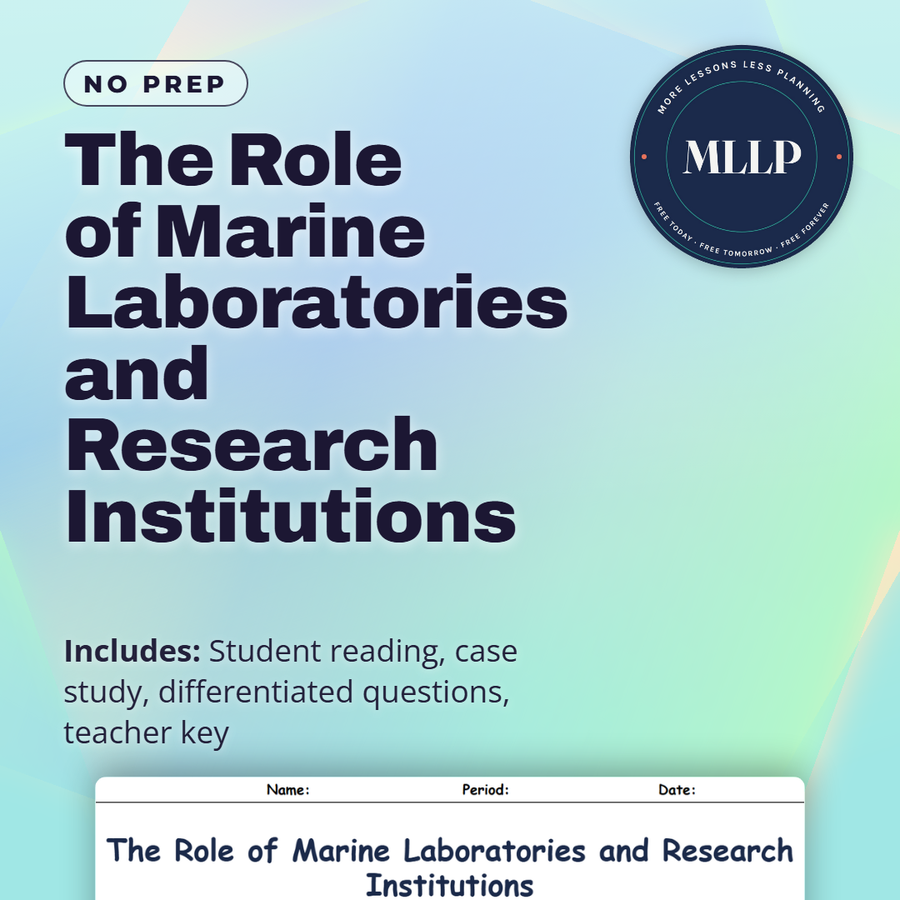
The Role of Marine Laboratories and Research Institutions
Quality reviewed September 2026
Facts verified September 14, 2026
- Subject
- Science
- Grades
- Grades 9-12
- Length
- 7-page student worksheet
- Time
- About one 50-minute class period
- Great for
- Sub plans and independent work
- Includes
- Reading passage, comprehension questions + full answer key
- Format
- Print-and-go PDF
What students do
- Match terms like WHOI, Scripps Institution, Alfred Wegener Institute, and JAMSTEC to their correct definitions
- Fill in the blank sentences on the Galápagos Rift, visitor centers, and chemosynthesis
- Answer multiple choice questions on which institution developed Alvin, what process powers hydrothermal vent life, and why marine labs matter for conservation
- Write short answers on how marine labs connect research to the public, why governments partner with marine institutions, and what role training plays in their mission
What it covers
- Marine laboratories like WHOI, Scripps, the Alfred Wegener Institute, and JAMSTEC and what each one contributes
- How marine labs support conservation, education, and public outreach through aquariums and training programs
- A case study on how Woods Hole Oceanographic Institution's Alvin submersible found hydrothermal vent life in 1977
Start reading this worksheet
Why Marine Laboratories Matter
Marine science is not confined to ships and submersibles. Much of the most important research happens at marine laboratories and research institutions located along coastlines around the world. These facilities provide scientists with equipment, controlled environments, and access to the sea, allowing for both short- and long-term studies. Laboratories serve as hubs where biologists, chemists, geologists, and oceanographers collaborate to advance knowledge and solve real-world problems. Marine labs play several roles: they support fieldwork, conduct laboratory experiments, train new scientists, and share findings with the public. For example, aquaria within labs can replicate ocean conditions to study how temperature or acidity affects marine organisms. Advanced laboratories house state-of-the-art technology, from DNA sequencing tools for studying marine genetics to mass spectrometers that detect chemical pollutants at trace levels. By linking field observations with lab analysis, marine scientists create a more complete understanding of the ocean.
Famous Marine Institutions
Some marine research institutions are known worldwide for their contributions. The Woods Hole Oceanographic Institution (WHOI) in Massachusetts is famous for developing the Alvin submersible and leading expeditions to explore hydrothermal vents and shipwrecks. The Scripps Institution of Oceanography in California is one of the oldest and largest centers for ocean and Earth science research, conducting studies on climate change, marine biology, and geology. Internationally, organizations such as the Alfred Wegener Institute in Germany focus on polar marine research, while Japan’s JAMSTEC operates advanced submersibles and research vessels. These institutions not only advance science but also provide training for students, partnerships with governments, and communication with the public. Their work ensures that marine science influences policy, conservation, and global awareness.
Marine Labs and Conservation
Marine laboratories also play a critical role in conservation. They study endangered species, monitor ecosystems, and test strategies for protecting marine environments. For example, scientists in coastal labs often monitor coral reefs, seagrass beds, and mangroves to track how they respond to pollution or climate change. Marine labs also partner with governments and international organizations to develop marine protected areas and sustainable fishing policies. By combining laboratory research with community outreach, marine institutions build public support for conservation. Many host visitor centers or aquariums where the public can see live marine animals and learn about their role in the ecosystem. These programs inspire future scientists while raising awareness about the importance of healthy oceans for human survival.
Like what you read? The full reading, the case study, and every question set are in the free download below, along with the answer key.
Why this matters
Marine science looks like fieldwork from the outside, one person on a boat with a net, but in 1977 the real breakthrough came from a submersible called Alvin descending to the Galápagos Rift and finding entire animal communities living without sunlight, powered by chemosynthesis instead of plants. That discovery came out of Woods Hole Oceanographic Institution, alongside labs like Scripps, the Alfred Wegener Institute, and JAMSTEC.
I use this reading to show the machinery behind that one dramatic dive: visitor centers, aquariums, and training programs that carry lab research out to the public. Governments partner with these institutions for a reason, and conservation policy leans on that partnership far more than on any single expedition.
From one teacher to another
Not all marine science happens on a ship, and this reading looks at the labs and institutions that keep the field running. Students read about WHOI, Scripps, the Alfred Wegener Institute, and JAMSTEC, and how each one supports research, training, and conservation. The case study covers WHOI's 1977 discovery of hydrothermal vent ecosystems using the Alvin submersible at the Galápagos Rift. Questions ask students to connect lab research to public outreach and conservation policy.
What you get
Download
Where should I send the next one?
Everything here is free and it stays that way. Leave your email and I'll send you the new lessons as they go up. You can unsubscribe from any one of them.
Related resources
Ancient Ocean Explorers: Polynesians, Phoenicians, and Beyond
Branches of Marine Science: Biology, Chemistry, Geology, and Physical Oceanography
Careers in Marine Science and Oceanography
Famous Expeditions: HMS Challenger, Alvin, and Beyond
Marine Science Contributions to Society: Medicine, Climate, and Food
Modern Tools of Ocean Exploration: ROVs, AUVs, and Sonar
Every lesson on this site is free to download and use. If one of them saved you a prep period, you can chip in a few bucks toward my three kids' daycare fund. That's genuinely where tips go.