
The Rise of Islam and the Caliphates
- Slide deck
- Guided notes
- Guided notes teacher key
- Activity + answer key
- Quiz + answer key
- Exit ticket + answer key
- Teacher guide
- Teacher presentation notes
Where should I send the next one?
Everything here is free and it stays that way. Leave your email and I'll send you the new lessons as they go up. You can unsubscribe from any one of them.
Every file in this toolkit
Related resources
Great Zimbabwe Stone City
Mansa Musa's Pilgrimage to Mecca
Songhai and Timbuktu Scholarship

The Great Schism of 1054
The Islamic Golden Age
The Swahili Coast Trade Cities
What students do
- Analyze al-Baladhuri's early Arab account of a conquest treaty as a one-sided historical document
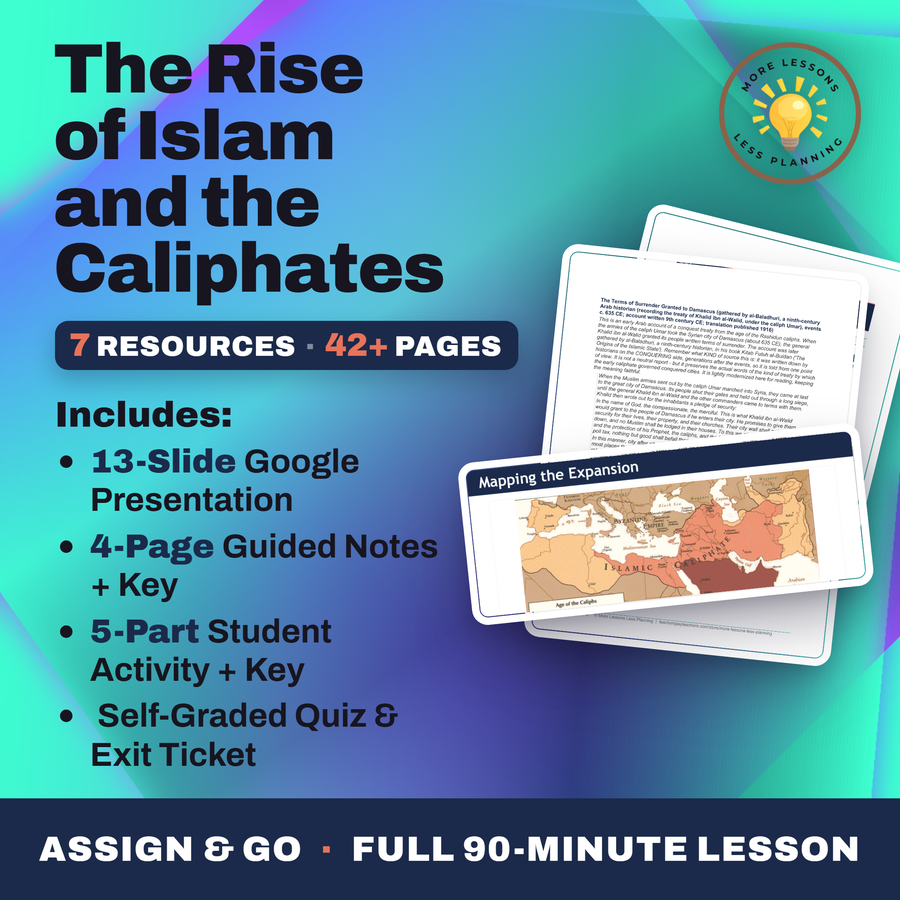
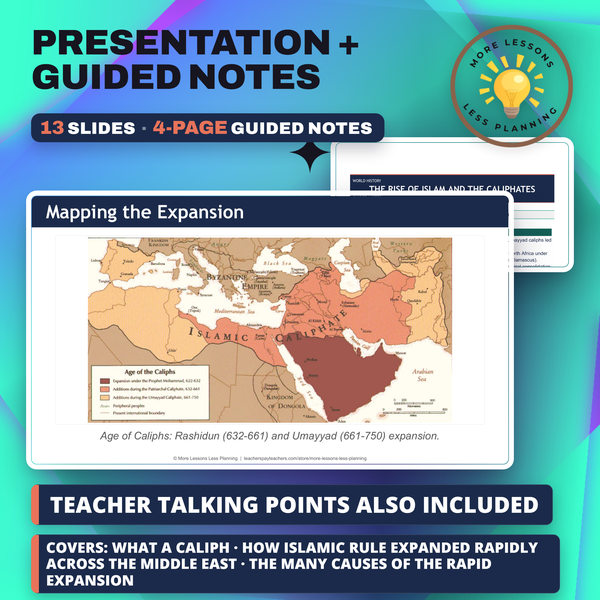
- Map the caliphate's expansion in stages, from the Rashidun conquests to the Umayyad reach into Spain
- Argue why the rapid expansion needs several causes, not religion alone, to explain it
- Distinguish how dhimmis actually lived under early Islamic rule from the forced-conversion myth
What it covers
- The difference between the four individually chosen Rashidun caliphs and the Umayyad ruling dynasty
- Why the exhausted Byzantine and Sasanian empires couldn't defend their own frontiers
- The jizya tax and what dhimmi status actually meant for conquered Christians and Jews
- How the Sunni-Shia split began as a leadership dispute, described without favoring either side
Learning targets
- Explain what a caliph and a caliphate were, and how the Rashidun and Umayyad caliphs led the Muslim community after Muhammad's death.
- Describe how Islamic rule expanded rapidly across the Middle East and North Africa under the Rashidun caliphs (632-661) and the Umayyad dynasty (661-750, capital Damascus).
- Identify the many causes of the rapid expansion - religious motivation, political consolidation, trade, and the exhaustion of the Byzantine and Sasanian empires - and explain how non-Muslims (dhimmis) lived under Islamic rule by paying the jizya.
- Analyze an early Arab account of a conquest treaty (al-Baladhuri, trans. Hitti 1916) as a primary source, reading it critically as a document written from one point of view.
From one teacher to another
I won't reduce this expansion to one cause, because both of the easy stories, pure religious conquest and barely a conquest at all, fall apart fast once students dig in. Mapping the Rashidun conquests apart from the Umayyad reach kills the second myth, and working out why dhimmis paid a tax instead of facing forced conversion kills the first, before anyone reads al-Baladhuri's own account of a city surrendering. The succession dispute that becomes the Sunni-Shia split gets the same neutral treatment as everything else here.
Every lesson on this site is free to download and use. If one of them saved you a prep period, you can chip in a few bucks toward my three kids' daycare fund. That's genuinely where tips go.