The Reign of Terror
Quality reviewed September 2026
- Grades
- Grades 9-12
- Time
- About two 50-minute class periods
- Includes
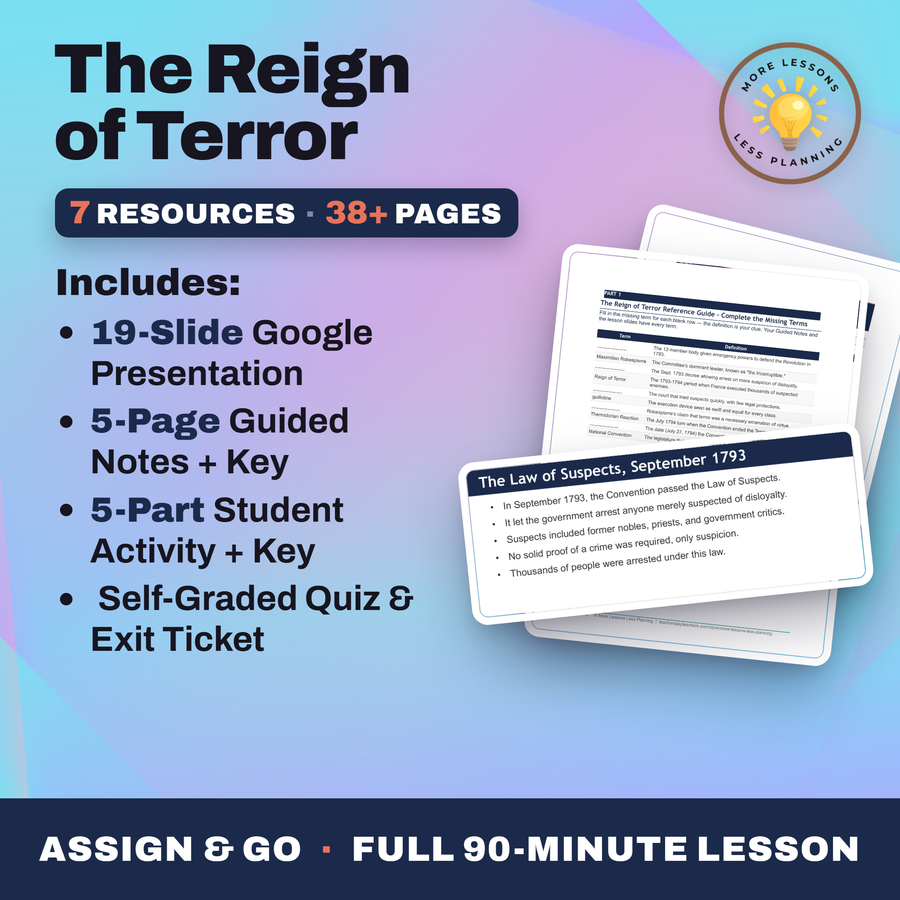
- 11 ready-to-teach files
- Format
- Word (.docx) · PowerPoint (.pptx)
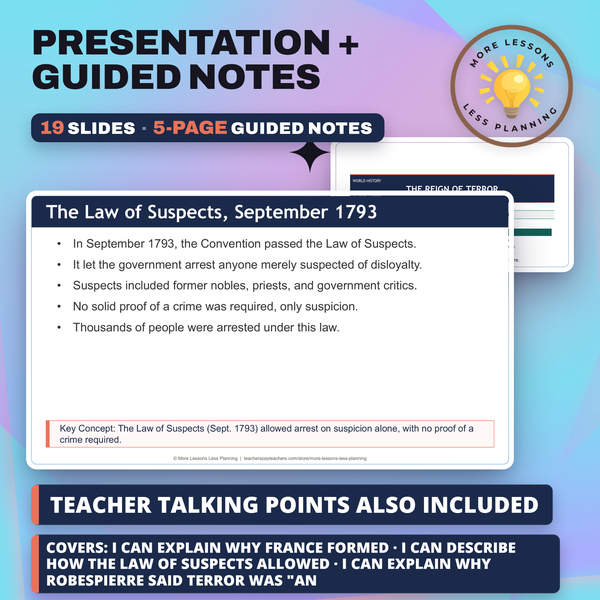
- Slide deck
- Guided notes
- Guided notes teacher key
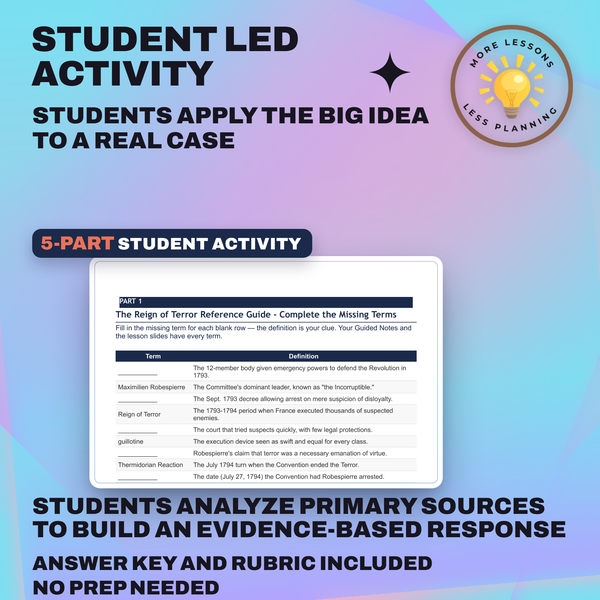
- Activity + answer key
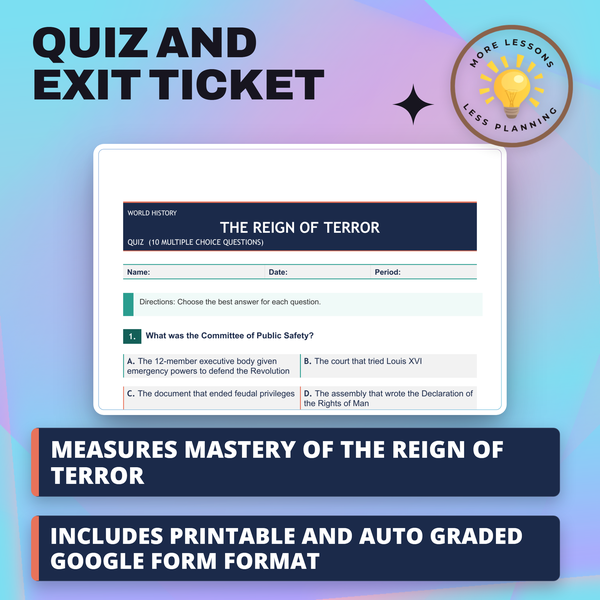
- Quiz + answer key
- Exit ticket + answer key
- Teacher guide
- Teacher presentation notes
What students do
- Explain why the Convention created the Committee of Public Safety in 1793 to defend the Revolution
- Read Robespierre's 1794 speech calling terror an emanation of virtue and explain his reasoning
- Trace how the Law of Suspects allowed arrests on suspicion alone, without evidence
- Analyze how the Terror turned on its own leaders, ending with Robespierre's own arrest and execution
What it covers
- The Committee of Public Safety and the emergency powers that produced the Terror
- The Law of Suspects and the Revolutionary Tribunal's use of arrest on suspicion alone
- Robespierre's own justification of terror as necessary virtue, from his February 1794 speech
- The Thermidorian Reaction and how the Terror consumed Robespierre himself
Learning targets
- I can explain why France formed the Committee of Public Safety in 1793.
- I can describe how the Law of Suspects allowed arrests on suspicion alone.
- I can explain why Robespierre said terror was "an emanation of virtue."
- I can explain how the Terror turned on its own leaders, including Robespierre.
- I can compare the Revolution's ideals to the violence of the Terror.
Peek inside
In April 1793, the National Convention created the Committee of Public Safety.
It was a 12-member body with emergency powers to defend the Revolution.
Robespierre joined the Committee and became its dominant voice by July 1793.
Robespierre was known as "the Incorruptible" for his strict principles.
The Committee could act fast, without waiting for the full Convention to debate.
A New Emergency Body
In 1793, the National Convention created the Committee of Public Safety.
It was a -member executive body with emergency powers.
Robespierre became the Committee’s dominant voice by 1793.
Robespierre was known as "the " for his strict principles.
1. In 1793, the National Convention formed a 12-member body. It got emergency powers to defend the Revolution. This body was the .
Why this matters
Suspicion alone, with no evidence required, was grounds for arrest once the Convention passed the Law of Suspects in 1793. Robespierre defended that system to the Convention's own face the following February, calling terror an emanation of virtue, and within months the same body that cheered him sent him to the guillotine.
This topic deals with state violence, so instead of dramatizing it I keep the lesson anchored to Robespierre's own words and the Committee of Public Safety that produced them, created to defend a revolution under attack from every direction. What lands hardest in class is how fast the machinery turned on the man who built it.
From one teacher to another
This lesson deals with state violence, so I built it to stay factual and sourced rather than dramatic. Students start with why the Convention created the Committee of Public Safety in 1793 to defend a revolution under attack from outside and inside France, then work through the Law of Suspects, which let the government arrest people on suspicion alone, with no evidence required. The center of the lesson is Robespierre's own words: a February 1794 speech where he told the Convention that terror was an emanation of virtue, necessary to protect the Republic. Students use that primary source to understand how revolutionary leaders justified what they were doing, then follow the Terror to its own end, when the same Convention turned on Robespierre and sent him to the guillotine within a day of his arrest. Guided notes track the slides, the activity has a full answer key, and the quiz and exit ticket both come with keys.
Every file in this toolkit
Download
Where should I send the next one?
Everything here is free and it stays that way. Leave your email and I'll send you the new lessons as they go up. You can unsubscribe from any one of them.
Related resources
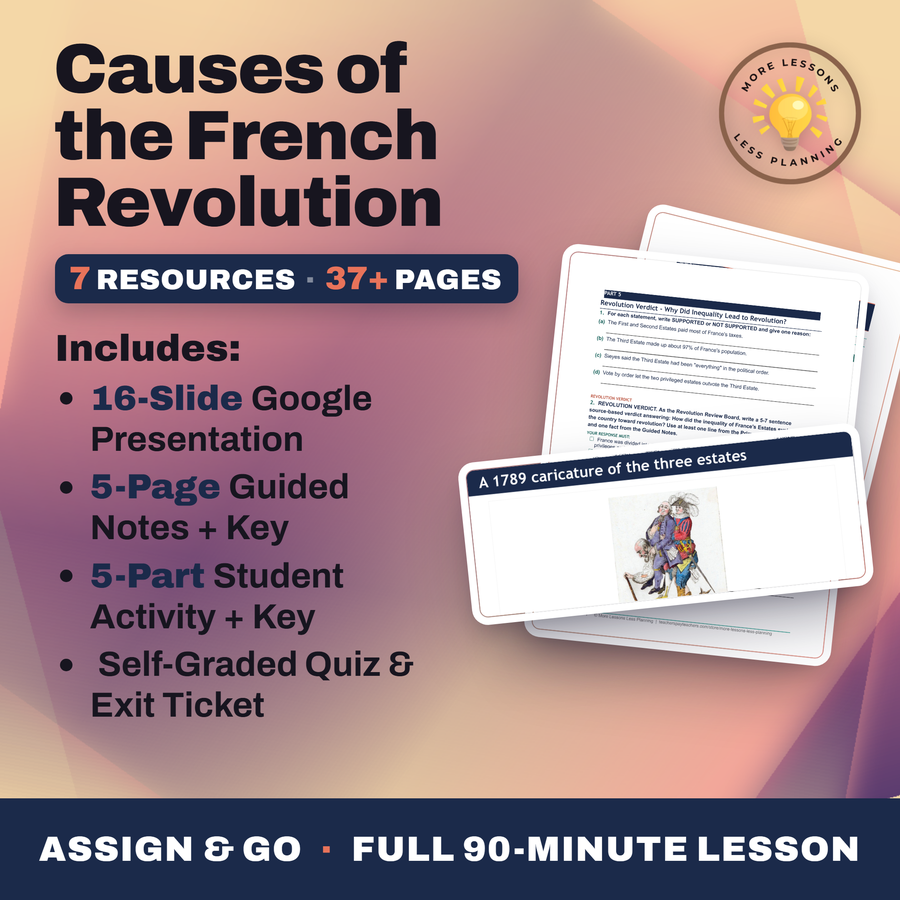
Causes of the French Revolution
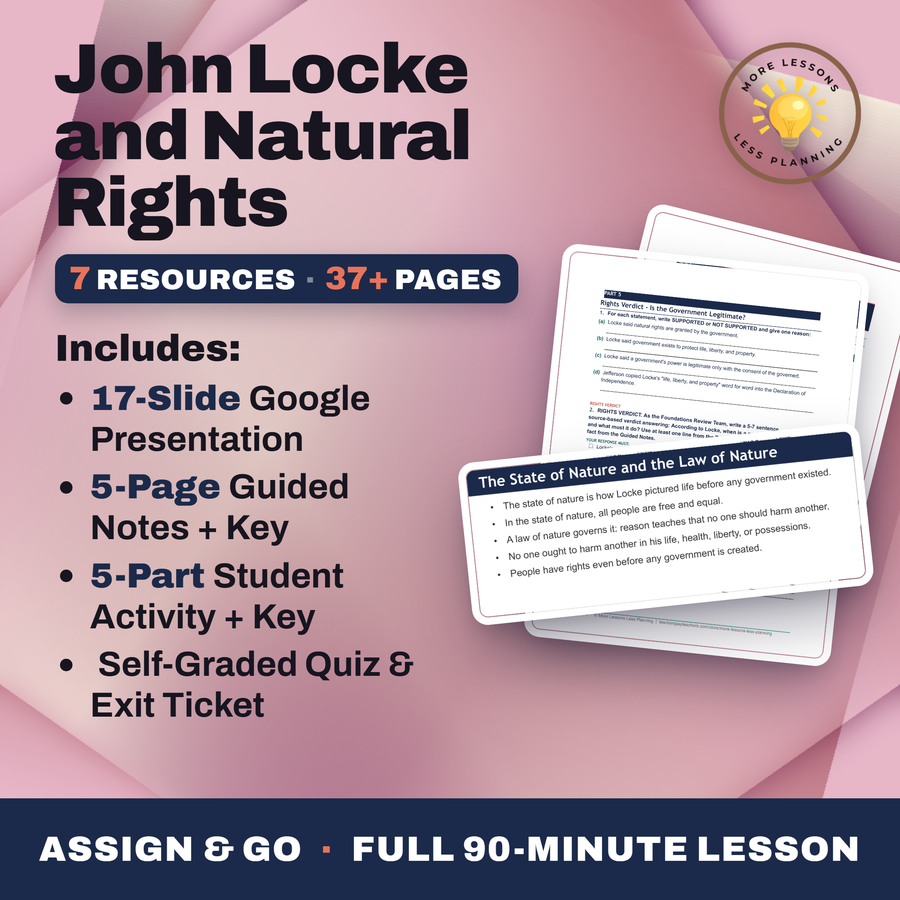
John Locke and Natural Rights
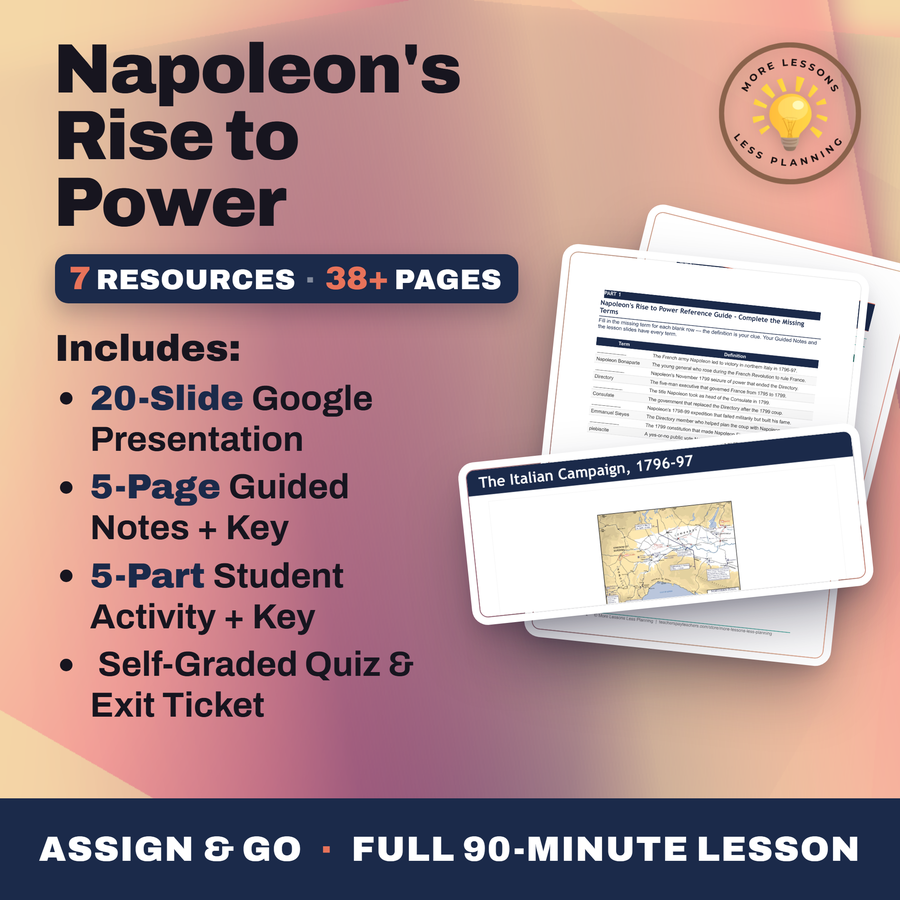
Napoleon's Rise to Power
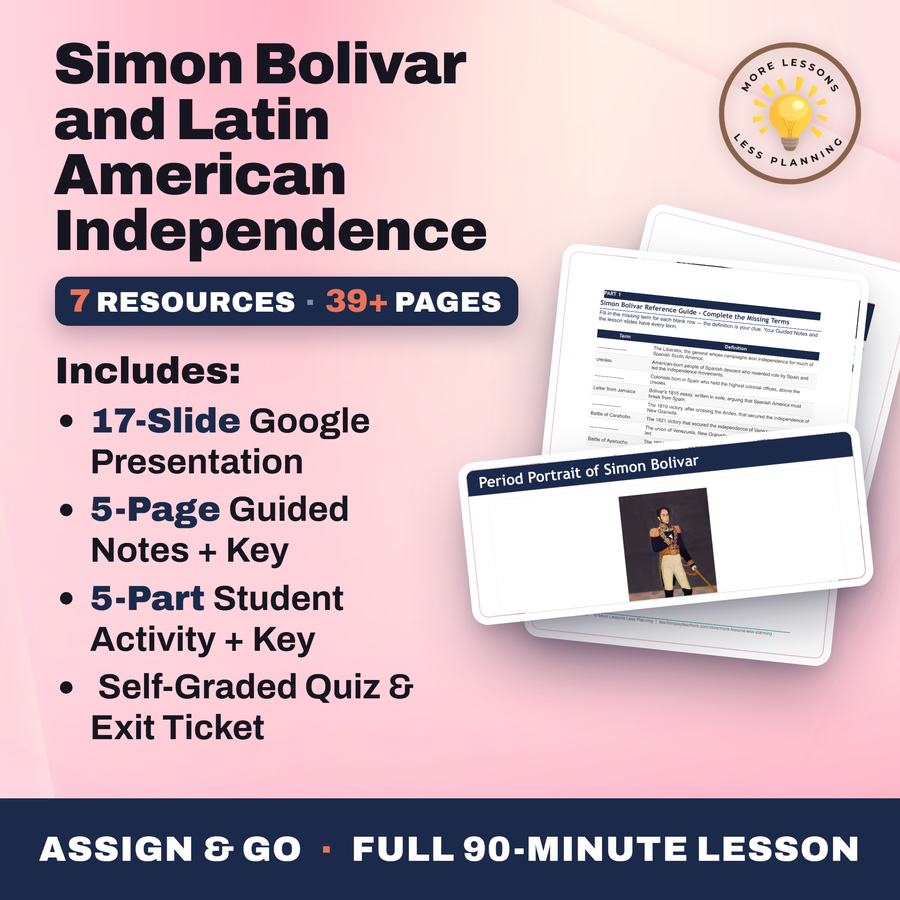
Simon Bolivar and Latin American Independence
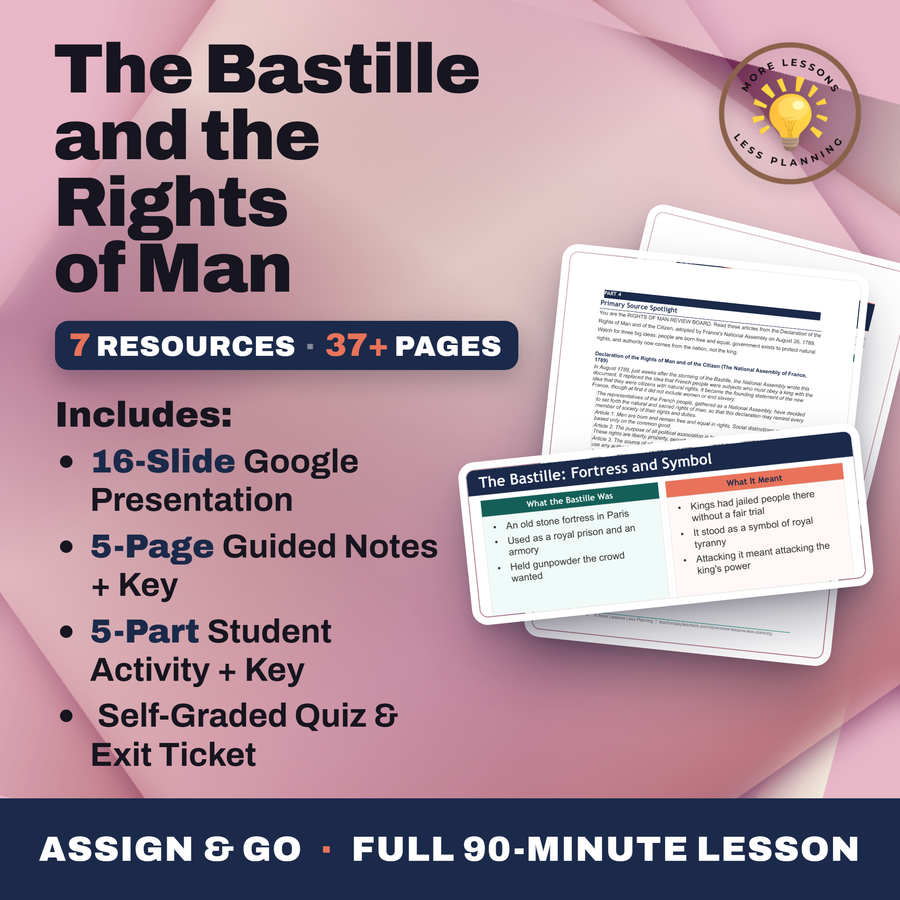
The Bastille and the Rights of Man
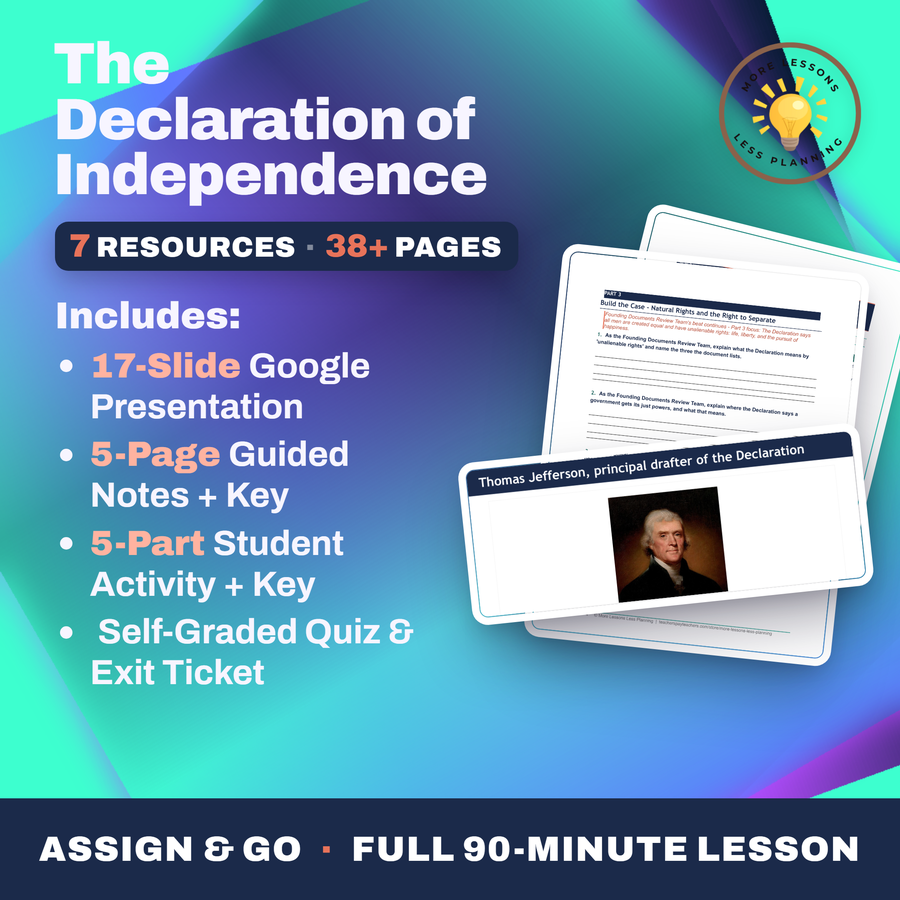
The Declaration of Independence
Every lesson on this site is free to download and use. If one of them saved you a prep period, you can chip in a few bucks toward my three kids' daycare fund. That's genuinely where tips go.