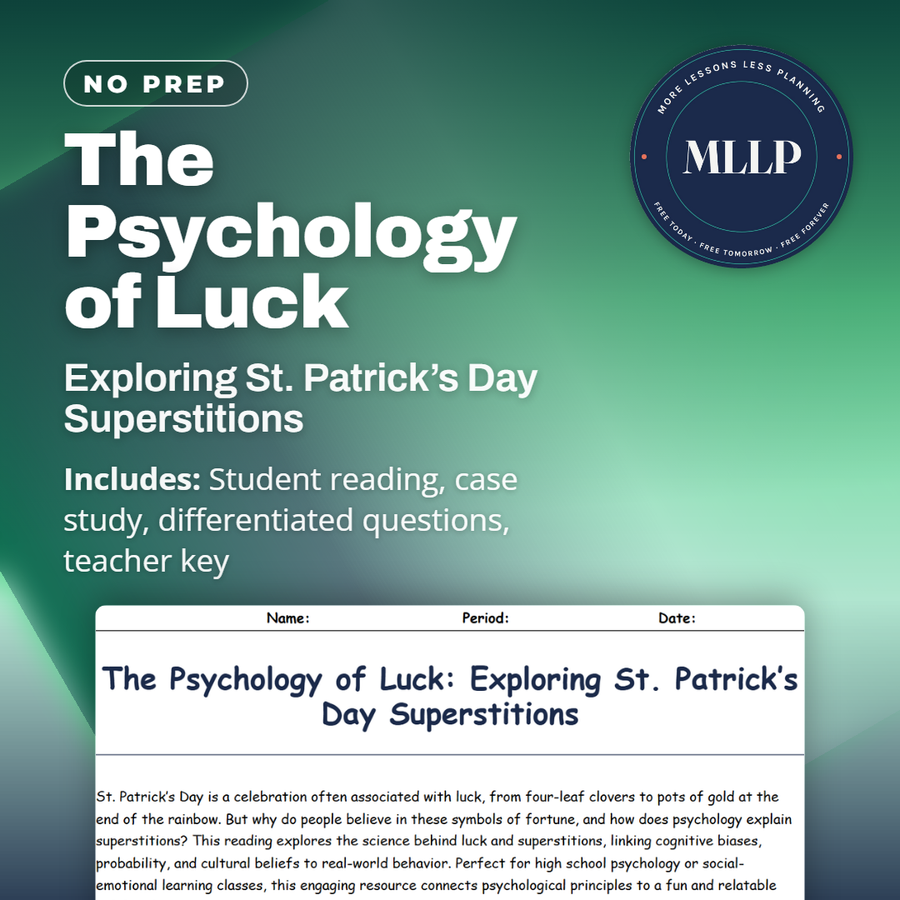
The Psychology of Luck: Exploring St. Patrick’s Day Superstitions
Quality reviewed September 2026
Facts verified September 9, 2026
- Subject
- Social Studies
- Grades
- Grades 9-12
- Length
- 6-page student worksheet
- Time
- About one 50-minute class period
- Great for
- Sub plans and independent work
- Includes
- Reading passage, comprehension questions + full answer key
- Format
- Print-and-go PDF
What students do
- Define illusory correlation and identify examples of false connections students make daily
- Explain how confirmation bias makes people remember lucky shirt wins and forget losses
- Analyze the gamblers fallacy and why people wrongly expect losing streaks to reverse
- Apply placebo effect research to show how belief changes performance and stress levels
What it covers
- Cognitive biases and superstition formation
- Illusory correlation and confirmation bias
- Placebo effect and the psychology of belief
Start reading this worksheet
St. Patrick’s Day is a celebration often associated with luck, from four-leaf clovers to pots of gold at the end of the rainbow. But why do people believe in these symbols of fortune, and how does psychology explain superstitions? This reading explores the science behind luck and superstitions, linking cognitive biases, probability, and cultural beliefs to real-world behavior. Perfect for high school psychology or social-emotional learning classes, this engaging resource connects psychological principles to a fun and relatable holiday theme.
Cultural Beliefs and the Origins of Superstitions
Throughout history, people have attributed luck to objects, rituals, and symbols. Four-leaf clovers, for example, are rare finds and have long been considered signs of good fortune. Similarly, legends of leprechauns guarding pots of gold highlight the human fascination with luck and reward. These cultural symbols reflect the universal human desire for control in uncertain situations. Psychologists suggest that superstitions provide a sense of security by offering explanations for random events. This belief system often stems from cognitive biases, such as the tendency to find patterns in unrelated events. For example, a student who aces an exam after wearing a “lucky shirt” may associate the shirt with academic success, even though the connection is purely coincidental.
The Science of Belief: Why We Seek Luck
Research in psychology highlights the brain’s inclination to seek patterns and attribute meaning to them, even when no logical connection exists. This is called illusory correlation, a cognitive bias where people falsely link two unrelated events. For instance, rituals like knocking on wood or crossing fingers may feel comforting because they create the illusion of control in uncertain situations. Additionally, probability and randomness play significant roles in perceptions of luck. People often misinterpret random events as being influenced by external forces, leading to confirmation bias, where they remember successful outcomes linked to rituals and forget instances when they didn’t work.
Like what you read? The full reading, the case study, and every question set are in the free download below, along with the answer key.
Why this matters
A study in this reading found people carrying a lucky charm did better on a memory task, not because the charm worked but because carrying it made them calmer and more confident. Belief changes behavior even when the belief is false, and the four leaf clover was never doing the work.
Illusory correlation and confirmation bias give students the vocabulary for why a lucky win gets remembered and a losing streak gets forgotten. Most are surprised the gambler's fallacy has a name, since at least one classmate believed a losing streak makes the next win more likely.
From one teacher to another
A study showed people with lucky charms performed better on memory tasks, not because magic was real but because they felt more confident and less stressed. That's how belief works in the brain, it shifts how we think and act. Students examine why four-leaf clovers feel lucky even though probability doesn't change, and they learn that rituals have real psychological benefits even when the luck itself isn't.
What you get
Download
Where should I send the next one?
Everything here is free and it stays that way. Leave your email and I'll send you the new lessons as they go up. You can unsubscribe from any one of them.
Related resources
The Forensics of St. Patrick’s Day: Holiday Crimes Solved
Altitude, Cold Stress, and Human Adaptation: How the Body Stays in Balance
American History and Cinco de Mayo: Cultural Exchange and Historical Narratives
Ancient Summer: What Did Summer Mean to the Egyptians, Greeks, and Romans?
Animal Courtship Biology: Sexual Selection in the Wild
Bats, Vampires, and Biology
Every lesson on this site is free to download and use. If one of them saved you a prep period, you can chip in a few bucks toward my three kids' daycare fund. That's genuinely where tips go.