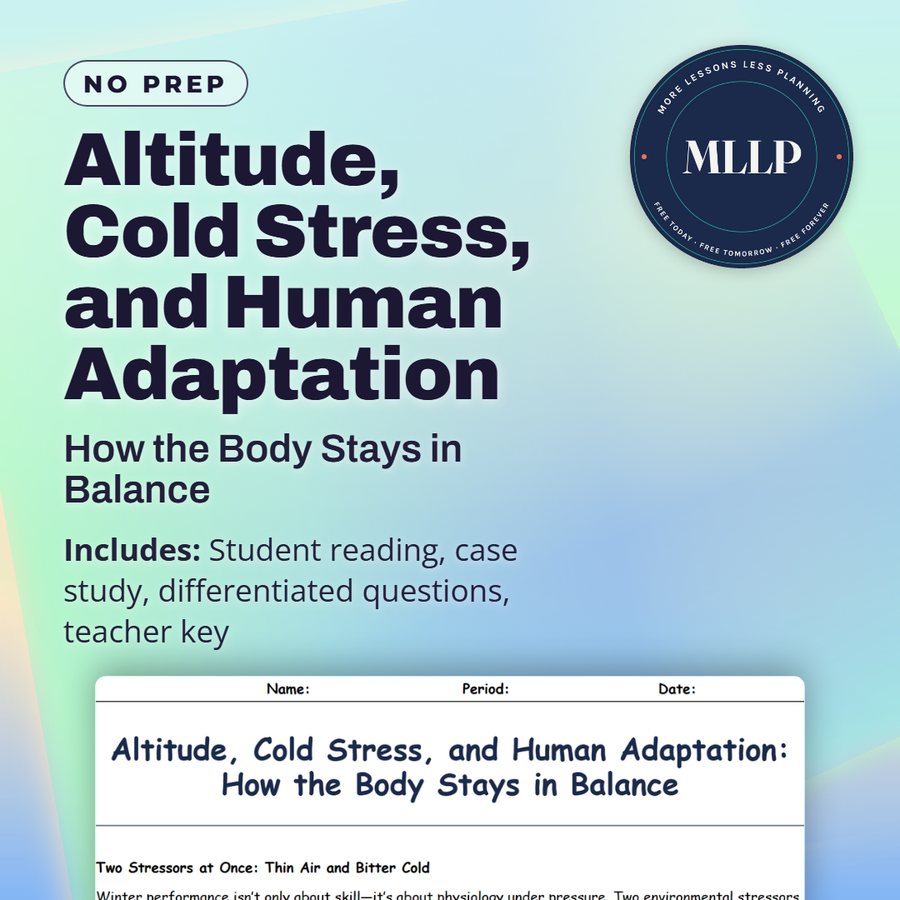
Altitude, Cold Stress, and Human Adaptation: How the Body Stays in Balance
Quality reviewed September 2026
Facts verified September 9, 2026
- Subject
- Science
- Grades
- Grades 9-12
- Length
- 8-page student worksheet
- Time
- About one 50-minute class period
- Great for
- Sub plans and independent work
- Includes
- Reading passage, comprehension questions + full answer key
- Format
- Print-and-go PDF
What students do
- Explain how homeostasis works when the body faces two stressors at once
- Describe how cold affects dexterity and decision-making in athletes
- Analyze the difference between immediate responses and long-term adaptations
- Evaluate why "live high, train low" helps athletes more than altitude-only training
What it covers
- Altitude and oxygen delivery
- Cold stress and thermoregulation
- Adaptation and homeostasis
Start reading this worksheet
Two Stressors at Once: Thin Air and Bitter Cold
Winter performance isn’t only about skill. It’s about physiology under pressure. Two environmental stressors show up repeatedly in winter sport: altitude and cold. At higher altitude, the air contains the same percentage of oxygen, but the oxygen pressure is lower, meaning it’s harder for oxygen to move from lungs into the blood. At the same time, cold increases the body’s energy demands because the body must maintain a stable internal temperature. Put those together and you get a double challenge: athletes must produce high power while managing oxygen limitations and heat loss. This is where homeostasis becomes the central concept. Homeostasis is the body’s ability to keep internal conditions stable (temperature, blood pH, oxygen levels, hydration) even when the environment changes. In winter sport, homeostasis is under constant attack. Cold can constrict blood vessels in the skin to reduce heat loss, but that can reduce dexterity in hands and feet. Breathing cold, dry air can irritate airways and contribute to exercise-induced breathing issues in some athletes. Altitude can raise heart rate and breathing rate even at rest as the body tries to deliver enough oxygen. The body also has to decide what to prioritize. When you’re cold, your body may divert energy toward warming itself. When you’re at altitude, your body may increase ventilation and cardiac output to move oxygen. During intense exercise, muscles demand oxygen and fuel immediately. Athletes who understand these stressors can train smarter: dress appropriately, manage pacing, plan acclimatization, and pay attention to hydration and fueling. This isn’t about being “tough.” It’s about respecting biology.
Breathing and Oxygen Delivery: What Changes at Altitude
At altitude, the body responds quickly and slowly. The quick response is increased breathing. You breathe faster and deeper to bring more oxygen into the lungs. Heart rate also rises to circulate blood faster. This can make early workouts at altitude feel strangely hard, even at speeds that usually feel easy. Athletes often describe it as feeling “out of gas” sooner. That’s not weakness; that’s oxygen physics. Over time, the body adapts. One long-term adaptation is increased production of red blood cells, which carry oxygen using hemoglobin. More red blood cells can improve oxygen transport, which can support endurance. This is the reasoning behind altitude training. However, adaptation takes time, and not all athletes respond the same way. Too rapid an increase in training intensity can lead to fatigue, illness, or overtraining. Smart altitude training includes gradual load, recovery, and monitoring. A key misconception is that altitude training automatically makes everyone faster. The benefit depends on timing, duration, and how the athlete balances training quality. If altitude causes an athlete to train less intensely for weeks, performance could stagnate. That’s why some athletes use “live high, train low” strategies: sleeping at altitude for adaptation but training at lower elevation for higher intensity sessions. Students should also connect this to respiration and energy use. If oxygen delivery is limited, the body may rely more on anaerobic energy pathways in high-intensity bursts, producing more lactate and increasing fatigue. That can change pacing and strategy during events.
Cold Stress: Thermoregulation, Energy Use, and the Risk of Mistakes
Cold is not just uncomfortable; it changes body function. To maintain temperature, the body increases heat production through metabolism and, if needed, shivering. Blood vessels in the skin constrict to conserve heat, which can reduce sensation and coordination in fingers and toes. That matters because winter sport performance requires precise timing: grip, balance, fine motor control. Cold hands can mean slower reaction and weaker grip. Cold muscles can mean reduced power and increased injury risk if warm-up is insufficient. Cold also affects fueling. The body may burn more energy to stay warm, especially in prolonged outdoor events like cross-country skiing or biathlon. Athletes who underfuel can experience faster fatigue and impaired judgment. Hydration is another hidden issue. Cold reduces thirst signals, and athletes may not notice dehydration. Meanwhile, breathing cold air increases water loss through respiration. Dehydration can thicken blood slightly, strain the cardiovascular system, and reduce performance. There’s also an equipment-meets-biology connection. Heavy layers can trap heat but may restrict movement. Sweating under layers can lead to chilling when the athlete slows down or stops, because wet clothing loses insulation. This is why athletes learn layering systems: moisture-wicking base layers, insulating mid layers, and windproof shells. That’s practical science. In winter sport, mistakes often happen when the body is stressed: fatigue, cold, low oxygen, poor hydration. Those mistakes aren’t “mental weakness.” They’re physiology shaping decision-making.
Like what you read? The full reading, the case study, and every question set are in the free download below, along with the answer key.
Why this matters
Altitude training is supposed to make an athlete faster, not slower, yet the opposite happens first. The body needs weeks to raise its red blood cell count before it can raise its pace. Cold adds a second demand, since blood pulled toward the core leaves fingers and toes clumsy exactly when precision matters most.
It's tempting to read effort as the only sign of progress. Watching a skier's easy pace turn brutal at altitude teaches students to separate the immediate stress response from the slower adaptation underneath it, and why a coach holds back intensity in the first weeks.
From one teacher to another
I use this one when we cover how winter athletes manage competing pressures on their bodies. The worksheet follows Noah, a distance skier who climbs to altitude three weeks before a big race. Watching his heart rate spike and his easy pace feel impossible is the hook, students see why altitude training feels harder before it makes athletes faster. The real learning comes in the second half, where students work through why his coach didn't push intensity early and how red blood cell adaptation actually takes time. Cold adds another layer, because it makes you choose between warmth and dexterity. That tradeoff shows up in almost every sport I teach.
What you get
Download
Where should I send the next one?
Everything here is free and it stays that way. Leave your email and I'll send you the new lessons as they go up. You can unsubscribe from any one of them.
Related resources
Blueprint of Power: Muscles and Joints That Make Winter Sports Work
Doping Investigations: How Forensic Science Protects Sport Integrity

Gold Medals Need Geography: Why Some Places Can Host and Others Can’t
Luge and Skeleton: Extreme Speed, Risk Variables, and Safety Engineering

Nations, Boycotts, and Global Messages: When the Olympics Become Diplomacy

Opening Ceremonies: The Night the Olympics Become a Global Story
Every lesson on this site is free to download and use. If one of them saved you a prep period, you can chip in a few bucks toward my three kids' daycare fund. That's genuinely where tips go.