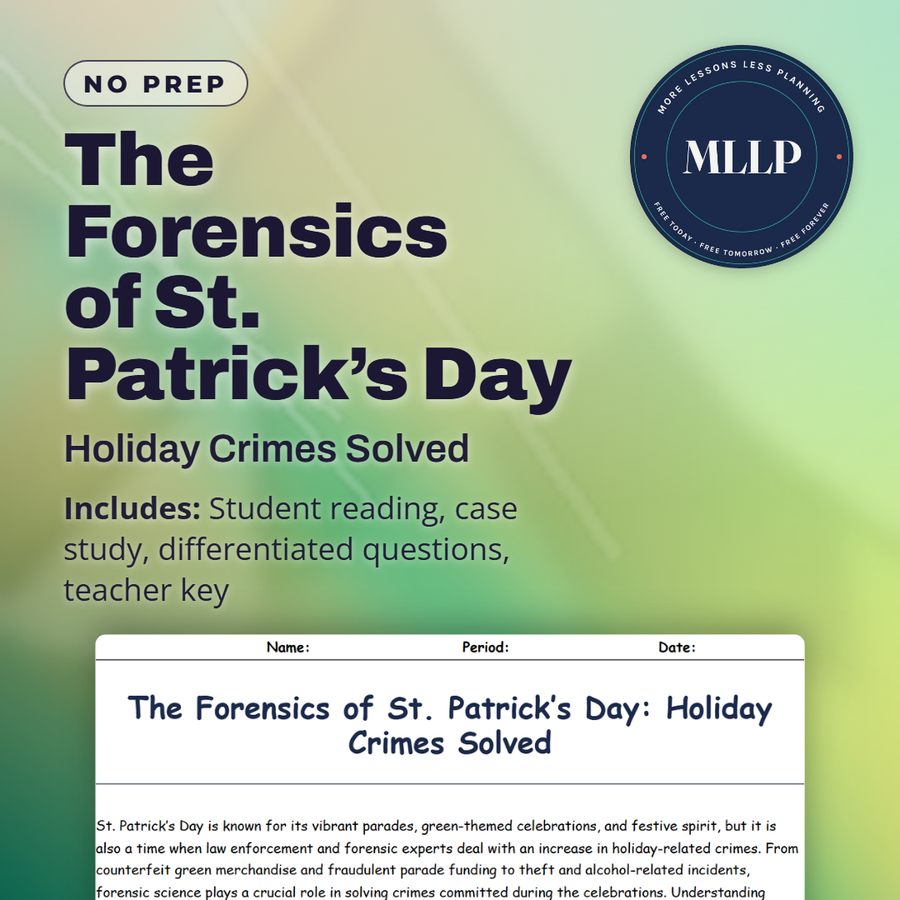
The Forensics of St. Patrick’s Day: Holiday Crimes Solved
Quality reviewed September 2026
Facts verified September 9, 2026
- Subject
- Science
- Grades
- Grades 9-12
- Length
- 6-page student worksheet
- Time
- About one 50-minute class period
- Great for
- Sub plans and independent work
- Includes
- Reading passage, comprehension questions + full answer key
- Format
- Print-and-go PDF
What students do
- Use UV light and fiber analysis to identify counterfeit St. Patrick's Day merchandise
- Analyze forensic accounting methods to detect parade funding fraud and embezzlement
- Apply toxicology and DNA evidence to solve alcohol-related crimes
- Reconstruct a bar fight using surveillance footage, fingerprints, and bloodstain patterns
What it covers
- Forensic techniques in merchandise fraud
- Financial forensics and parade funding crimes
- Toxicology and alcohol-related crime investigation
Start reading this worksheet
St. Patrick’s Day is known for its vibrant parades, green-themed celebrations, and festive spirit, but it is also a time when law enforcement and forensic experts deal with an increase in holiday-related crimes. From counterfeit green merchandise and fraudulent parade funding to theft and alcohol-related incidents, forensic science plays a crucial role in solving crimes committed during the celebrations. Understanding forensic techniques used to investigate these cases provides insight into both criminal justice and scientific inquiry.
Investigating Counterfeit Merchandise
Every year, street vendors flood the market with fake “official” St. Patrick’s Day merchandise, including counterfeit t-shirts, hats, and novelty items. These items often violate intellectual property laws and deceive consumers into buying low-quality, unlicensed goods. Forensic investigators use document analysis, ink chromatography, and fiber comparison to distinguish counterfeit goods from legitimate merchandise. UV light and chemical testing can identify fake brand markings and distinguish authentic materials from subpar imitations. Law enforcement agencies collaborate with forensic experts to track distribution networks of counterfeit goods. By tracing fraudulent supply chains, authorities can locate manufacturers, seize illegal merchandise, and prosecute offenders under trademark infringement laws.
Fraud in Parade Funding
Organizing a large-scale parade requires significant financial resources, and not all transactions are legitimate. Cases of embezzlement, bribery, and money laundering tied to parade planning have surfaced in various cities. One notable case occurred in New York City, where an investigation uncovered that a nonprofit organization responsible for organizing the city’s St. Patrick’s Day Parade had misappropriated hundreds of thousands of dollars in parade donations. The organization’s officials were charged with wire fraud and embezzlement, having funneled funds into personal accounts rather than parade-related expenses. Financial forensic analysts detected discrepancies in bookkeeping, including inflated vendor invoices and unaccounted sponsorship money. Another case in Boston revealed that certain parade organizers had been accepting bribes from businesses seeking prime spots along the parade route. Investigators uncovered emails and bank records showing evidence of under-the-table payments in exchange for securing premium parade positions. Forensic accountants played a key role in tracking financial transactions and exposing the corruption. Forensic accountants analyze financial records to detect suspicious money transfers, fraudulent invoices, and discrepancies in reported expenses. Investigators also rely on handwriting analysis and forensic auditing techniques to uncover forged signatures or altered contracts. In past cases, officials have traced missing funds to fraudulent nonprofit organizations set up to siphon parade donations.
Like what you read? The full reading, the case study, and every question set are in the free download below, along with the answer key.
Why this matters
A stolen wallet, a bar fight, and a blood alcohol reading twice the legal limit turned one St. Patrick's Day night in Chicago into a full forensic case. Fingerprints placed a suspect at the scene, DNA from bloodstains confirmed it, and toxicology closed the argument that witnesses alone could never have settled.
Students tend to think forensic science belongs to headline murders, not a bar fight on a holiday weekend, so this case resets that assumption fast. Once they see fingerprints and DNA solve something as ordinary as a stolen wallet, they stop treating evidence as something dramatic and start treating it as something reliable.
From one teacher to another
A Chicago bar fight on St. Patrick's Day turned into a larceny and assault case thanks to forensics: fingerprints on the stolen wallet, DNA from bloodstains, toxicology showing the suspect was twice the legal limit. This worksheet uses the scenario to show how forensic science untangles what witnesses see differently. Even holiday crimes follow evidence, not rumor.
What you get
Download
Where should I send the next one?
Everything here is free and it stays that way. Leave your email and I'll send you the new lessons as they go up. You can unsubscribe from any one of them.
Related resources
The Psychology of Luck: Exploring St. Patrick’s Day Superstitions
Altitude, Cold Stress, and Human Adaptation: How the Body Stays in Balance
American History and Cinco de Mayo: Cultural Exchange and Historical Narratives
Ancient Summer: What Did Summer Mean to the Egyptians, Greeks, and Romans?
Animal Courtship Biology: Sexual Selection in the Wild
Bats, Vampires, and Biology
Every lesson on this site is free to download and use. If one of them saved you a prep period, you can chip in a few bucks toward my three kids' daycare fund. That's genuinely where tips go.