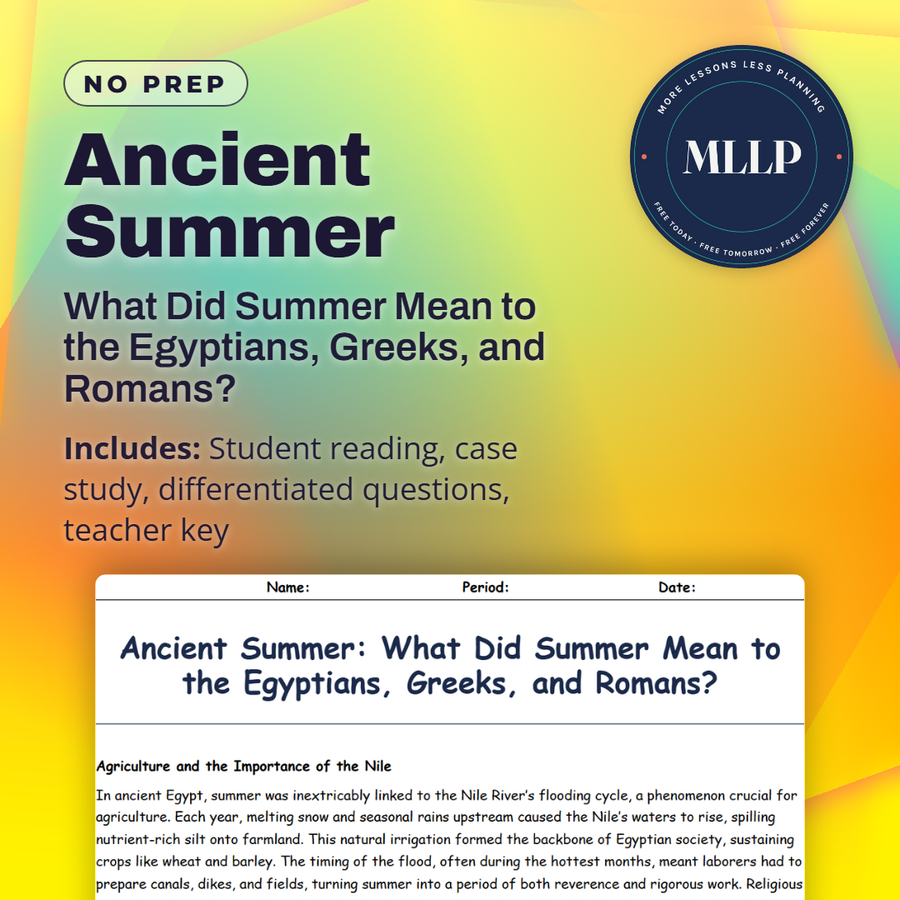
Ancient Summer: What Did Summer Mean to the Egyptians, Greeks, and Romans?
Quality reviewed September 2026
Facts verified September 9, 2026
- Subject
- Social Studies
- Grades
- Grades 9-12
- Length
- 6-page student worksheet
- Time
- About one 50-minute class period
- Great for
- Sub plans and independent work
- Includes
- Reading passage, comprehension questions + full answer key
- Format
- Print-and-go PDF
What students do
- Analyze how social class shaped daily summer life using primary-source letters from a Roman estate owner
- Explain how astronomical events like Sirius's rising guided Egyptian agricultural planning
- Identify how festivals and athletic competitions unified Greek city-states despite political rivalries
- Match ancient deities and events to their respective civilizations
What it covers
- Nile flooding cycles and divine protection
- Olympic Games and Greek festivals
- Roman villas and public entertainment
Start reading this worksheet
Agriculture and the Importance of the Nile
In ancient Egypt, summer was inextricably linked to the Nile River’s flooding cycle, a phenomenon crucial for agriculture. Each year, melting snow and seasonal rains upstream caused the Nile’s waters to rise, spilling nutrient-rich silt onto farmland. This natural irrigation formed the backbone of Egyptian society, sustaining crops like wheat and barley. The timing of the flood, often during the hottest months, meant laborers had to prepare canals, dikes, and fields, turning summer into a period of both reverence and rigorous work. Religious and cultural practices reflected the river’s significance. Egyptian deities like Hapi, personification of the Nile, were celebrated with offerings and festivals. The reliability of the yearly inundation was seen as a divine gift, ensuring enough harvest to feed the populace and bolster trade. Because the Nile’s floods aligned roughly with the heliacal rising of the star Sirius, astronomy played a role in predicting agricultural schedules. This interplay of astronomy and farming solidified the concept that summer was not just a season but an essential marker of life-sustaining renewal. For the Egyptians, summer meant both patience and preparedness. Farmers and officials collaborated to manage water resources, track flood levels, and plan for planting once waters receded. The entire society hinged on this cyclical blessing, shaping everything from temple rituals to economic planning. This dependence on the Nile underscores how deeply an ancient civilization could be shaped by its summer climate.
Greek Festivals and Athletic Games
In ancient Greece, the summer months were ripe with festivals, many dedicated to Olympian gods. The Olympic Games, traditionally held every four years, often fell in the middle of the Greek summer. Athletes from various city-states converged on Olympia to compete in footraces, wrestling, and chariot races, among other events. These games honored Zeus and were a cornerstone of Greek identity, showcasing unity, competition, and reverence for divine patrons. Other summer festivals included Panathenaea in Athens, which celebrated the city’s patron goddess, Athena. Processions, sacrifices, and athletic contests took place, reflecting how the Greeks combined religious piety with civic pride. The warm season allowed for open-air gatherings, encouraging travelers and participants from neighboring regions. Through these events, alliances were forged, cultural practices exchanged, and rivalries played out in public. Because the Greeks valued philosophy and the arts, some summer gatherings also featured dramatic or poetic competitions. Spectators would attend in large amphitheaters, enjoying plays that tackled moral, political, or comedic themes. This synergy of culture, sport, and spirituality helped define Greek summer, weaving physical prowess with intellectual and sacred pursuits.
Like what you read? The full reading, the case study, and every question set are in the free download below, along with the answer key.
Why this matters
Every summer the Nile rose over its banks, and Egyptians called it the arrival of the god Hapi, building their farming calendar around it. Three civilizations lived the same season differently: flooding rivers driving Egyptian religion, athletic contests uniting rival Greek city-states, and public spectacles keeping restless Roman crowds content.
I set the estate owner Lucius Varro's cooled villa against the dawn-to-dusk labor of the enslaved farmworkers who kept it running, and the ancient world stops looking like one flat era for my students. Summer becomes evidence of who held power and who didn't.
From one teacher to another
The Nile's summer floods weren't just weather, Egyptians treated them as divine messages from the god Hapi, which shaped agriculture, ritual, and survival itself. Students work with primary-source letters from the Roman estate owner Lucius Varro, contrasting his cooled villas and philosophical afternoons against the dawn-to-dusk labor of enslaved farmworkers. This worksheet draws connections between how three civilizations experienced summer: flooded rivers driving Egyptian religion, athletic contests uniting Greek city-states, and public spectacles keeping Roman crowds content. By the end, they see that summer practices reveal who had power and who didn't.
What you get
Download
Where should I send the next one?
Everything here is free and it stays that way. Leave your email and I'll send you the new lessons as they go up. You can unsubscribe from any one of them.
Related resources
Environmental Science and the Summer Season: Tourism, Trash, and Sustainability

Forensic Files: Summer Crimes and the Science Behind the Cases
Summer Around the World: Global History of Festivals and Solstice Celebrations

Summer Science: The Biology Of Sunscreen And Skin Protection
The Economics Of Summer: Ice Cream, Travel, And Supply And Demand

The Health Science of Summer Heat: Hydration, Heatstroke, and Body Systems
Every lesson on this site is free to download and use. If one of them saved you a prep period, you can chip in a few bucks toward my three kids' daycare fund. That's genuinely where tips go.