The Power of Attention
Quality reviewed September 2026
Facts verified September 10, 2026
- Subject
- Social Studies
- Grades
- Grades 9-12
- Length
- 5-page student worksheet
- Time
- About one 50-minute class period
- Great for
- Sub plans and independent work
- Includes
- Reading passage, comprehension questions + full answer key
- Format
- Print-and-go PDF
What students do
- Match selective attention, divided attention, automatic processing, and the Stroop effect to their definitions
- Fill in the blank naming the Stroop effect, selective attention, and automatic processing
- Explain the difference between selective attention and divided attention in a short-answer response
- Read the William James case study excerpt and connect his definition of attention to selective attention
What it covers
- Selective attention and the dichotic listening task, where participants attend to one message and ignore another
- Divided attention and why performance suffers when we try to focus on too many tasks at once
- Automatic processing and the Stroop effect, including why reading interferes with naming ink color
Start reading this worksheet
Introduction
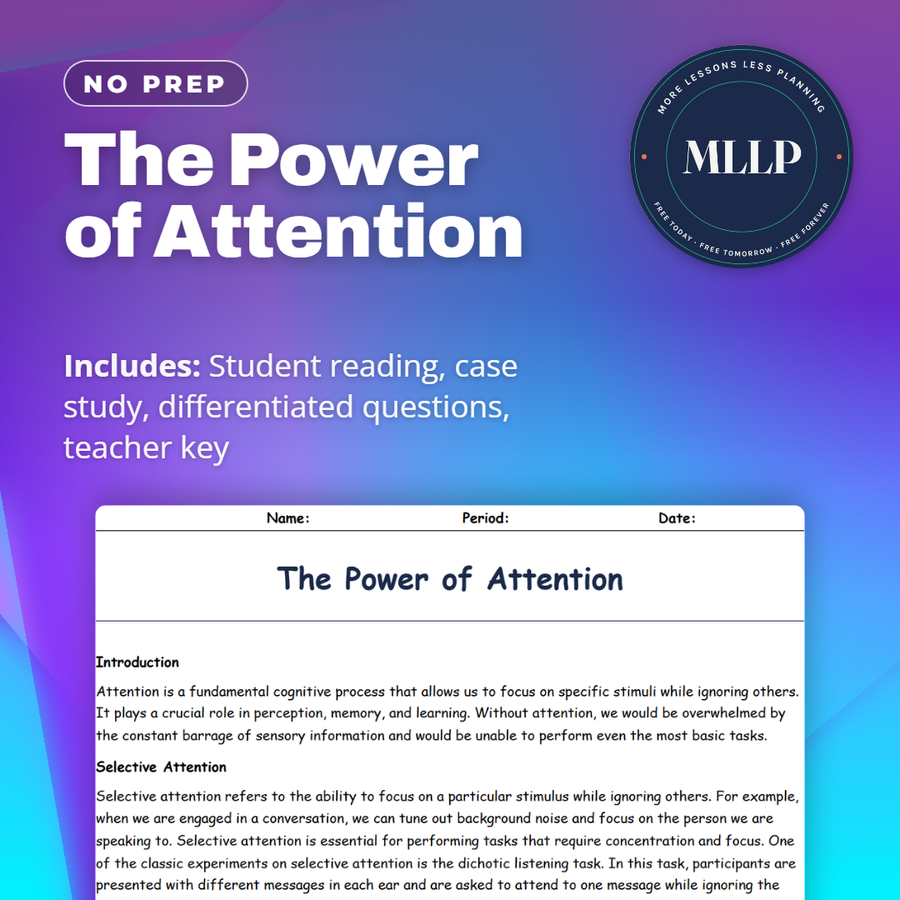
Attention is a fundamental cognitive process that allows us to focus on specific stimuli while ignoring others. It plays a crucial role in perception, memory, and learning. Without attention, we would be overwhelmed by the constant barrage of sensory information and would be unable to perform even the most basic tasks.
Selective Attention
Selective attention refers to the ability to focus on a particular stimulus while ignoring others. For example, when we are engaged in a conversation, we can tune out background noise and focus on the person we are speaking to. Selective attention is essential for performing tasks that require concentration and focus. One of the classic experiments on selective attention is the dichotic listening task. In this task, participants are presented with different messages in each ear and are asked to attend to one message while ignoring the other. Studies have shown that it is difficult to completely ignore information presented to the unattended ear, although participants can selectively attend to the target message.
Divided Attention
Divided attention refers to the ability to attend to multiple stimuli simultaneously. While we are generally better at focusing on a single task at a time, we can sometimes divide our attention between two or more tasks. However, the ability to divide attention is limited, and when we try to focus on too many things at once, our performance on each task tends to suffer.
Like what you read? The full reading, the case study, and every question set are in the free download below, along with the answer key.
Why this matters
Try to name the ink color of a printed word and reading keeps getting in the way. Most students cannot explain why until they meet the Stroop effect here. Automatic processing is the reason: reading happens without effort, so it interferes with naming the ink color, and that is why the Stroop effect is so hard to overcome.
William James gets real presence here, not just a name to memorize. My students connect his century-old definition of attention to selective attention, then work out why divided attention costs performance in a way selective attention does not.
From one teacher to another
I use this reading to kick off the attention section since the Stroop effect always gets a reaction once students try it themselves. My students match terms like selective attention and automatic processing to their definitions, then read the William James case study excerpt and connect his century-old definition of attention to the selective attention concept in the passage. The short-answer questions have them explain the difference between selective and divided attention and describe why the Stroop effect is hard to overcome.
What you get
Download
Where should I send the next one?
Everything here is free and it stays that way. Leave your email and I'll send you the new lessons as they go up. You can unsubscribe from any one of them.
Related resources
Illusions: The Mind's Tricks
Perception: The Brain's Interpretation
Sensation: The Gateway to Perception
Sensory Disorders and Challenges
The Five Senses: A Closer Look
The Future of Perception Technology
Every lesson on this site is free to download and use. If one of them saved you a prep period, you can chip in a few bucks toward my three kids' daycare fund. That's genuinely where tips go.