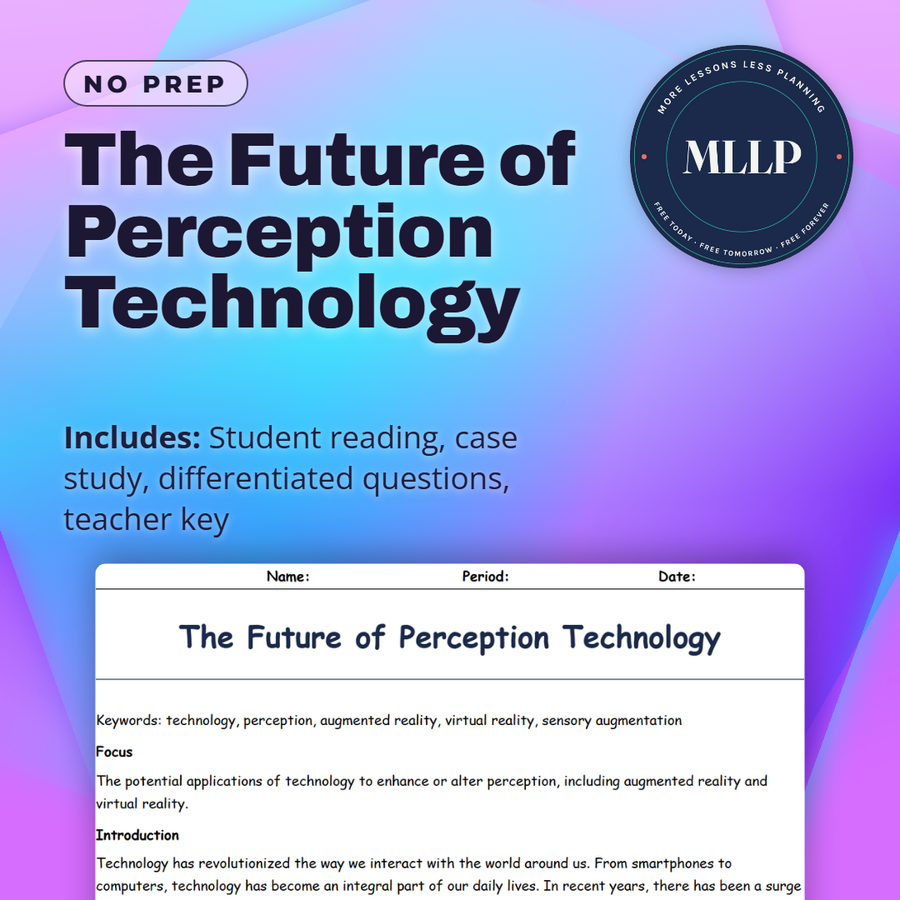
The Future of Perception Technology
Quality reviewed September 2026
Facts verified September 10, 2026
- Subject
- Social Studies
- Grades
- Grades 9-12
- Length
- 6-page student worksheet
- Time
- About one 50-minute class period
- Great for
- Sub plans and independent work
- Includes
- Reading passage, comprehension questions + full answer key
- Format
- Print-and-go PDF
What students do
- Match augmented reality, virtual reality, sensory augmentation, and sensory deprivation to their definitions
- Fill in the blank naming augmented reality and sensory augmentation
- Explain the potential benefits and risks of sensory augmentation in a short-answer response
- Read the Milgram and Kishino case study excerpt and explain how their definition of AR differs from VR
What it covers
- Augmented reality applications in gaming, education, healthcare, and surgery
- Virtual reality applications like the Oculus Rift in training, architecture, and tourism
- Sensory augmentation devices like the cochlear implant and bionic eye, plus the ethics of the technology
Start reading this worksheet
Keywords: technology, perception, augmented reality, virtual reality, sensory augmentation
Focus
The potential applications of technology to enhance or alter perception, including augmented reality and virtual reality.
Introduction
Technology has redefined the way we interact with the world around us. From smartphones to computers, technology has become an integral part of our daily lives. In recent years, there has been a surge of interest in developing technology that can enhance or alter our perception. This includes augmented reality (AR) and virtual reality (VR), which have the potential to transform the way we experience the world.
Like what you read? The full reading, the case study, and every question set are in the free download below, along with the answer key.
Why this matters
A student swiping through an AR filter or talking about a VR headset is already living inside this topic, they just don't have the words for it. Milgram and Kishino's case study gives them that vocabulary, drawing the line between augmented and virtual reality instead of letting the two blur together.
That distinction matters once the reading moves into sensory augmentation, where a cochlear implant or a bionic eye comes with real ethical stakes attached, not just a technical description. Students who cannot separate AR from VR tend to flatten sensory augmentation into the same category and miss why those ethical stakes matter.
From one teacher to another
I use this reading when we cover how technology intersects with perception, since most of my students have already used AR filters or heard of VR headsets without knowing the psychology terms for them. My students match terms like augmented reality and sensory augmentation to their definitions, then read the Milgram and Kishino case study excerpt to explain how their definition of AR differs from VR. The short-answer questions push them to weigh the benefits and risks of devices like cochlear implants and bionic eyes.
What you get
Download
Where should I send the next one?
Everything here is free and it stays that way. Leave your email and I'll send you the new lessons as they go up. You can unsubscribe from any one of them.
Related resources
Illusions: The Mind's Tricks
Perception: The Brain's Interpretation
Sensation: The Gateway to Perception
Sensory Disorders and Challenges
The Five Senses: A Closer Look
The Impact of Sensory Deprivation
Every lesson on this site is free to download and use. If one of them saved you a prep period, you can chip in a few bucks toward my three kids' daycare fund. That's genuinely where tips go.