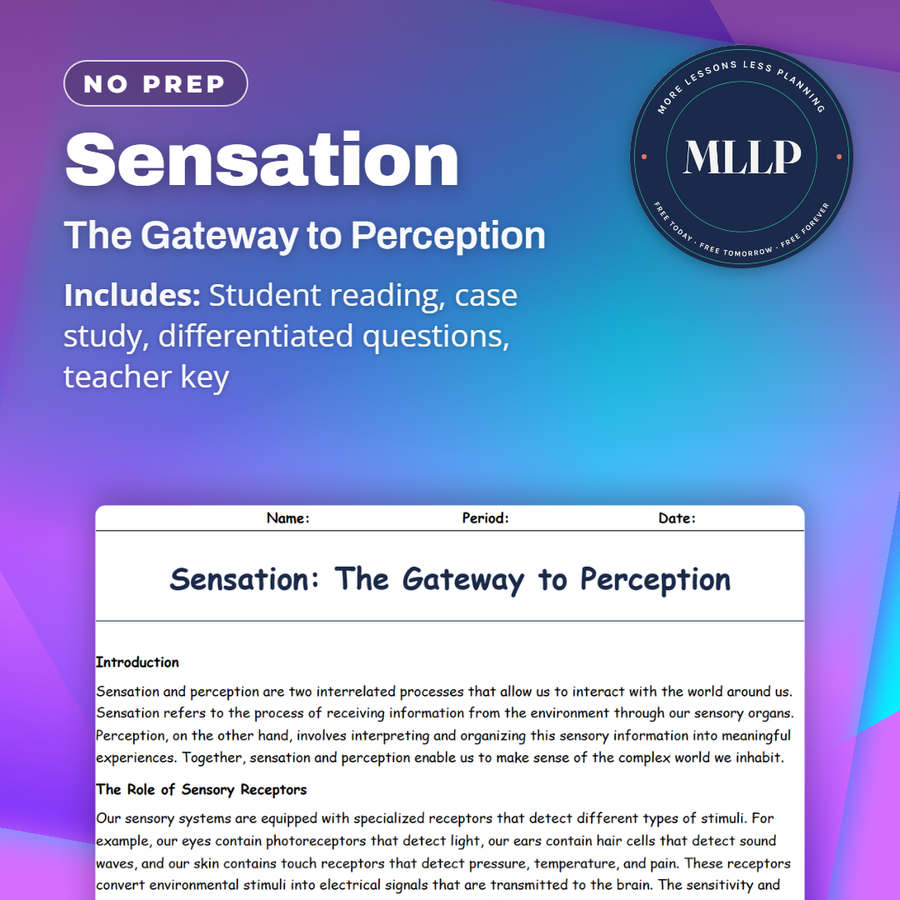
Sensation: The Gateway to Perception
Quality reviewed September 2026
Facts verified September 10, 2026
- Subject
- Social Studies
- Grades
- Grades 9-12
- Length
- 6-page student worksheet
- Time
- About one 50-minute class period
- Great for
- Sub plans and independent work
- Includes
- Reading passage, comprehension questions + full answer key
- Format
- Print-and-go PDF
What students do
- Match photoreceptors, hair cells, touch receptors, and sensory nerves to what each one detects or carries
- Fill in the blank naming sensation, the brain, and the Gestalt principle of organization
- Explain the difference between sensation and perception in a short-answer response
- Read the Kant case study excerpt and explain why the brain filtering out irrelevant information supports his claim
What it covers
- How sensory receptors like photoreceptors and hair cells convert stimuli into electrical signals
- How sensory information travels from receptors through the nervous system to the brain
- The Gestalt principle of organization and the role attention plays in perception
Start reading this worksheet
Introduction
Sensation and perception are two interrelated processes that allow us to interact with the world around us. Sensation refers to the process of receiving information from the environment through our sensory organs. Perception, on the other hand, involves interpreting and organizing this sensory information into meaningful experiences. Together, sensation and perception enable us to make sense of the complex world we inhabit.
The Role of Sensory Receptors
Our sensory systems are equipped with specialized receptors that detect different types of stimuli. For example, our eyes contain photoreceptors that detect light, our ears contain hair cells that detect sound waves, and our skin contains touch receptors that detect pressure, temperature, and pain. These receptors convert environmental stimuli into electrical signals that are transmitted to the brain. The sensitivity and range of our sensory receptors vary depending on the sense. For example, our eyes are highly sensitive to light, allowing us to detect even faint levels of illumination. Our ears are also sensitive to sound, enabling us to hear a wide range of frequencies. However, our sense of smell is less sensitive than our vision or hearing, and we can only detect a limited range of odors.
The Transmission of Sensory Information
Once sensory information is detected by the receptors, it is transmitted to the brain through the nervous system. The sensory nerves carry electrical signals from the receptors to the brain, where they are processed and interpreted. The pathway for sensory information varies depending on the sense. For example, visual information is transmitted to the visual cortex, auditory information is transmitted to the auditory cortex, and tactile information is transmitted to the somatosensory cortex. The brain plays a crucial role in interpreting sensory information. It organizes and integrates sensory inputs from different senses to create a coherent and meaningful representation of the world. The brain also filters out irrelevant or redundant sensory information, allowing us to focus on the most important stimuli.
Like what you read? The full reading, the case study, and every question set are in the free download below, along with the answer key.
Why this matters
Hair cells in the ear and photoreceptors in the eye look nothing alike, but they do the same basic job: converting a physical stimulus into an electrical signal that travels toward the brain. This reading opens the unit by naming what each receptor type detects before asking how that raw signal turns into something meaningful.
Students usually treat sensation and perception as the same word until asked to explain where one ends and the other begins, and that gap is why this reading opens the unit. The Kant excerpt on the brain filtering out irrelevant information gets them thinking about how much of what they perceive their brain has already edited before they notice it.
From one teacher to another
This is the reading I use to open the sensation and perception unit, since it lays out the basic vocabulary students need before we get into anything more complicated. My students match receptor types like photoreceptors and hair cells to what they detect, then work through the Kant case study to explain why the brain filtering out irrelevant sensory information supports his claim that perception is not passive. The short-answer questions have them explain the difference between sensation and perception and describe the Gestalt principle of organization with an example.
What you get
Download
Where should I send the next one?
Everything here is free and it stays that way. Leave your email and I'll send you the new lessons as they go up. You can unsubscribe from any one of them.
Related resources
Illusions: The Mind's Tricks
Perception: The Brain's Interpretation
Sensory Disorders and Challenges
The Five Senses: A Closer Look
The Future of Perception Technology
The Impact of Sensory Deprivation
Every lesson on this site is free to download and use. If one of them saved you a prep period, you can chip in a few bucks toward my three kids' daycare fund. That's genuinely where tips go.