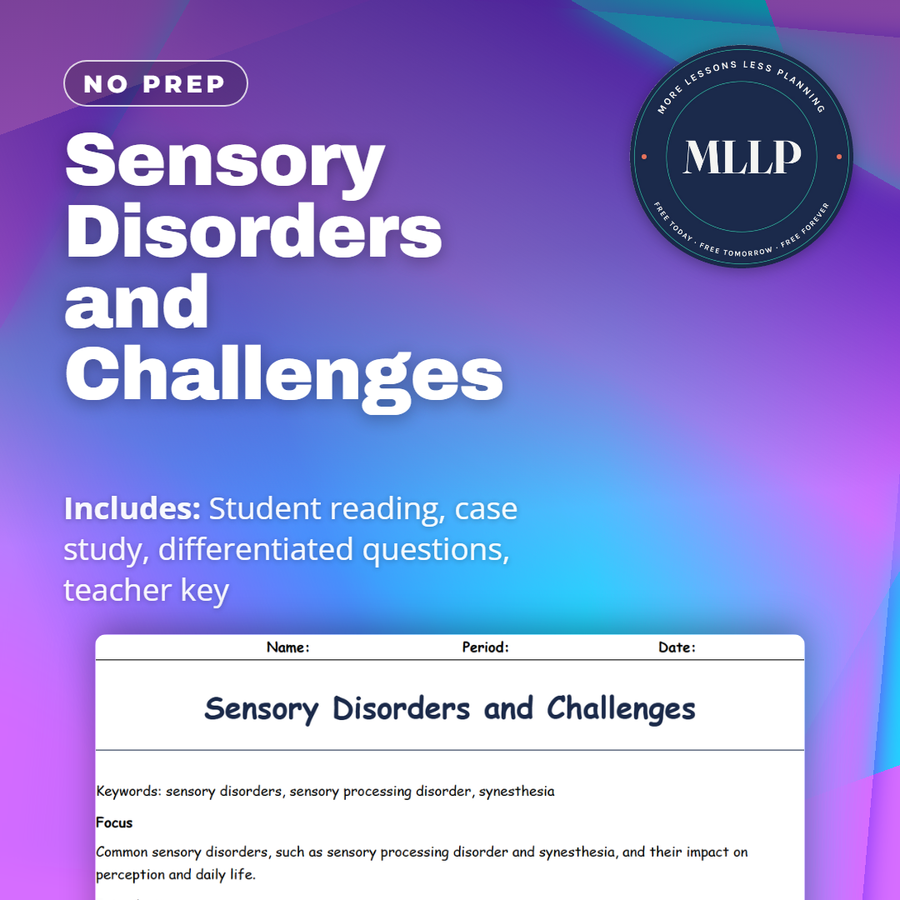
Sensory Disorders and Challenges
Quality reviewed September 2026
Facts verified September 10, 2026
- Subject
- Social Studies
- Grades
- Grades 9-12
- Length
- 6-page student worksheet
- Time
- About one 50-minute class period
- Great for
- Sub plans and independent work
- Includes
- Reading passage, comprehension questions + full answer key
- Format
- Print-and-go PDF
What students do
- Match sensory processing disorder, synesthesia, sensory overload, and sensory seeking to their definitions
- Fill in the blank naming sensory processing disorder, synesthesia, and daily life
- Explain how sensory processing disorder can affect a person's social relationships in a short-answer response
- Read the Baranek case study excerpt and explain how SPD can affect a child's participation in everyday activities
What it covers
- Sensory processing disorder, including sensory oversensitivity, undersensitivity, and sensory seeking
- Synesthesia and its different forms, including grapheme-color and sound-to-color synesthesia
- How sensory disorders affect school, work, and social participation in daily life
Start reading this worksheet
Keywords: sensory disorders, sensory processing disorder, synesthesia
Focus
Common sensory disorders, such as sensory processing disorder and synesthesia, and their impact on perception and daily life.
Introduction
Our senses are essential for interacting with the world around us. They provide us with information about our environment, allowing us to navigate, communicate, and learn. However, sometimes our senses can malfunction, leading to sensory disorders that can significantly impact our perception and daily life. In this reading, we will explore some common sensory disorders, including sensory processing disorder and synesthesia.
Like what you read? The full reading, the case study, and every question set are in the free download below, along with the answer key.
Why this matters
A child with sensory processing disorder can find going to school or eating a meal overwhelming in ways that are easy to miss without knowing what sensory seeking or sensory overload look like. The Baranek case study excerpt walks through exactly how SPD interferes with those everyday activities.
Synesthesia gets the attention in most classes because it's the stranger sounding condition, grapheme-color or sound-to-color, but I spend more time on SPD because it's more likely to describe an actual student in the room. Classroom accommodations are what I keep steering the discussion back to, the difference between knowing the term and knowing what to do when a student is overwhelmed.
From one teacher to another
I use this reading when we talk about how the senses can malfunction, since most students have never heard of sensory processing disorder or synesthesia before. My students match terms like sensory seeking and sensory overload to their definitions, then read the Baranek case study excerpt to explain how SPD can get in the way of everyday activities like going to school or eating meals. The short-answer questions ask them to discuss the challenges synesthesia can create in a classroom and why accommodations matter.
What you get
Download
Where should I send the next one?
Everything here is free and it stays that way. Leave your email and I'll send you the new lessons as they go up. You can unsubscribe from any one of them.
Related resources
Illusions: The Mind's Tricks
Perception: The Brain's Interpretation
Sensation: The Gateway to Perception
The Five Senses: A Closer Look
The Future of Perception Technology
The Impact of Sensory Deprivation
Every lesson on this site is free to download and use. If one of them saved you a prep period, you can chip in a few bucks toward my three kids' daycare fund. That's genuinely where tips go.