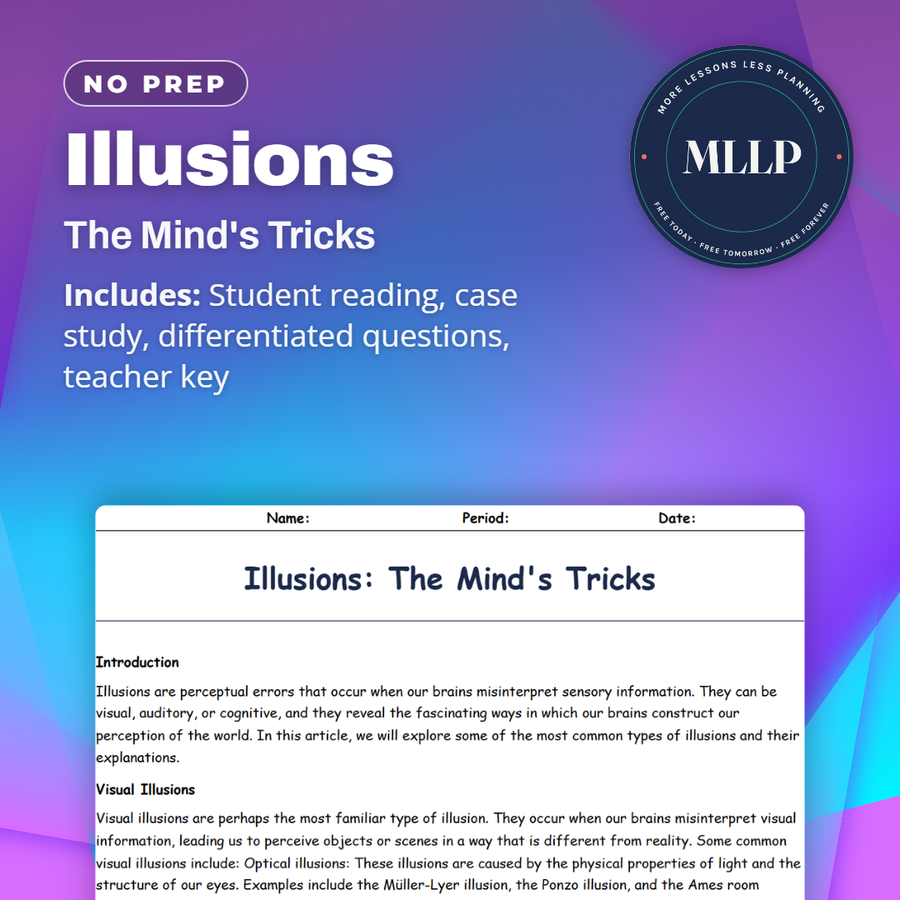
Illusions: The Mind's Tricks
Quality reviewed September 2026
Facts verified September 10, 2026
- Subject
- Social Studies
- Grades
- Grades 9-12
- Length
- 5-page student worksheet
- Time
- About one 50-minute class period
- Great for
- Sub plans and independent work
- Includes
- Reading passage, comprehension questions + full answer key
- Format
- Print-and-go PDF
What students do
- Match the Müller-Lyer illusion, Shepard tone illusion, Stroop effect, and Ebbinghaus illusion to their definitions
- Fill in the blank naming the Müller-Lyer illusion and the Stroop effect
- Explain the difference between optical illusions and cognitive illusions in a short-answer response
- Read the Helmholtz case study excerpt and explain the eye's active role in interpreting visual information
What it covers
- Visual illusions like the Müller-Lyer, Ponzo, and Ames room illusions
- Auditory illusions including the Shepard tone illusion
- Cognitive illusions such as the Stroop effect, framing effect, and anchoring effect
Start reading this worksheet
Introduction
Illusions are perceptual errors that occur when our brains misinterpret sensory information. They can be visual, auditory, or cognitive, and they reveal the fascinating ways in which our brains construct our perception of the world. In this article, we will explore some of the most common types of illusions and their explanations.
Visual Illusions
Visual illusions are perhaps the most familiar type of illusion. They occur when our brains misinterpret visual information, leading us to perceive objects or scenes in a way that is different from reality. Some common visual illusions include: Optical illusions: These illusions are caused by the physical properties of light and the structure of our eyes. Examples include the Müller-Lyer illusion, the Ponzo illusion, and the Ames room illusion. Cognitive illusions: These illusions are caused by our brains' tendency to apply cognitive shortcuts or heuristics when interpreting visual information. Examples include the Stroop effect and the Ebbinghaus illusion.
Auditory Illusions
Auditory illusions are less common than visual illusions, but they can be just as fascinating. Auditory illusions occur when our brains misinterpret auditory information, leading us to perceive sounds in a way that is different from reality. Examples of auditory illusions include the Shepard tone illusion and the autokinetic effect.
Like what you read? The full reading, the case study, and every question set are in the free download below, along with the answer key.
Why this matters
The eye gets treated like a camera that simply records what is there, but the Helmholtz case study argues it actively interprets what it sees. Visual illusions like the Muller-Lyer and Ponzo sit next to the Shepard tone illusion and cognitive illusions like the Stroop effect, so students see the mind get fooled through sight, hearing, and plain thinking, not just one sense.
The Stroop effect is the one students insist they can beat every time, so explaining the difference between optical and cognitive illusions in writing forces them to admit some tricks happen in the brain, not the eye. I open the unit here because students walk in curious, before I say a word.
From one teacher to another
I use this reading when we start the sensation and perception unit because illusions grab students' attention right away. My students match terms like the Müller-Lyer illusion and the Stroop effect to definitions, then work through the Helmholtz case study to explain why the eye is described as an active organ rather than a passive one. The short-answer questions push them to explain the difference between optical and cognitive illusions in their own words.
What you get
Download
Where should I send the next one?
Everything here is free and it stays that way. Leave your email and I'll send you the new lessons as they go up. You can unsubscribe from any one of them.
Related resources
Perception: The Brain's Interpretation
Sensation: The Gateway to Perception
Sensory Disorders and Challenges
The Five Senses: A Closer Look
The Future of Perception Technology
The Impact of Sensory Deprivation
Every lesson on this site is free to download and use. If one of them saved you a prep period, you can chip in a few bucks toward my three kids' daycare fund. That's genuinely where tips go.