The Five Senses: A Closer Look
Quality reviewed September 2026
Facts verified September 10, 2026
- Subject
- Social Studies
- Grades
- Grades 9-12
- Length
- 6-page student worksheet
- Time
- About one 50-minute class period
- Great for
- Sub plans and independent work
- Includes
- Reading passage, comprehension questions + full answer key
- Format
- Print-and-go PDF
What students do
- Match cochlea, somatosensory cortex, rods, and taste buds to their functions
- Fill in the blank naming smell, palms, and cones
- Explain how the sense of smell works from airborne molecules to the olfactory cortex in a short-answer response
- Read the Kant case study excerpt and explain why the brain's map of the body supports his claim about perception
What it covers
- The structure of the eye, from the cornea and pupil to the retina's rods and cones
- The structure of the ear and how the malleus, incus, and stapes transmit sound
- The senses of touch, taste, and smell, including mechanoreceptors, taste buds, and olfactory receptors
Start reading this worksheet
Introduction
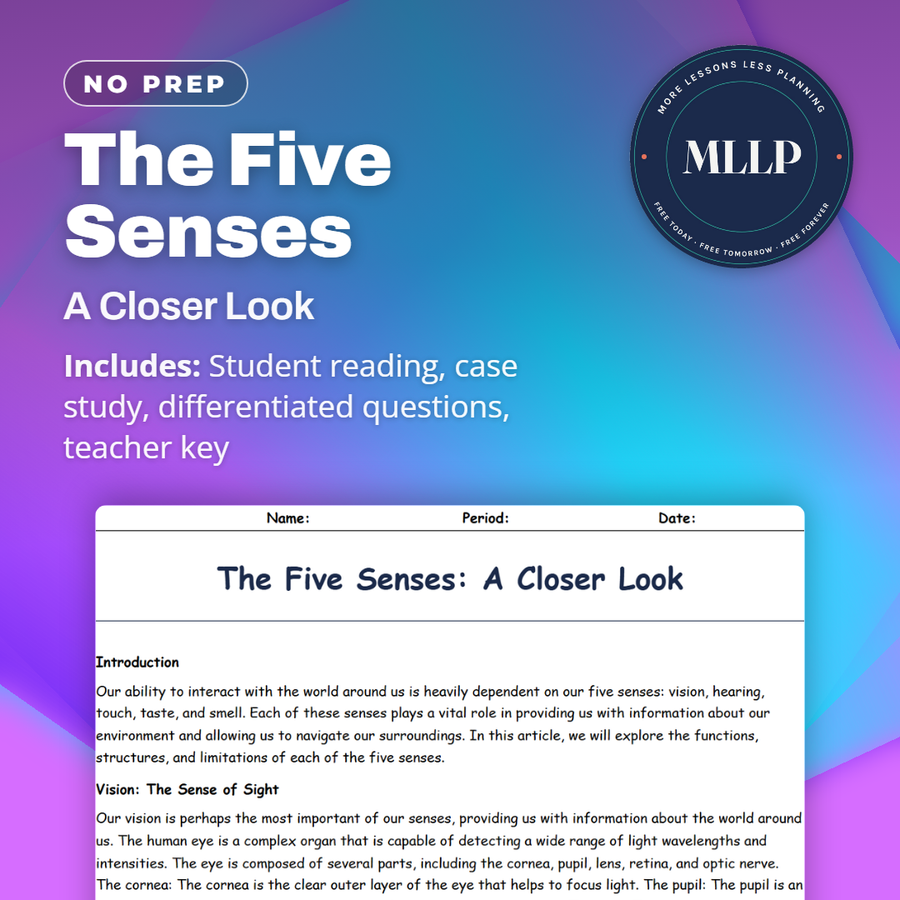
Our ability to interact with the world around us is heavily dependent on our five senses: vision, hearing, touch, taste, and smell. Each of these senses plays a vital role in providing us with information about our environment and allowing us to navigate our surroundings. In this article, we will explore the functions, structures, and limitations of each of the five senses.
Vision: The Sense of Sight
Our vision is perhaps the most important of our senses, providing us with information about the world around us. The human eye is a complex organ that is capable of detecting a wide range of light wavelengths and intensities. The eye is composed of several parts, including the cornea, pupil, lens, retina, and optic nerve. The cornea: The cornea is the clear outer layer of the eye that helps to focus light. The pupil: The pupil is an opening in the iris that controls the amount of light that enters the eye. The lens: The lens is a transparent structure behind the pupil that further focuses light onto the retina. The retina: The retina is a layer of tissue at the back of the eye that contains photoreceptor cells, including rods and cones. Rods are sensitive to low levels of light and are responsible for vision in dim conditions. Cones are responsible for color vision and are more sensitive to bright light. The optic nerve: The optic nerve transmits visual information from the retina to the brain. The brain processes visual information in the visual cortex, where it is interpreted and assigned meaning. Visual perception is influenced by a number of factors, including the properties of the visual stimulus, our past experiences, and our expectations.
Hearing: The Sense of Sound
Our sense of hearing allows us to detect and interpret sound waves. The human ear is divided into three main parts: the outer ear, the middle ear, and the inner ear. The outer ear: The outer ear collects sound waves and funnels them into the ear canal. The middle ear: The middle ear contains three small bones, known as the malleus, incus, and stapes, that transmit sound vibrations from the outer ear to the inner ear. The inner ear: The inner ear contains the cochlea, a spiral-shaped structure that contains hair cells that convert sound vibrations into electrical signals. These signals are then transmitted to the brain via the auditory nerve. The brain processes auditory information in the auditory cortex, where it is interpreted and assigned meaning. Hearing is influenced by a number of factors, including the intensity and frequency of sound waves and the individual's hearing sensitivity.
Like what you read? The full reading, the case study, and every question set are in the free download below, along with the answer key.
Why this matters
The malleus, incus, and stapes are three tiny bones most people never think about, and together they turn vibrating air outside the ear into sound signals passed toward the brain. This reading walks through that kind of actual anatomy behind each sense, the cornea and retina, the mechanoreceptors under the skin, instead of stopping at "we have five senses."
Once students trace a smell from airborne molecules to the olfactory cortex themselves, the Kant case study reads differently. The claim that the brain's map of the body is a construction, not a copy, finally has something to test against: the eye and ear they just labeled bone by bone.
From one teacher to another
I use this reading as the anchor for the five senses lesson because it walks through actual anatomy, the cornea and retina, the malleus and cochlea, the mechanoreceptors in the skin, instead of just naming the senses. My students match structures like the cochlea and somatosensory cortex to their functions, then work through the Kant case study to explain why the brain's map of the body supports the idea that perception is a construction rather than a copy. The short-answer questions have them trace a smell or a sound all the way to the brain.
What you get
Download
Where should I send the next one?
Everything here is free and it stays that way. Leave your email and I'll send you the new lessons as they go up. You can unsubscribe from any one of them.
Related resources
Illusions: The Mind's Tricks
Perception: The Brain's Interpretation
Sensation: The Gateway to Perception
Sensory Disorders and Challenges
The Future of Perception Technology
The Impact of Sensory Deprivation
Every lesson on this site is free to download and use. If one of them saved you a prep period, you can chip in a few bucks toward my three kids' daycare fund. That's genuinely where tips go.