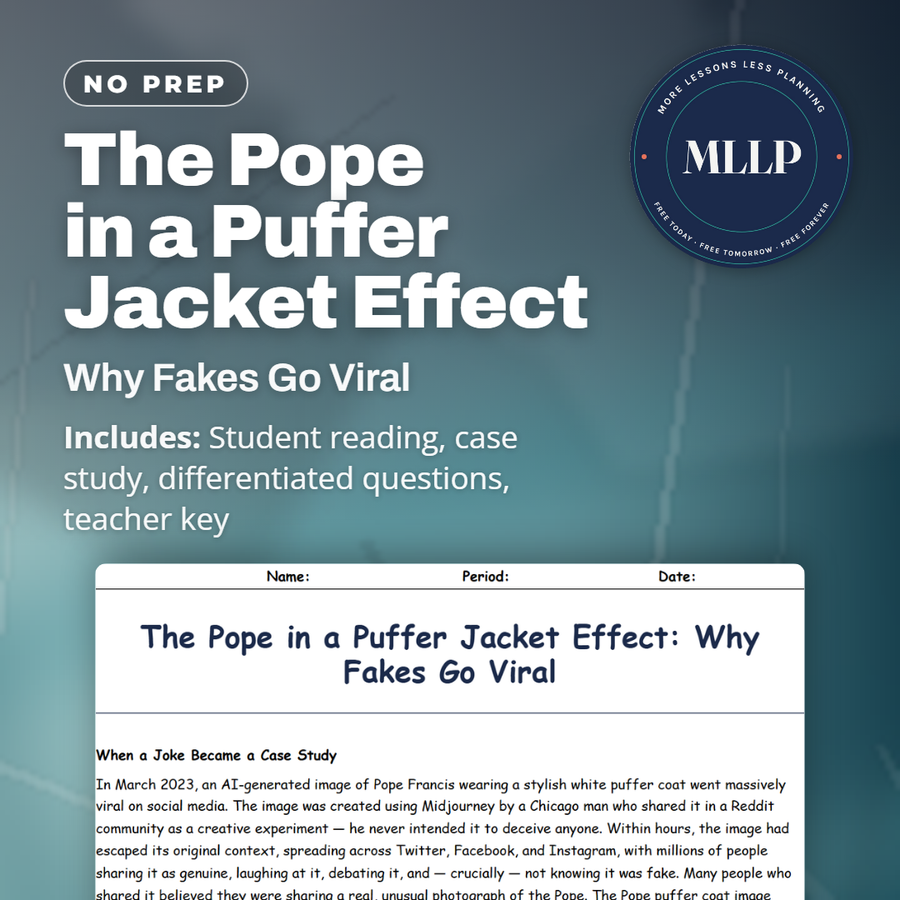
The Pope in a Puffer Jacket Effect: Why Fakes Go Viral
Quality reviewed September 2026
Facts verified September 20, 2026
- Subject
- Career & Life Skills
- Grades
- Grades 9-12
- Length
- 10-page student worksheet
- Time
- About one 50-minute class period
- Great for
- Sub plans and independent work
- Includes
- Reading passage, comprehension questions + full answer key
- Format
- Print-and-go PDF
What students do
- The 2023 Pope Francis puffer coat image traces how one Reddit joke escaped its context and went viral
- Answer how novelty, emotional resonance, and context collapse each contribute to a fake image's spread
- Explain the MIT finding that human users, not bots, drive most misinformation sharing
- A wildfire deer case study applies three viral mechanisms to a second real fake image
What it covers
- The novelty-plausibility sweet spot and why a Pope in a puffer coat hit it exactly
- The MIT Media Lab finding that false news outpaces true corrections, driven mainly by people, not bots
- Prebunking as a defense that works before misinformation spreads, not after
Start reading this worksheet
When a Joke Became a Case Study
In March 2023, an AI-generated image of Pope Francis wearing a stylish white puffer coat went massively viral on social media. The image was created using Midjourney by a Chicago man who shared it in a Reddit community as a creative experiment; he never intended it to deceive anyone. Within hours, the image had escaped its original context, spreading across Twitter, Facebook, and Instagram, with millions of people sharing it as genuine, laughing at it, debating it, and, crucially, not knowing it was fake. Many people who shared it believed they were sharing a real, unusual photograph of the Pope. The Pope puffer coat image became an instant case study in AI virality, studied by researchers, journalists, and media literacy educators because it illustrated a cluster of dynamics that consistently drive AI-generated images to viral spread. Understanding these dynamics is not just academically interesting: it's practically essential. Because the same mechanisms that made a harmless joke go viral are the exact same mechanisms that make genuinely dangerous political deepfakes spread faster than corrections can travel.
The Novelty-Plausibility Sweet Spot
The Pope puffer coat image hit what researchers call the novelty-plausibility sweet spot: it was surprising enough to be attention-grabbing, but plausible enough to be believable. An image of the Pope in a suit would not go viral; it's not interesting. An image of the Pope surfing a wave or driving a race car would not go viral as a genuine photo; it's too implausible to believe without strong skepticism. But a fashionable winter coat? That's just unusual enough to be shareable, just plausible enough to pass the quick mental check most people apply to images before sharing. This sweet spot is not accidental in most viral disinformation. Sophisticated fabricators deliberately calibrate content to be surprising (which drives sharing behavior) while staying within the boundaries of plausibility (which suppresses verification behavior). A video of a politician saying something slightly more extreme than what they normally say hits this target precisely: extreme enough to be alarming and shareable, familiar enough that people don't immediately think 'that can't be real.'
Emotional Resonance and Cognitive Bypass
Content that triggers strong emotional responses (amusement, outrage, admiration, fear, disgust) spreads faster than neutral content across every social media platform. This is not a bug in platform design; it is an intentional feature. Platforms discovered early in their development that emotionally engaging content generates more clicks, more time-on-site, and more ad revenue. The algorithmic systems that decide what content to amplify were literally trained to prioritize emotional engagement. Strong emotional responses also suppress the cognitive processes associated with critical evaluation. When we are amused, outraged, or frightened, activity in the prefrontal cortex (the brain region most associated with deliberative reasoning) is partially downregulated. We are, neurologically, worse at evaluating truth when we are feeling strong emotions. This means that content engineered to produce strong emotional responses is also content specifically engineered to bypass our most careful thinking. The two effects compound each other: emotional content spreads faster and is evaluated less carefully.
Like what you read? The full reading, the case study, and every question set are in the free download below, along with the answer key.
Why this matters
The Pope in a puffer coat is a low-stakes way into a genuinely high-stakes idea, that the exact mechanics making a funny fake photo spread across a family group chat are the same mechanics that will spread a political deepfake faster than any fact-check can catch up to it. Students leave with prebunking as a concrete tool, since research in the reading shows that teaching the manipulation pattern in advance works better than correcting it afterward, and a habit of asking who benefits from a share before making it.
From one teacher to another
A Chicago man's joking Midjourney image of Pope Francis in a white puffer coat is the case that opens this reading, and it became a real case study precisely because it was never meant to deceive anyone. Students trace the specific mechanics behind its spread: the novelty-plausibility sweet spot, the emotional bypass of the prefrontal cortex, and the context collapse that strips a screenshot of the label explaining it was AI art. A section on a 2018 MIT Media Lab study shows that false news spreads faster than true corrections mainly because of human sharers, not bots, and a second case study applies the same mechanisms to a viral wildfire photo of deer. The reading closes on prebunking, teaching the manipulation pattern before students meet it in the wild.
What you get
Download
Where should I send the next one?
Everything here is free and it stays that way. Leave your email and I'll send you the new lessons as they go up. You can unsubscribe from any one of them.
Related resources
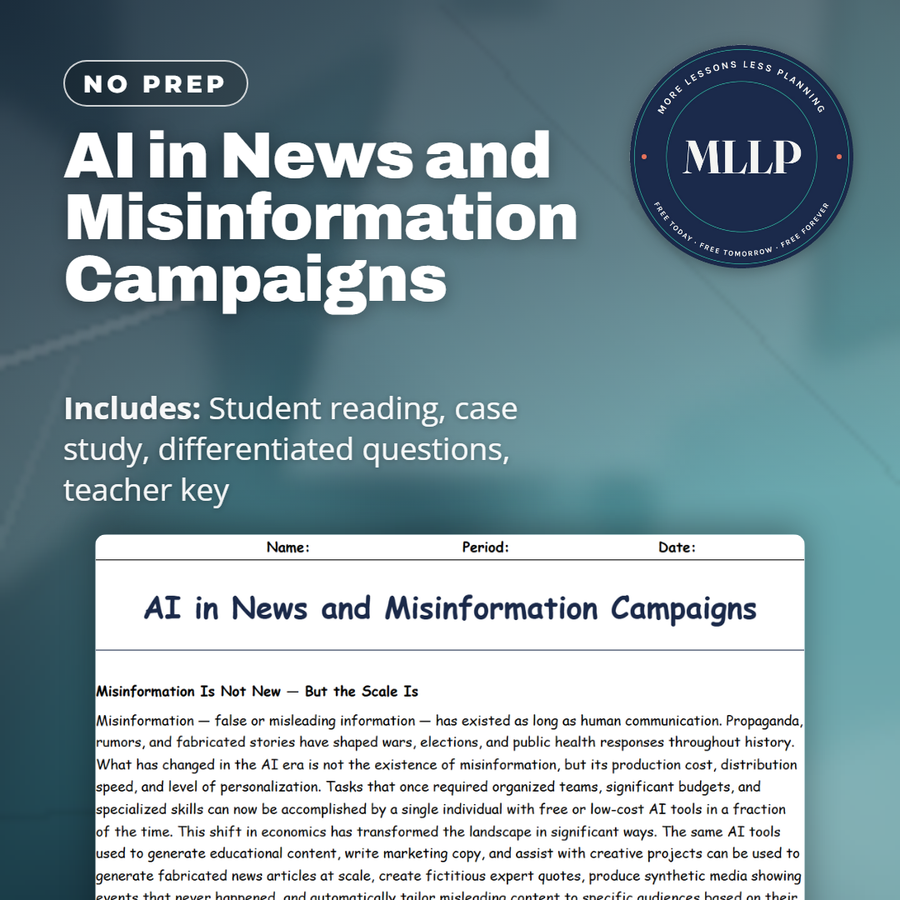
AI in News and Misinformation Campaigns
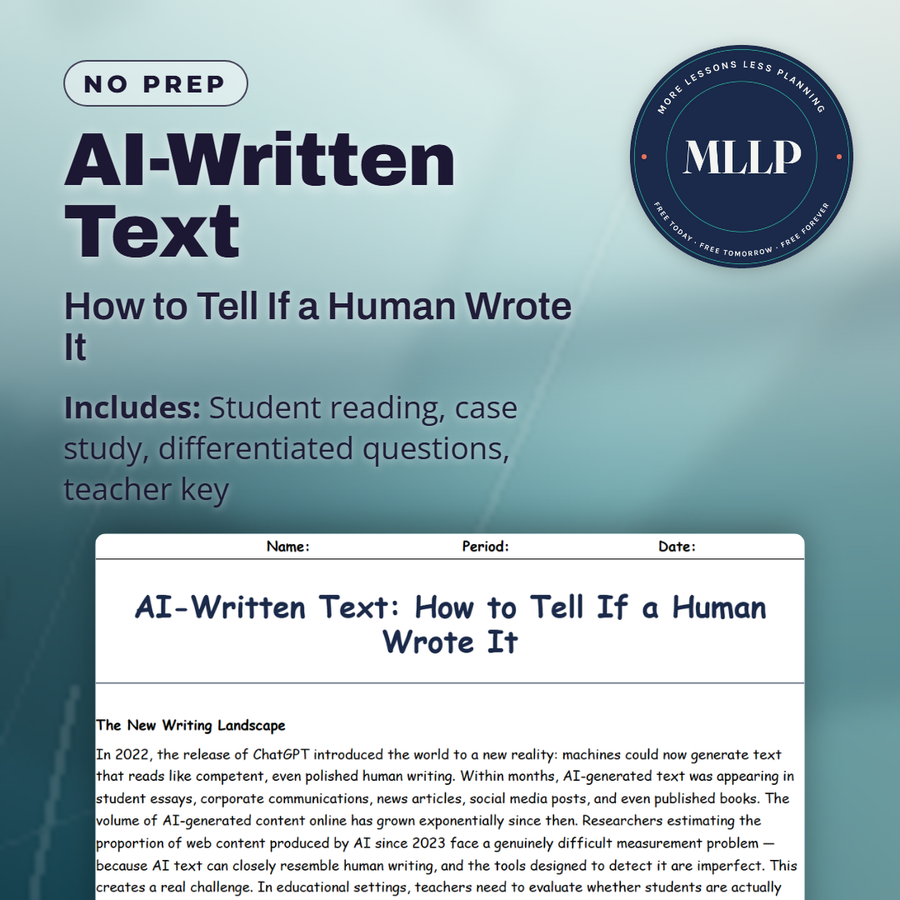
AI-Written Text: How to Tell If a Human Wrote It

Building a Personal Verify Before You Share Habit
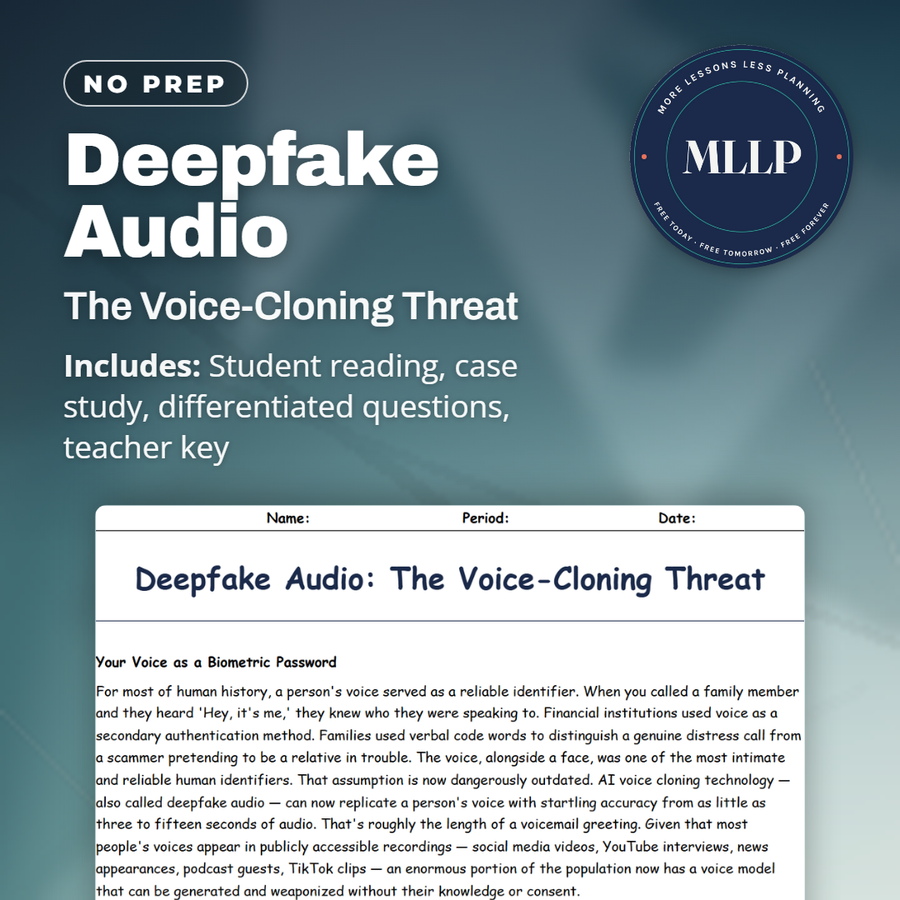
Deepfake Audio: The Voice-Cloning Threat
Lateral Reading: Verifying What You See Online

Reverse Image Search and Other Detection Tools
Every lesson on this site is free to download and use. If one of them saved you a prep period, you can chip in a few bucks toward my three kids' daycare fund. That's genuinely where tips go.