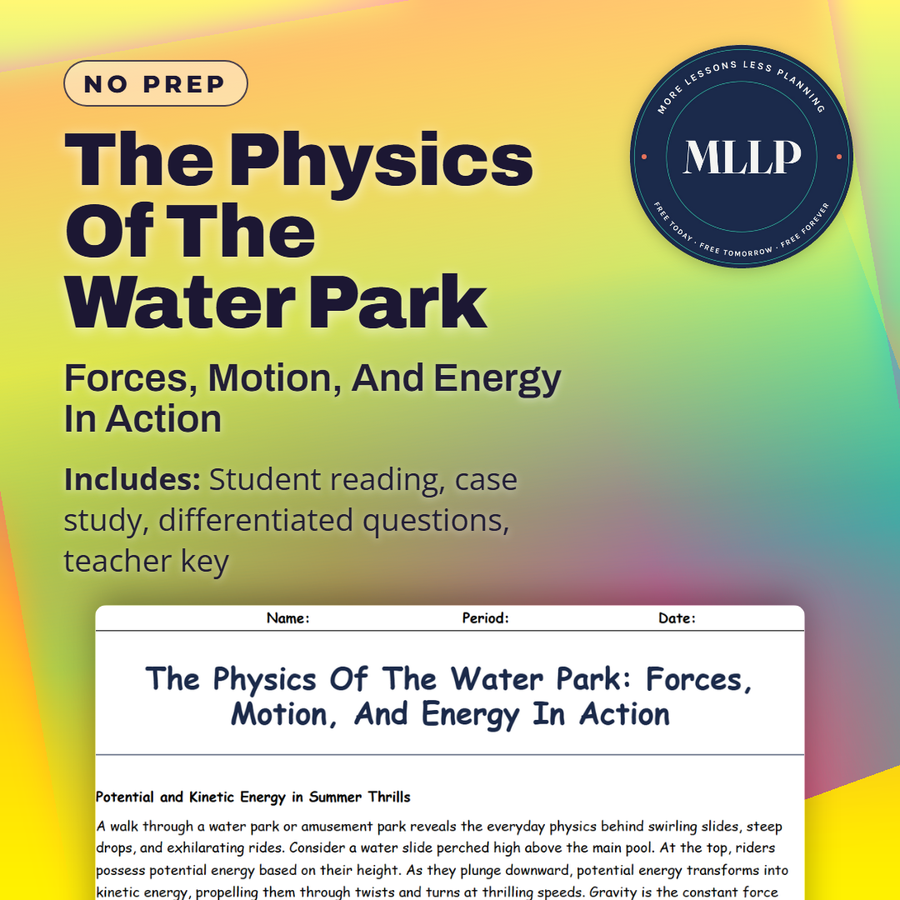
The Physics Of The Water Park: Forces, Motion, And Energy In Action
Quality reviewed September 2026
Facts verified September 9, 2026
- Subject
- Science
- Grades
- Grades 9-12
- Length
- 7-page student worksheet
- Time
- About one 50-minute class period
- Great for
- Sub plans and independent work
- Includes
- Reading passage, comprehension questions + full answer key
- Format
- Print-and-go PDF
What students do
- Apply conservation of energy principles to explain how potential energy at the top of a slide converts to kinetic energy
- Analyze the role of centripetal force in keeping riders safely on curved paths without flying off tangentially
- Evaluate why increasing a slope by 5 degrees yields only a 10% speed boost rather than proportional gains
- Calculate how friction, water flow, and raft weight interact to determine final velocity and safety margins
What it covers
- Potential and kinetic energy transformations
- Forces, acceleration, and Newton's laws
- Friction and resistance in fluid motion
Start reading this worksheet
Potential and Kinetic Energy in Summer Thrills
A walk through a water park or amusement park reveals the everyday physics behind swirling slides, steep drops, and exhilarating rides. Consider a water slide perched high above the main pool. At the top, riders possess potential energy based on their height. As they plunge downward, potential energy transforms into kinetic energy, propelling them through twists and turns at thrilling speeds. Gravity is the constant force pulling them toward the ground, while friction from the slide’s surface and the water resists motion. The interplay of potential and kinetic energy is also evident in roller coasters, which often begin with a large initial ascent. That first climb builds up potential energy that fuels the rest of the ride. Each subsequent hill or loop draws from the leftover kinetic energy, gradually diminishing as air resistance and track friction dissipate energy into the surroundings. By the end, the coaster slows down naturally, often gliding into the station without the need for additional braking power. This mesmerizing exchange of energies, governed by the law of conservation of energy, underpins the excitement of these attractions. Yet water rides add another layer: buoyancy and fluid dynamics. On a raft ride, for instance, the craft’s shape displaces water, generating an upward force. The flow of water beneath can reduce friction on the raft, making riders feel like they’re gliding effortlessly. Designers carefully balance these factors to ensure rides are both safe and exhilarating. By managing angles, water flow, and funnel shapes, they create a predictable yet thrilling sequence of high speeds and sudden turns.
Forces, Acceleration, and Safety
Newton’s laws of motion come to life in amusement parks. First, an object at rest remains at rest unless acted upon by a force. This is clear when you’re sitting at the top of a slide—until gravity (and possibly a gentle push) sets you in motion. Second, force equals mass times acceleration (F = m*a). Heavier riders on a slide will experience slightly different accelerations due to friction variations, but the principle holds: greater mass can result in a greater force if acceleration remains constant. Park safety relies on centripetal force for circular motion in rides like water slides that loop or curve. The slide exerts an inward force on the rider, keeping them following a curved path instead of flying off tangentially. In a large funnel-shaped slide, riders swoosh up the side, then accelerate down due to gravity and the slope’s angle. Careful calculations ensure the funnel’s shape and angle keep riders safely inside, relying on friction and the normal force from the slide’s surface. Engineers integrate multiple safety measures to handle these forces. Banked turns, water jets controlling speed, and strategically placed friction pads manage acceleration. Weight limits are sometimes imposed to prevent excessive force or stress on the slide’s structure. Regular maintenance checks ensure that friction levels, water flow, and structural integrity stay within design parameters. This synergy of math, physics, and engineering fosters a balance between the adrenaline rush riders crave and the necessary safety margins.
Like what you read? The full reading, the case study, and every question set are in the free download below, along with the answer key.
Why this matters
Ask a student why a steeper slide should be faster and they will say more slope means more speed. The H2O Adventures case study breaks that apart: steepening one section by 5 degrees produced only 10 percent more speed, and heavier rafts got stuck, because friction and water jets were negotiating with gravity too.
That is where centripetal force stops being an equation and becomes the reason a rider stays pressed against the wall on a funnel turn. Once students tie the wave breakers engineers add to the same forces keeping a rider seated, Newton's laws start showing up somewhere they have actually stood in line.
From one teacher to another
The river rapids redesign case study shows students that thrilling engineering isn't about steep slopes alone. It's about managing forces under real-world constraints. When H2O Adventures steepened one section by 5 degrees expecting a proportional speed jump, heavier rafts got stuck because friction, water jets, and resistance forces don't scale predictably. Students discover that a 5-degree change yields only 10% more speed because gravity, friction, and fluid dynamics constantly negotiate with each other. This worksheet takes abstract concepts like centripetal force and makes them tactile: this is why you stay pressed against the slide's outer wall on a funnel turn, and this is why engineers add "wave breakers" to prevent crashes, not thrill-seekers.
What you get
Download
Where should I send the next one?
Everything here is free and it stays that way. Leave your email and I'll send you the new lessons as they go up. You can unsubscribe from any one of them.
Related resources
Ancient Summer: What Did Summer Mean to the Egyptians, Greeks, and Romans?
Environmental Science and the Summer Season: Tourism, Trash, and Sustainability

Forensic Files: Summer Crimes and the Science Behind the Cases

Summer Around the World: Global History of Festivals and Solstice Celebrations
Summer Science: The Biology Of Sunscreen And Skin Protection
The Economics Of Summer: Ice Cream, Travel, And Supply And Demand
Every lesson on this site is free to download and use. If one of them saved you a prep period, you can chip in a few bucks toward my three kids' daycare fund. That's genuinely where tips go.