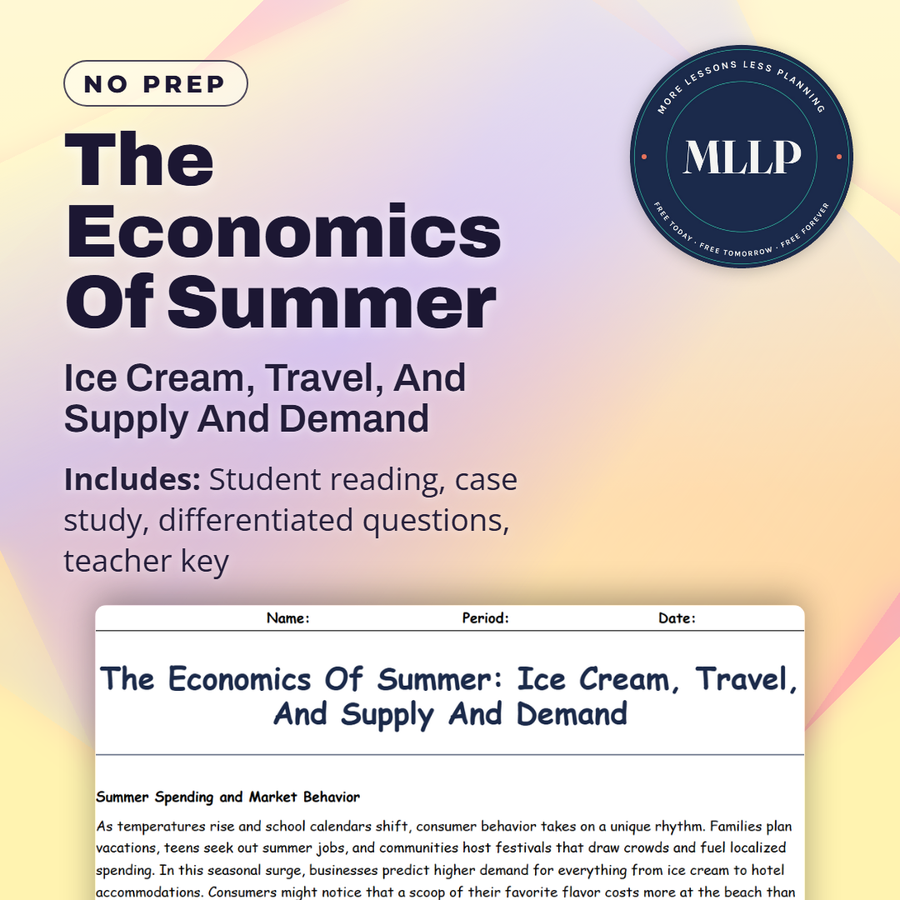
The Economics Of Summer: Ice Cream, Travel, And Supply And Demand
Quality reviewed September 2026
Facts verified September 9, 2026
- Subject
- Social Studies
- Grades
- Grades 9-12
- Length
- 7-page student worksheet
- Time
- About one 50-minute class period
- Great for
- Sub plans and independent work
- Includes
- Reading passage, comprehension questions + full answer key
- Format
- Print-and-go PDF
What students do
- Analyze why seasonal pricing lets businesses charge more during peak travel season when demand surges
- Apply supply and demand curves to explain price increases at beach boardwalks versus inland shops
- Evaluate how new competition affects pricing strategy and whether it signals market health or oversaturation
- Calculate the impact of loyalty and brand differentiation when competitors offer lower prices
What it covers
- Supply and demand in seasonal markets
- Seasonal pricing and price discrimination
- Consumer psychology and behavioral economics
Start reading this worksheet
Summer Spending and Market Behavior
As temperatures rise and school calendars shift, consumer behavior takes on a unique rhythm. Families plan vacations, teens seek out summer jobs, and communities host festivals that draw crowds and fuel localized spending. In this seasonal surge, businesses predict higher demand for everything from ice cream to hotel accommodations. Consumers might notice that a scoop of their favorite flavor costs more at the beach than at a standard ice cream parlor, or that flights and lodging spike in price around popular travel dates. These fluctuations aren’t random; they reflect the intricate dance of supply and demand, especially when demand surges during a finite window of time. For instance, imagine an ice cream stand that operates near a bustling boardwalk. Throughout the cooler months, it might shut down entirely or run with minimal staff. But as soon as the summer heat intensifies, it’s overwhelmed by customers craving cold treats. In response, the stand raises prices, hires seasonal workers, and invests in advertising. Simultaneously, new competitors might set up shop, hoping to cash in on the rising number of customers. With more competition, the original stand might reconsider its prices, offer special flavors, or create bundle deals to stand out. These rapid changes exemplify how market dynamics accelerate during the summer, prompting producers to strike a balance between meeting demand and ensuring a profit margin. Summer also influences broader macroeconomic trends. Tourism booms bring an influx of revenue to coastal cities, national parks, and amusement centers. Gas stations along popular driving routes see a spike in gasoline sales as families embark on road trips. On the flip side, certain industries experience declines. Winter sports, for example, see fewer participants, and cold-weather apparel often goes on clearance. The interplay of these ups and downs keeps the economy humming with seasonal rhythms, illustrating how price and production adapt to consumer needs, weather changes, and cultural practices.
Price Discrimination and Seasonal Pricing
Another hallmark of the summer economy is seasonal pricing, a form of price discrimination where businesses charge different prices for the same product or service depending on the time of year. Airfare, lodging, and even theme park tickets tend to be more expensive in late spring and throughout the summer, as families have more flexibility to travel. This pricing strategy aligns with consumer willingness to pay. Many are more inclined to spend extra for experiences when they have time off from school or work. As a result, airlines often implement peak season surcharges, and hotels use dynamic pricing software to track demand in real time, adjusting rates accordingly. The concept of price discrimination can be both beneficial and frustrating. On one hand, it allows companies to maximize their revenue during busy periods when demand is high. On the other hand, it often places a heavier financial burden on travelers who have no choice but to travel when prices are elevated. For students of economics, summer offers a tangible window into understanding how and why businesses set their prices. It reflects strategic thinking: setting prices too high might deter customers, but setting them too low might mean a missed profit opportunity. Meanwhile, producers grapple with costs of production unique to the season. Ice cream manufacturers, for example, might need more refrigeration or faster distribution to keep their products from melting during transportation. Travel agencies may hire extra staff to handle peak-season booking inquiries. As these costs rise, so do prices for consumers. The cycle exemplifies the law of supply and demand: as demand rises, so too can the price—unless an influx of suppliers enters the market to keep competition tight. Even then, summer’s limited time frame means businesses attempt to capitalize on consumer eagerness before the season ends.
Like what you read? The full reading, the case study, and every question set are in the free download below, along with the answer key.
Why this matters
Every kid on a boardwalk in July has felt it: the same ice cream that was easy to get in the spring suddenly costs more once summer travel peaks. Lila's Ice Cream Shack in Sunset Cove saw demand jump 40 percent the moment summer arrived, and when a competitor moved in nearby with discounts, her regulars stayed anyway.
I bring this in early in a supply and demand unit, before the vocabulary gets abstract, because every student has already paid a summer markup without asking why. My students' instinct is to call higher prices greed, so working through Lila's costs, her seasonal labor, her loyal customers, gives them a real business to test that instinct against.
From one teacher to another
Lila's Ice Cream Shack in Sunset Cove went from barely surviving to thriving in one summer, and the economics tell a story about more than sunshine. When demand spiked 40% and Captain Scoop's moved in with discounts, Lila didn't panic. Instead, her loyalty customers, unusual flavors, and consistent quality let her hold her prices. Students discover through this case that higher prices in summer aren't just greed; they reflect real costs, faster distribution, seasonal labor, equipment maintenance. But they also see the psychology: people will pay more for experiences they perceive as limited or special. This worksheet grounds abstract economics in something they live through every summer.
What you get
Download
Where should I send the next one?
Everything here is free and it stays that way. Leave your email and I'll send you the new lessons as they go up. You can unsubscribe from any one of them.
Related resources

Ancient Summer: What Did Summer Mean to the Egyptians, Greeks, and Romans?

Environmental Science and the Summer Season: Tourism, Trash, and Sustainability

Forensic Files: Summer Crimes and the Science Behind the Cases

Summer Around the World: Global History of Festivals and Solstice Celebrations

Summer Science: The Biology Of Sunscreen And Skin Protection

The Health Science of Summer Heat: Hydration, Heatstroke, and Body Systems
Every lesson on this site is free to download and use. If one of them saved you a prep period, you can chip in a few bucks toward my three kids' daycare fund. That's genuinely where tips go.