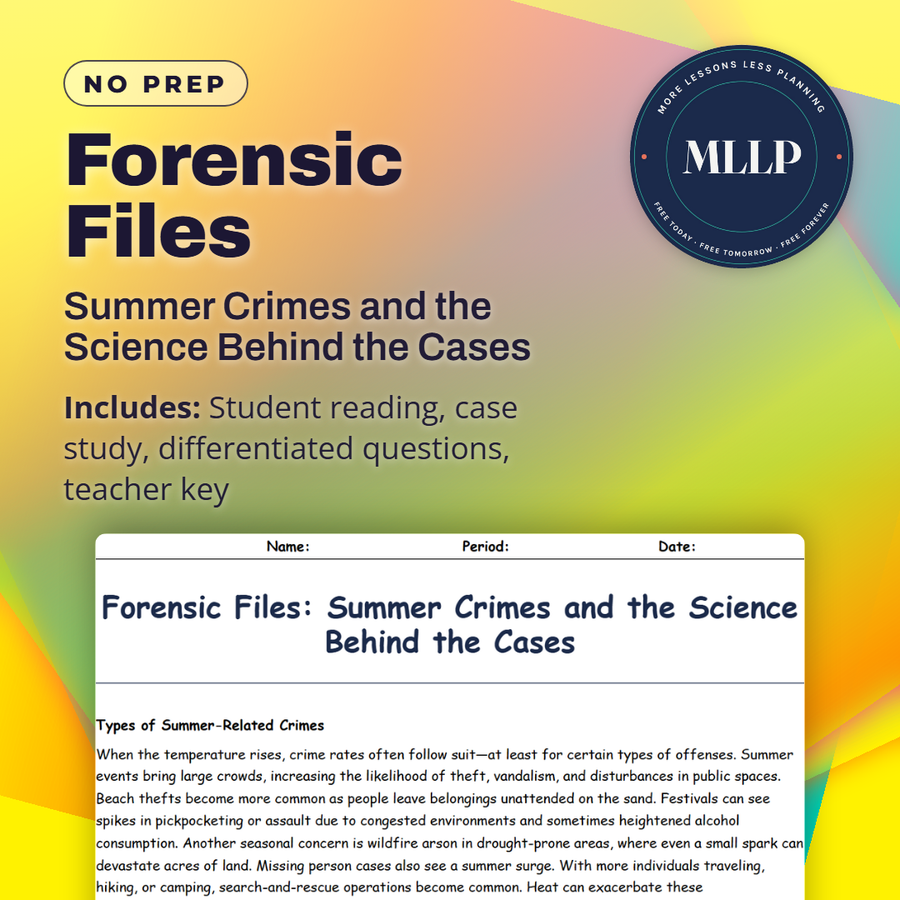
Forensic Files: Summer Crimes and the Science Behind the Cases
Quality reviewed September 2026
Facts verified September 9, 2026
- Subject
- Science
- Grades
- Grades 9-12
- Length
- 6-page student worksheet
- Time
- About one 50-minute class period
- Great for
- Sub plans and independent work
- Includes
- Reading passage, comprehension questions + full answer key
- Format
- Print-and-go PDF
What students do
- Analyze how DNA evidence and social media tracking worked together to solve a beach theft spree
- Explain why hot weather accelerates decomposition and how forensic entomologists account for temperature
- Evaluate which forensic techniques are most reliable at crowded summer events with multiple suspects
- Apply ballistics and trace evidence concepts to real crime scenarios
What it covers
- Summer crime patterns and crowded environments
- DNA, fingerprinting, and trace evidence collection
- Forensic entomology and time-of-death estimation
Start reading this worksheet
Types of Summer-Related Crimes
When the temperature rises, crime rates often follow suit, at least for certain types of offenses. Summer events bring large crowds, increasing the likelihood of theft, vandalism, and disturbances in public spaces. Beach thefts become more common as people leave belongings unattended on the sand. Festivals can see spikes in pickpocketing or assault due to congested environments and sometimes heightened alcohol consumption. Another seasonal concern is wildfire arson in drought-prone areas, where even a small spark can devastate acres of land. Missing person cases also see a summer surge. With more individuals traveling, hiking, or camping, search-and-rescue operations become common. Heat can exacerbate these disappearances, as dehydration or disorientation poses additional risk. For forensic scientists and law enforcement, the varied contexts of summer crimes demand a broad range of investigative techniques, from DNA analysis on stolen items to forensic entomology for tracking time-of-death in outdoor cases.
Forensic Methods: From DNA to Ballistics
Modern forensic science encompasses a vast toolkit to solve summer-themed crimes. DNA analysis remains a cornerstone, helping to match suspects to evidence like beach towels, water bottles, or personal belongings left at crime scenes. Fingerprinting is another staple: smooth surfaces such as glass, metal, or plastic cups at festival grounds can preserve latent prints. In cases of wildfire arson, investigators look for signs of accelerants or unusual burn patterns that might indicate a deliberate set, rather than a natural ignition. Trace evidence, like soil, seeds, or ashes, can tie a suspect to a specific location, especially if they track unique plant species back to the suspect’s vehicle. Meanwhile, ballistics comes into play if firearms are used during high-tension summer gatherings or property disputes. Matching bullet striations to a suspect’s weapon can be conclusive evidence in court. Forensic entomology helps determine the post-mortem interval when a victim is discovered outdoors. Insects colonize remains in predictable stages, allowing experts to estimate how long a body has been exposed. Heat accelerates insect life cycles, so forensic entomologists account for temperature in their analyses. This combination of biology and investigation is vital for cases where reliable eyewitnesses or surveillance may be lacking.
Like what you read? The full reading, the case study, and every question set are in the free download below, along with the answer key.
Why this matters
A single hair turns up inside a stolen beach tote, and that is where the Grand Beach mystery case study starts, alongside social media posts that place a suspect at the scene and footage that backs up the timeline. The investigation layers DNA results on top of eyewitness accounts and digital evidence, the way real investigators avoid trusting any single source alone.
Most people think of summer heat as something that ruins a beach trip, not something that changes an investigation. Warm weather actually speeds up insect colonization and bacterial growth, forcing forensic entomologists to build temperature into their estimate of time of death.
From one teacher to another
Forensic science becomes real when I frame it around summer: a busy beach, a hair found in a stolen tote, and social media posts that place a suspect at the scene. The Grand Beach mystery case study walks students through layered investigation, the DNA test plus the integration of eyewitness accounts, camera footage, and digital evidence. What I love is how students discover that heat does more than ruin your beach trip; it accelerates insect colonization and bacterial growth, which makes outdoor crime scenes trickier for investigators. This worksheet shows them that forensics means reading environments under pressure, not only running tests in a lab.
What you get
Download
Where should I send the next one?
Everything here is free and it stays that way. Leave your email and I'll send you the new lessons as they go up. You can unsubscribe from any one of them.
Related resources

Ancient Summer: What Did Summer Mean to the Egyptians, Greeks, and Romans?
Environmental Science and the Summer Season: Tourism, Trash, and Sustainability

Summer Around the World: Global History of Festivals and Solstice Celebrations
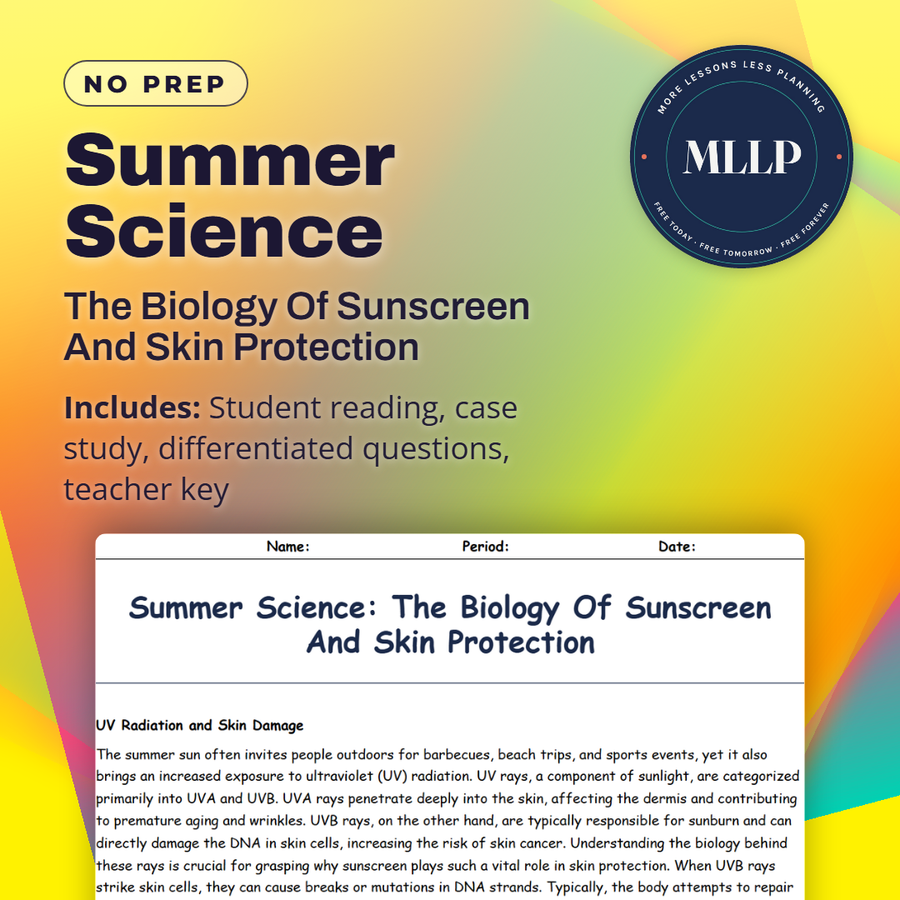
Summer Science: The Biology Of Sunscreen And Skin Protection

The Economics Of Summer: Ice Cream, Travel, And Supply And Demand

The Health Science of Summer Heat: Hydration, Heatstroke, and Body Systems
Every lesson on this site is free to download and use. If one of them saved you a prep period, you can chip in a few bucks toward my three kids' daycare fund. That's genuinely where tips go.