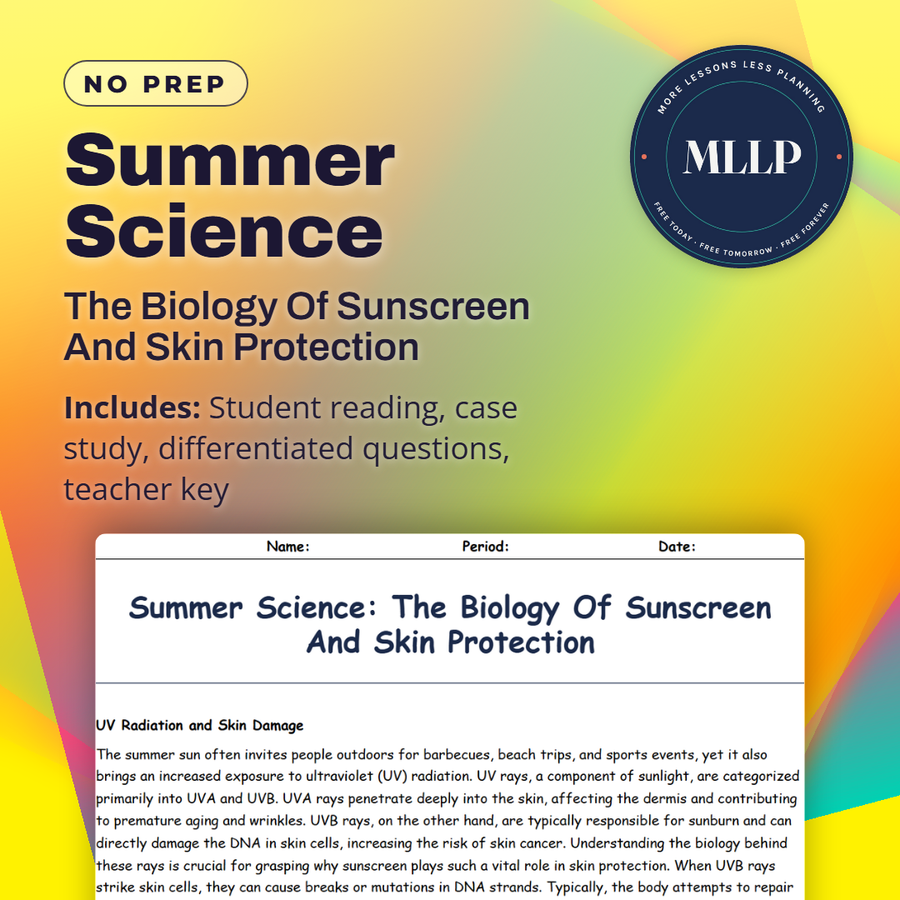
Summer Science: The Biology Of Sunscreen And Skin Protection
Quality reviewed September 2026
Facts verified September 9, 2026
- Subject
- Science
- Grades
- Grades 9-12
- Length
- 8-page student worksheet
- Time
- About one 50-minute class period
- Great for
- Sub plans and independent work
- Includes
- Reading passage, comprehension questions + full answer key
- Format
- Print-and-go PDF
What students do
- Explain how UVB rays damage DNA directly and why repeated exposure overwhelms repair mechanisms
- Distinguish between physical blockers and chemical absorbers in sunscreen formulations
- Analyze why consistent reapplication and proper application amount matter more than high SPF numbers
- Evaluate community health initiatives that increased sun safety awareness on a Pacific island
What it covers
- UV radiation and skin damage mechanisms
- Sunscreen ingredients and SPF ratings
- Public health strategies for cancer prevention
Start reading this worksheet
UV Radiation and Skin Damage
The summer sun often invites people outdoors for barbecues, beach trips, and sports events, yet it also brings an increased exposure to ultraviolet (UV) radiation. UV rays, a component of sunlight, are categorized primarily into UVA and UVB. UVA rays penetrate deeply into the skin, affecting the dermis and contributing to premature aging and wrinkles. UVB rays, on the other hand, are typically responsible for sunburn and can directly damage the DNA in skin cells, increasing the risk of skin cancer. Understanding the biology behind these rays is crucial for grasping why sunscreen plays such a vital role in skin protection. When UVB rays strike skin cells, they can cause breaks or mutations in DNA strands. Typically, the body attempts to repair this damage through enzymes like DNA polymerase, but repeated exposure can overwhelm these repair mechanisms. This is why a simple sunburn, which initially appears as red, inflamed skin, can lead to more long-term consequences if it happens frequently. Factors like skin pigmentation and melanin production also play a role. Melanin helps absorb UV radiation, offering a degree of natural protection. However, no one is immune to UV damage; even individuals with darker skin tones are vulnerable if they spend extensive time in intense sunlight. Beyond cancer risks, excessive UV radiation can lead to oxidative stress in skin cells, where harmful free radicals cause further cellular damage. This oxidative stress accelerates aging, weakening the skin’s elasticity and resilience. Scientific studies reinforce the idea that early protection (especially during childhood and adolescence) has long-term benefits, reducing the chance of cumulative damage that shows up decades later in the form of wrinkles or precancerous lesions.
How Sunscreen Works
Sunscreens protect the skin by filtering or blocking a significant portion of UV rays before they can penetrate deeply. They typically contain two types of active ingredients: physical blockers like titanium dioxide or zinc oxide that reflect the rays, and chemical absorbers like avobenzone or octisalate that absorb UV radiation and release it as heat. Modern formulations often combine both types, giving broad-spectrum coverage that defends against both UVA and UVB rays. The Sun Protection Factor (SPF) rating measures how long a sunscreen can prevent UVB-induced sunburn relative to unprotected skin. For instance, SPF 30 means you can theoretically stay in the sun 30 times longer before burning compared to not wearing sunscreen. However, SPF ratings can be misleading if misunderstood. A higher SPF doesn’t necessarily offer exponentially greater protection. While SPF 30 blocks around 97% of UVB rays, SPF 50 blocks about 98%. Proper application and reapplication matter more than chasing very high SPF numbers. Dermatologists recommend applying sunscreen generously (about one ounce to cover exposed areas) and reapplying every two hours or after swimming or sweating. Failing to apply enough sunscreen or forgetting to reapply reduces effectiveness significantly. In addition to sunscreen, protective clothing, hats, and shade are integral to an effective sun-safe strategy. Wearing UV-protective sunglasses can also shield eyes from harmful rays that contribute to cataracts. From a cell biology standpoint, less UV radiation hitting skin cells translates into fewer DNA breaks, less oxidative stress, and a lower overall burden on the body’s repair mechanisms. For students studying biology, this offers a clear, real-world application: how a combination of chemical and physical science principles converge to mitigate a natural environmental hazard.
Like what you read? The full reading, the case study, and every question set are in the free download below, along with the answer key.
Why this matters
A sunscreen that blocks every harmful ray still fails if the swimmer wearing it refuses to reapply it because it stings. That is the finding inside the island lifeguard case study: people preferred zinc based sunscreen because it felt less irritating, and that preference changed how often they used it.
A higher SPF number seems like the whole answer walking in, before UVB rays breaking DNA strands directly show that the number on the bottle was never the point by itself. Seeing comfort drive real behavior change on that island turns sunscreen from pure chemistry into a public health problem that has to work on an actual body.
From one teacher to another
The island lifeguard program case study always gets students: they expect to hear about sunscreen chemistry, and they do, but what strikes them is the comfort angle. When the program discovered that people preferred zinc-based sunscreen because it felt less irritating, it revealed something deeper about behavior change. You can hand out the best UV protection in the world, but if it stings or feels gross, compliance crashes. This worksheet connects dermatology (how UVB rays break DNA strands) to public health messaging, showing students that the science of skin protection has to include making protection doable in real life.
What you get
Download
Where should I send the next one?
Everything here is free and it stays that way. Leave your email and I'll send you the new lessons as they go up. You can unsubscribe from any one of them.
Related resources
Ancient Summer: What Did Summer Mean to the Egyptians, Greeks, and Romans?
Environmental Science and the Summer Season: Tourism, Trash, and Sustainability
Forensic Files: Summer Crimes and the Science Behind the Cases

Summer Around the World: Global History of Festivals and Solstice Celebrations
The Economics Of Summer: Ice Cream, Travel, And Supply And Demand
The Health Science of Summer Heat: Hydration, Heatstroke, and Body Systems
Every lesson on this site is free to download and use. If one of them saved you a prep period, you can chip in a few bucks toward my three kids' daycare fund. That's genuinely where tips go.