The Physics of Fear
Quality reviewed September 2026
Facts verified September 9, 2026
- Subject
- Science
- Grades
- Grades 9-12
- Length
- 6-page student worksheet
- Time
- About one 50-minute class period
- Great for
- Sub plans and independent work
- Includes
- Reading passage, comprehension questions + full answer key
- Format
- Print-and-go PDF
What students do
- Analyze how amplitude and frequency of sound waves trigger fear responses
- Evaluate the physics behind jump scares in horror films and haunted houses
- Explain how strobe lights and darkness manipulate perception and startle responses
- Compare infrasound vibrations to audible sounds and their physical effects
What it covers
- Sound waves, amplitude, and the startle reflex
- Light, vision, and perception in low-light conditions
- Physics applied to entertainment and sensory design
Start reading this worksheet
Fear and the Human Body
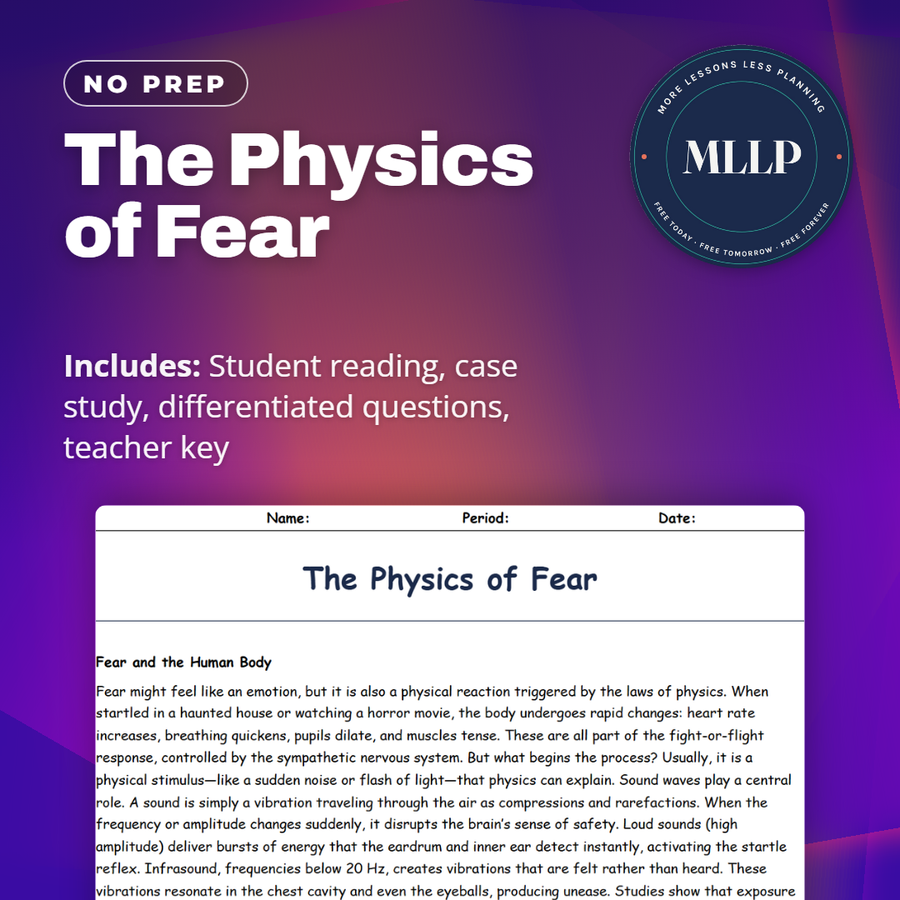
Fear might feel like an emotion, but it is also a physical reaction triggered by the laws of physics. When startled in a haunted house or watching a horror movie, the body undergoes rapid changes: heart rate increases, breathing quickens, pupils dilate, and muscles tense. These are all part of the fight-or-flight response, controlled by the sympathetic nervous system. But what begins the process? Usually, it is a physical stimulus, like a sudden noise or flash of light, that physics can explain. Sound waves play a central role. A sound is simply a vibration traveling through the air as compressions and rarefactions. When the frequency or amplitude changes suddenly, it disrupts the brain’s sense of safety. Loud sounds (high amplitude) deliver bursts of energy that the eardrum and inner ear detect instantly, activating the startle reflex. Infrasound, frequencies below 20 Hz, creates vibrations that are felt rather than heard. These vibrations resonate in the chest cavity and even the eyeballs, producing unease. Studies show that exposure to infrasound can raise adrenaline levels, increasing fear responses.
The Science of Startle Responses
Jump scares, those moments when a quiet scene explodes into noise, rely on physics. The contrast in sound intensity (decibels) tricks the nervous system, which is primed to detect sudden changes. A jump from 40 decibels (quiet background) to 90 decibels (slamming door) is enough to jolt the body into panic. Light works similarly. Strobe lights flash rapidly, interrupting the brain’s ability to process continuous images. This takes advantage of the persistence of vision, where the brain holds onto one image for a fraction of a second before replacing it. Rapid flashes confuse the visual system, increasing tension. Low lighting reduces the number of photons entering the eye, forcing the retina to switch from cone cells (color vision) to rod cells (low-light vision). This makes edges blur, shadows lengthen, and movement harder to track. Those are the perfect conditions for fear.
Like what you read? The full reading, the case study, and every question set are in the free download below, along with the answer key.
Why this matters
Most students assume a jump scare works because a movie is scary, not because someone engineered it. This reading names the mechanism: a sudden spike in decibels, a strobe timed to confuse persistence of vision, an infrasound frequency low enough to resonate in the chest before it registers as sound.
One student told me this is why her parents' old horror movies always felt scarier, they understood the science better. Once students can name amplitude, frequency, and persistence of vision, a jump scare stops being magic and becomes a nervous system doing exactly what physics predicts.
From one teacher to another
Most students know jump scares feel real, but they don't realize the filmmakers are using measurable physics to mess with their nervous systems. This worksheet breaks down how sudden changes in decibels, how strobe lights confuse persistence of vision, how infrasound resonates in your chest even when you don't consciously hear it. I've had students say, "Oh. That's why my parents' horror movies always feel scarier than the new ones, they know the science." It transforms abstract physics into something they've felt.
What you get
Download
Where should I send the next one?
Everything here is free and it stays that way. Leave your email and I'll send you the new lessons as they go up. You can unsubscribe from any one of them.
Related resources

Every lesson on this site is free to download and use. If one of them saved you a prep period, you can chip in a few bucks toward my three kids' daycare fund. That's genuinely where tips go.