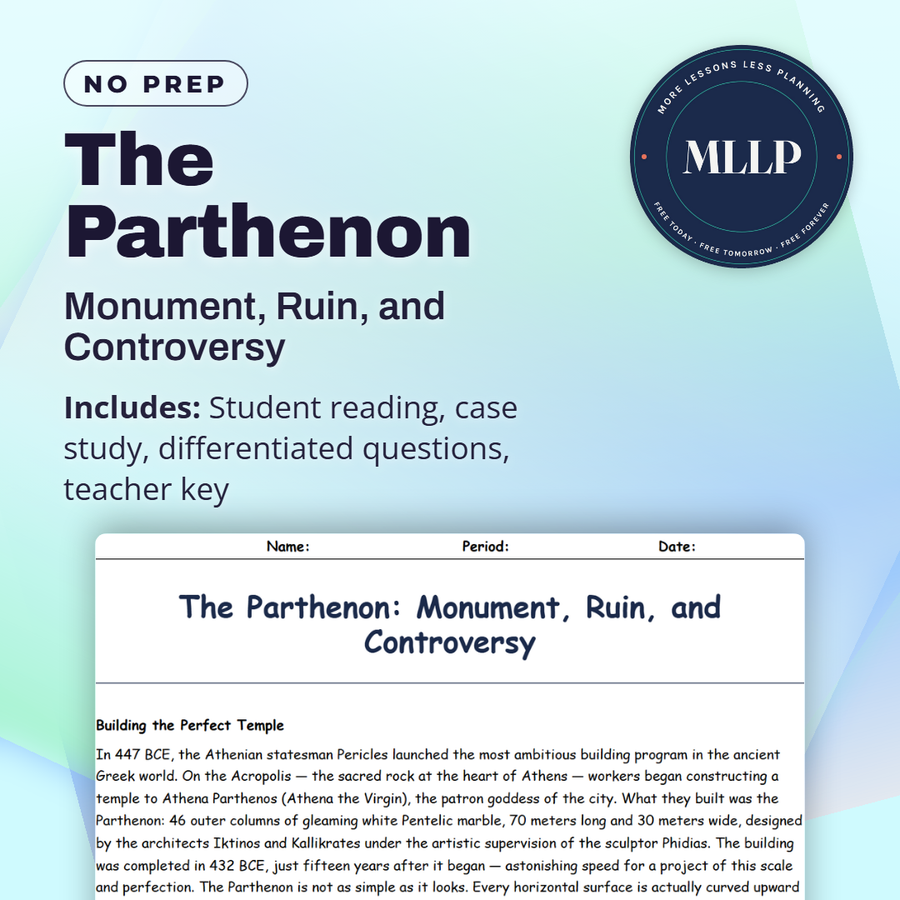
The Parthenon: Monument, Ruin, and Controversy
Quality reviewed September 2026
Facts verified September 21, 2026
- Subject
- Social Studies
- Grades
- Grades 9-12
- Length
- 8-page student worksheet
- Time
- About one 50-minute class period
- Great for
- Sub plans and independent work
- Includes
- Reading passage, comprehension questions + full answer key
- Format
- Print-and-go PDF
What students do
- Fill in three blanks naming the Parthenon's optical adjustment, the 1687 explosion's cause, and the museum built in Athens in 2009
- Explain how the Parthenon changed use as a temple, a Christian church, and later an Ottoman mosque
- A scholar seeing the Parthenon frieze split between London and Athens for the first time frames two case study questions
- The competing British and Greek arguments over the Elgin Marbles get checked in a multiple-choice question on the British Museum's position
What it covers
- The Parthenon's optical refinements and Phidias's lost gold and ivory statue
- The 1687 explosion that turned the Parthenon into a ruin
- The Elgin Marbles dispute between Britain and Greece
Start reading this worksheet
Building the Perfect Temple
In 447 BCE, the Athenian statesman Pericles launched the most ambitious building program in the ancient Greek world. On the Acropolis, the sacred rock at the heart of Athens, workers began constructing a temple to Athena Parthenos (Athena the Virgin), the patron goddess of the city. What they built was the Parthenon: 46 outer columns of gleaming white Pentelic marble, 70 meters long and 30 meters wide, designed by the architects Iktinos and Kallikrates under the artistic supervision of the sculptor Phidias. The building was completed in 432 BCE, just fifteen years after it began. That was astonishing speed for a project of this scale and perfection. The Parthenon is not as simple as it looks. Every horizontal surface is actually curved upward slightly: the floor bows gently in the center, and the columns lean very slightly inward. These subtle adjustments, known as optical refinements, were deliberate corrections to counteract optical illusions that would otherwise make the building appear to sag or lean outward when viewed from a distance. The architects understood how human perception works and designed the building to appear perfectly straight and balanced precisely because it was not. This level of mathematical and perceptual sophistication continues to astonish modern architects and engineers.
Phidias and the Sculptures
The Parthenon was covered in sculpture. The triangular pediments at each end were filled with large marble figures depicting scenes from Athena's mythology. The frieze running around the outside of the inner chamber showed the Panathenaic Procession, a festival in which Athens's citizens marched together to present a new robe to the goddess. Inside the temple stood the most famous sculpture of the ancient world: a forty-foot-tall statue of Athena Parthenos by Phidias, made of ivory and gold over a wooden frame. The statue no longer exists (it was removed in antiquity and eventually destroyed), but descriptions and small copies give us a sense of its staggering scale and wealth. Phidias himself did not survive his connection to the Parthenon. According to ancient sources, he was accused of embezzling gold intended for the statue and was imprisoned. He died in jail, possibly executed. Whether the charges were genuine or politically motivated (Pericles had enemies who saw attacking Phidias as a way of attacking him) is unknown. The story illustrates how dangerous artistic genius could be in ancient Athens, where art, politics, and religion were inseparable.
Two Thousand Years of Use and Abuse
The Parthenon's history after the Classical period is a story of survival through constant reinvention and occasional catastrophe. In the third century CE, the cult statue of Athena was removed. In the sixth century CE, the Parthenon was converted into a Christian church dedicated to the Virgin Mary, an interesting parallel to Athena Parthenos. The Christians walled up the outer colonnade, altered the interior, and added an apse at one end. When the Ottoman Turks conquered Athens in 1458 CE, the church became a mosque. In 1687, the greatest catastrophe struck: the Venetians were besieging Athens, and the Ottomans were using the Parthenon to store gunpowder. A Venetian artillery shell hit the building. The resulting explosion blew off the roof, destroyed the interior walls, and sent columns flying. The Parthenon went from a remarkably well-preserved ancient building to a ruin in a single afternoon.
Like what you read? The full reading, the case study, and every question set are in the free download below, along with the answer key.
Why this matters
The Elgin Marbles argument in this reading is a real, unresolved dispute, not a settled historical question, and that is exactly why it is worth sitting with both sides before deciding what to think. Britain's case rests on preservation and access for millions of visitors, while Greece's case rests on the fact that the sculptures were removed from a country under foreign occupation and now sit split from the rest of the same continuous carved story. The scholar in the case study calls the frieze "cut off mid-word," and that image helps explain what gets lost, both physically and narratively, when a single artwork is divided between two countries that both have real claims to it.
From one teacher to another
Pericles started the most ambitious building project in the Greek world in 447 BCE, and what his architects finished fifteen years later was a temple with no straight lines at all, every column and floor surface subtly curved to correct for how the human eye actually sees a large building. This worksheet covers that engineering trick alongside the Parthenon's long afterlife: a Christian church, then an Ottoman mosque, then a ruin after a Venetian shell hit the gunpowder the Ottomans were storing inside in 1687. Students also read about Phidias, the sculptor who oversaw the temple's decoration and died in prison on embezzlement charges that may have been political revenge against Pericles. A case study follows a scholar seeing the Parthenon frieze in the British Museum for the first time and noticing exactly where the carved story breaks off mid-scene. The reading ends on the ongoing dispute over whether Britain should return the sculptures to Greece.
What you get
Download
Where should I send the next one?
Everything here is free and it stays that way. Leave your email and I'll send you the new lessons as they go up. You can unsubscribe from any one of them.
Related resources
Alexander's Empire: Archaeology Across Three Continents
Ancient Greece: An Overview
Delphi: The Center of the Ancient World
Greek Pottery: Art That Tells Stories
Knossos and the Minoans: Europe's First Civilization
Mycenae and the Trojan War: Where Myth Meets Archaeology
Every lesson on this site is free to download and use. If one of them saved you a prep period, you can chip in a few bucks toward my three kids' daycare fund. That's genuinely where tips go.