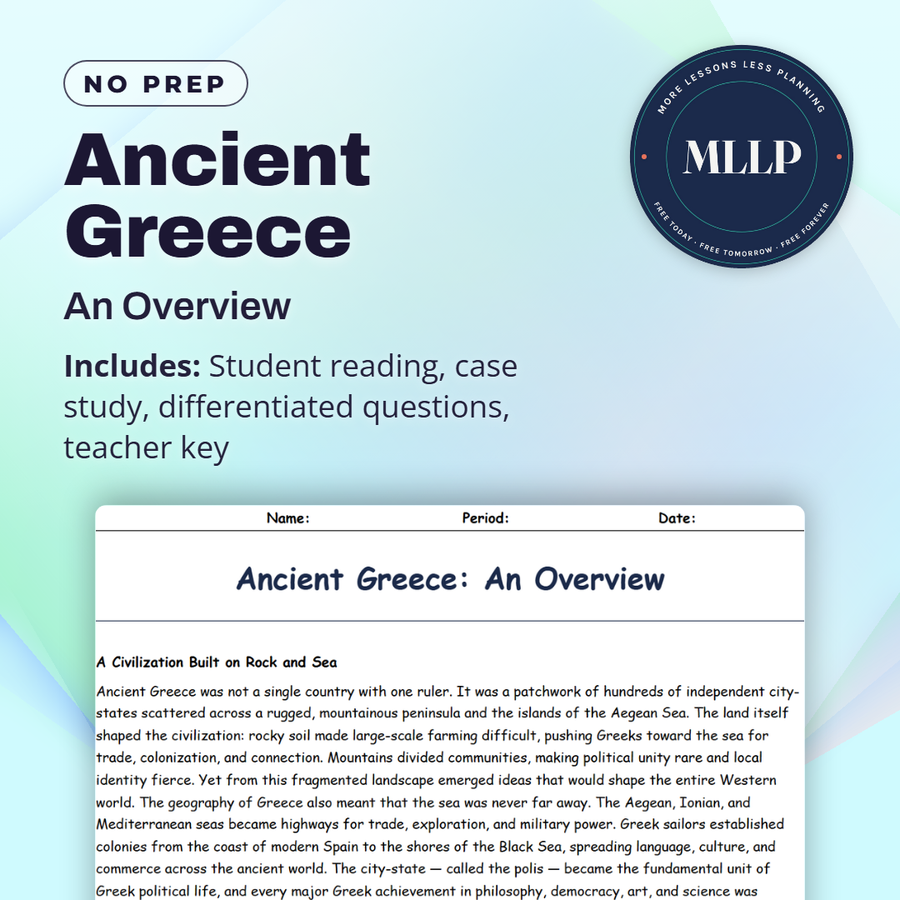
Ancient Greece: An Overview
Quality reviewed September 2026
Facts verified September 21, 2026
- Subject
- Social Studies
- Grades
- Grades 9-12
- Length
- 9-page student worksheet
- Time
- About one 50-minute class period
- Great for
- Sub plans and independent work
- Includes
- Reading passage, comprehension questions + full answer key
- Format
- Print-and-go PDF
What students do
- Ancient Greece's patchwork of independent city-states, from Minoan Crete to Alexander's Hellenistic world, gets tracked across a five-period timeline
- Trace how geography pushed Greeks toward the sea for trade instead of large-scale farming
- Answer short-response questions on why Athenian democracy excluded women, enslaved people, and foreigners
- A city worker's discovery of an ancient wall under a modern Athens street leads to two case study questions
What it covers
- The five periods of Greek civilization, from the Minoans through the Hellenistic world
- The polis, the agora, and how Greek city-states governed themselves
- Why modern construction in Athens keeps running into ancient ruins
Start reading this worksheet
A Civilization Built on Rock and Sea
Ancient Greece was not a single country with one ruler. It was a patchwork of hundreds of independent city-states scattered across a rugged, mountainous peninsula and the islands of the Aegean Sea. The land itself shaped the civilization: rocky soil made large-scale farming difficult, pushing Greeks toward the sea for trade, colonization, and connection. Mountains divided communities, making political unity rare and local identity fierce. Yet from this fragmented landscape emerged ideas that would shape the entire Western world. The geography of Greece also meant that the sea was never far away. The Aegean, Ionian, and Mediterranean seas became highways for trade, exploration, and military power. Greek sailors established colonies from the coast of modern Spain to the shores of the Black Sea, spreading language, culture, and commerce across the ancient world. The city-state, called the polis, became the fundamental unit of Greek political life, and every major Greek achievement in philosophy, democracy, art, and science was rooted in the competitive, innovative culture of these small but intensely proud communities.
From Minoans to Macedonians: A Timeline of Greek Civilization
Greek civilization did not begin with Athens and Socrates. Its roots stretch back more than three thousand years to two earlier civilizations that archaeologists have spent over a century piecing together from ruins and artifacts. The Minoan civilization, centered on the island of Crete, flourished between roughly 2700 and 1450 BCE. The Minoans were a sophisticated seafaring culture with elaborate palaces, colorful frescoes, and a writing system that remains undeciphered. They were not Greek-speaking, but they heavily influenced the cultures that followed them. Around 1600 BCE, the Mycenaean civilization rose on the Greek mainland. The Mycenaeans spoke an early form of Greek and built fortified citadels at Mycenae, Tiryns, and other sites. They traded widely, fought wars, and left behind the Bronze Age culture that later Greeks would remember in epic poems. Around 1200 BCE, the Bronze Age Collapse (a catastrophic period of drought, invasion, and systems failure) destroyed Mycenaean civilization along with many other Eastern Mediterranean cultures. Greece entered a Dark Age of reduced population, lost literacy, and simpler material culture. Recovery came slowly. By 800 BCE, the Archaic period had begun: population grew, writing was reintroduced, city-states developed, and Greeks colonized the Mediterranean. The Classical period (480-323 BCE) represents the peak of Greek cultural achievement: the age of Pericles, Socrates, the Parthenon, and Athenian democracy. Alexander the Great's conquests launched the Hellenistic period, spreading Greek culture across three continents until Rome absorbed the Greek world in the second and first centuries BCE.
The Polis: City-State as a Way of Life
The polis was more than just a city. It was a community, an identity, and a political unit all at once. A typical polis consisted of an urban center (often built around a fortified hill called the acropolis) and the surrounding agricultural territory. Citizens (exclusively free adult males in most poleis) participated directly in government, whether through democracy as in Athens or an oligarchy of elite families as in Corinth. The polis demanded loyalty that modern people might find extreme: a citizen was expected to fight in its army, worship its gods, attend its assemblies, and subordinate personal interest to the community's welfare. The agora, or public marketplace, was the heart of civic life. Here, citizens bought and sold goods, argued politics, listened to philosophers, and conducted legal business. The agora was simultaneously an economic, political, and social space. Archaeologists have recovered extraordinary evidence from Greek agoras: pottery sherds with names scratched into them for ostracism votes, bronze weights used in commerce, inscriptions recording laws and treaties, and the foundations of temples and public buildings. These material remains allow us to reconstruct not just what Greeks built, but how they lived, argued, and organized their societies.
Like what you read? The full reading, the case study, and every question set are in the free download below, along with the answer key.
Why this matters
Athens sitting directly on top of ancient Athens shows how the past and present physically compete for the same ground, and it is the daily reality of Greek archaeology. Every water pipe or subway tunnel in Athens might hit a two-thousand-year-old wall, and the reading's case study shows a real construction worker choosing to stop and wait for archaeologists rather than push the project through. Students who think about infrastructure, zoning, or historic preservation in their own towns are dealing with a smaller version of the same tension between building forward and protecting what came before.
From one teacher to another
Ancient Greece was never one country. It was hundreds of independent city-states scattered across mountains and islands, each fiercely proud of its own identity. This worksheet walks through the whole arc: the Bronze Age Minoans and Mycenaeans, the Dark Age that followed their collapse, and the Classical Athens of Socrates and the Parthenon. Students read about the polis as a way of life, not a political unit alone, and about the agora where citizens traded, argued, and voted. A case study follows a real water authority worker in modern Athens whose backhoe hits an ancient wall mid-project, which is closer to how Greek archaeology actually works than any textbook photo of the Parthenon.
What you get
Download
Where should I send the next one?
Everything here is free and it stays that way. Leave your email and I'll send you the new lessons as they go up. You can unsubscribe from any one of them.
Related resources
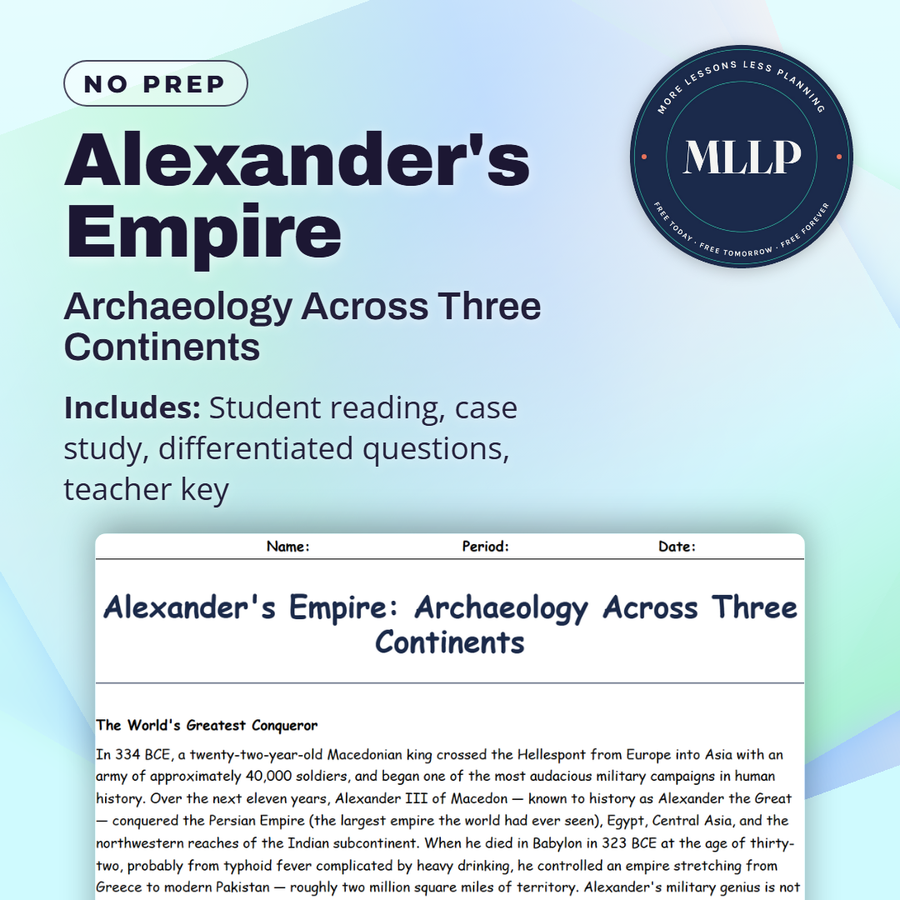
Alexander's Empire: Archaeology Across Three Continents
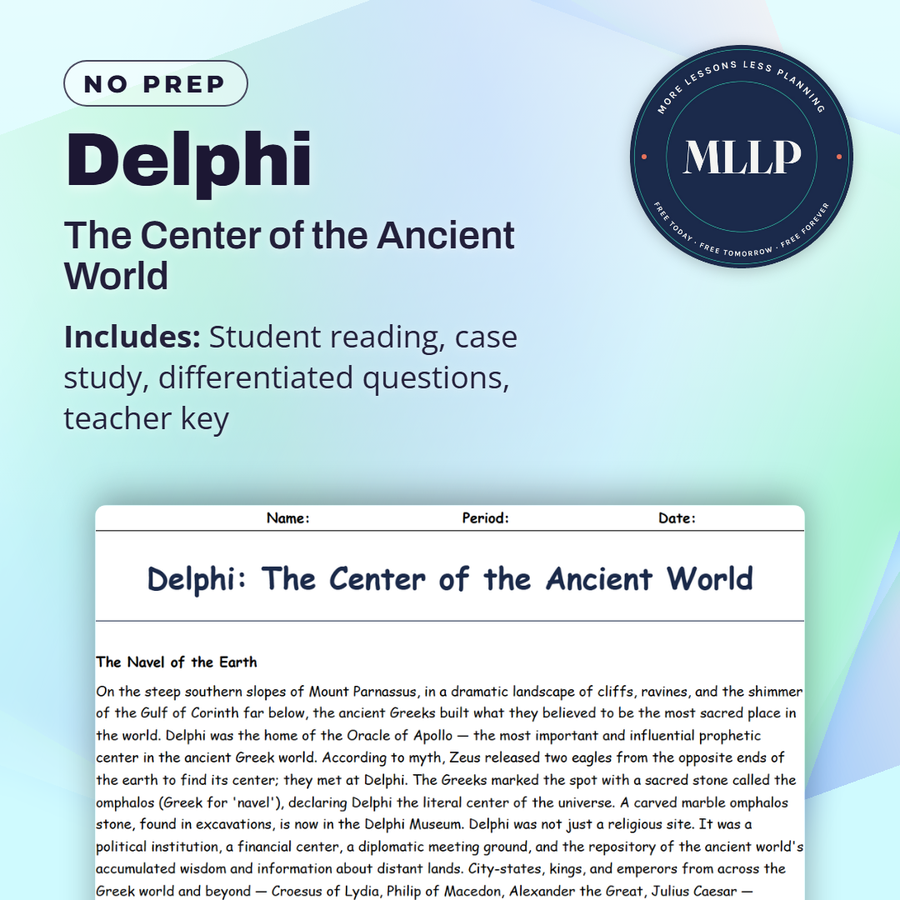
Delphi: The Center of the Ancient World
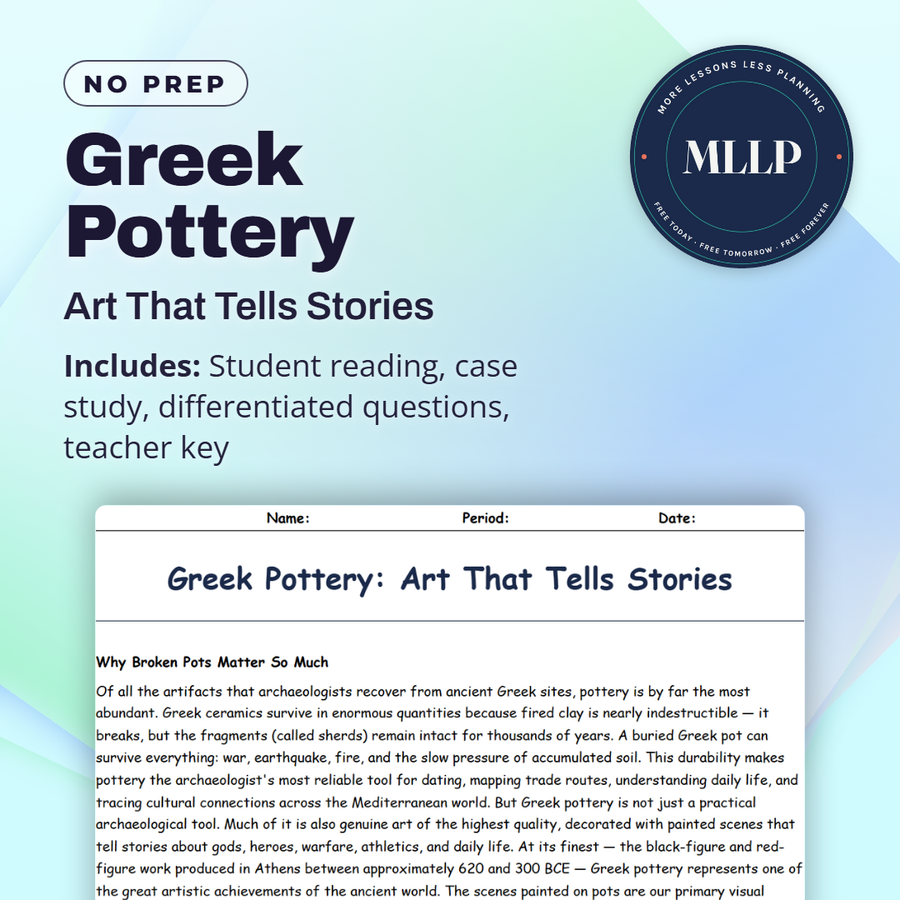
Greek Pottery: Art That Tells Stories
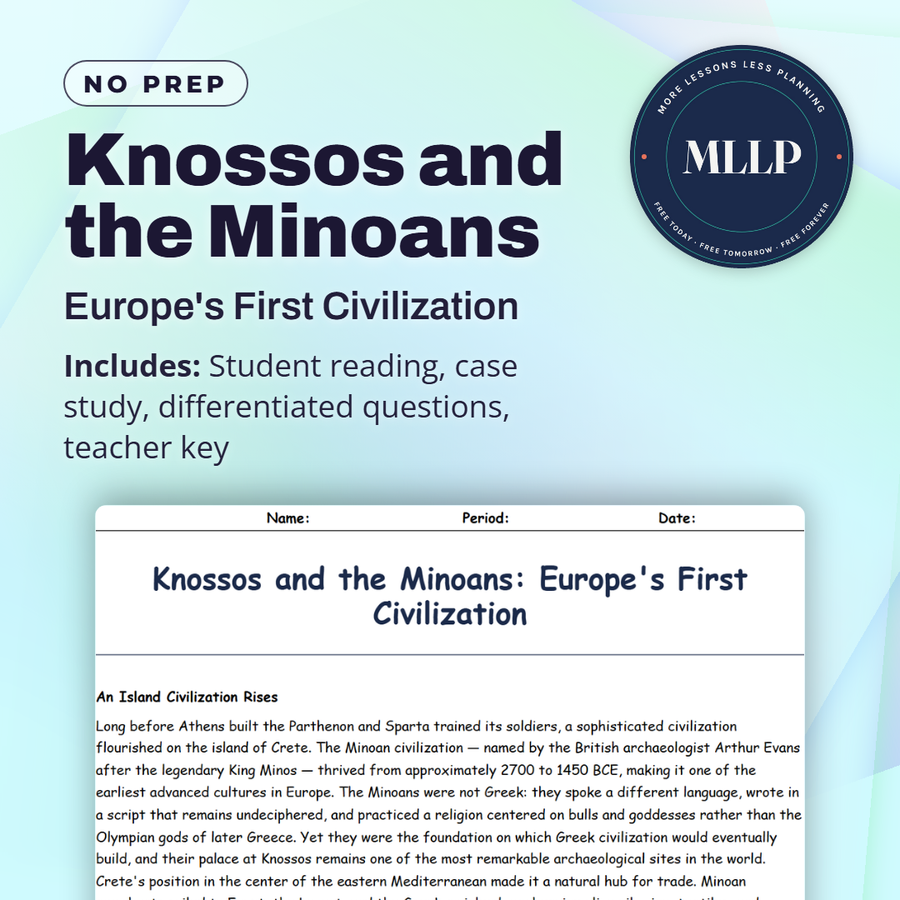
Knossos and the Minoans: Europe's First Civilization
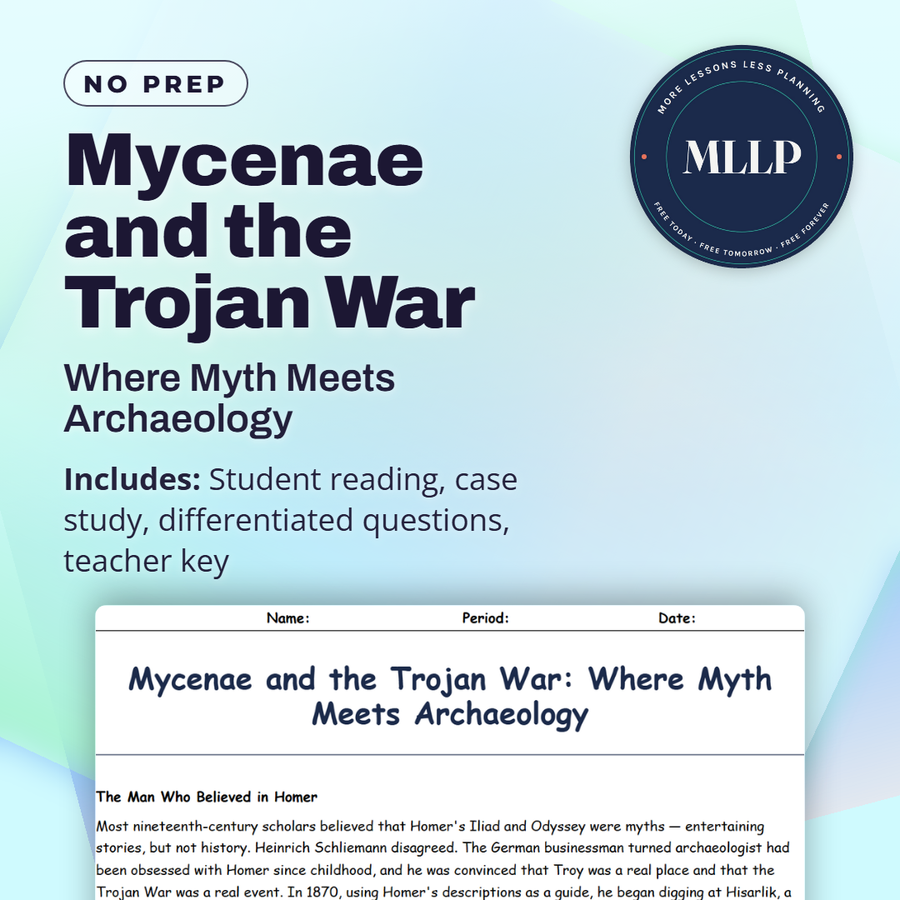
Mycenae and the Trojan War: Where Myth Meets Archaeology
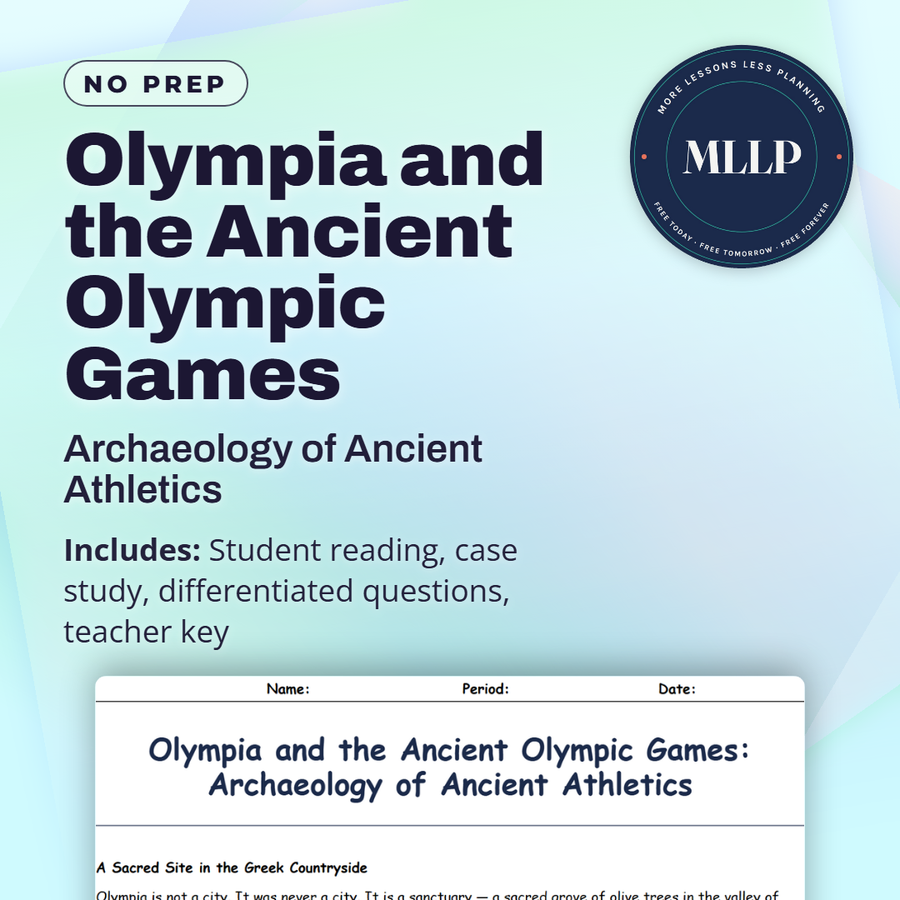
Olympia and the Ancient Olympic Games: Archaeology of Ancient Athletics
Every lesson on this site is free to download and use. If one of them saved you a prep period, you can chip in a few bucks toward my three kids' daycare fund. That's genuinely where tips go.